Aurangabad to Lonar Crater Day Trip Guide 2026 – Distance & Route
I have made the Aurangabad to Lonar Crater drive more times than I can count, usually with a group who has just spent two full days at Ajanta and Ellora and still has the appetite for one more extraordinary thing. My honest advice, every single time: do not treat Lonar as a box to tick on your way out of the region. It is genuinely one of the most extraordinary geological sites in India — a 50,000-year-old meteor impact crater with ancient temples on its rim — but it rewards people who give it real time, and the distance means you need to plan for that properly rather than squeeze it in.
The Distance and Route Reality
Lonar Crater is approximately 140 km from Chhatrapati Sambhajinagar (Aurangabad), located in Buldhana district. The drive takes approximately 3 to 3.5 hours each way under normal conditions, via the route through Jalna and Sindkhed Raja.
This means a same-day round trip involves 6 to 7 hours of driving alone, before accounting for meaningful time at the crater itself — which, given its scale (1.8 km diameter, with a rim trail and multiple temples), deserves more than a rushed hour or two.
💡 Tip: Unlike the Shirdi route, there is no expressway shortcut for Lonar at this time — I always confirm current road conditions before a trip, since this is a longer, more rural drive than my Ellora or Shirdi routes, and quality can shift by season, particularly around monsoon.
What Makes Lonar Crater Genuinely Extraordinary
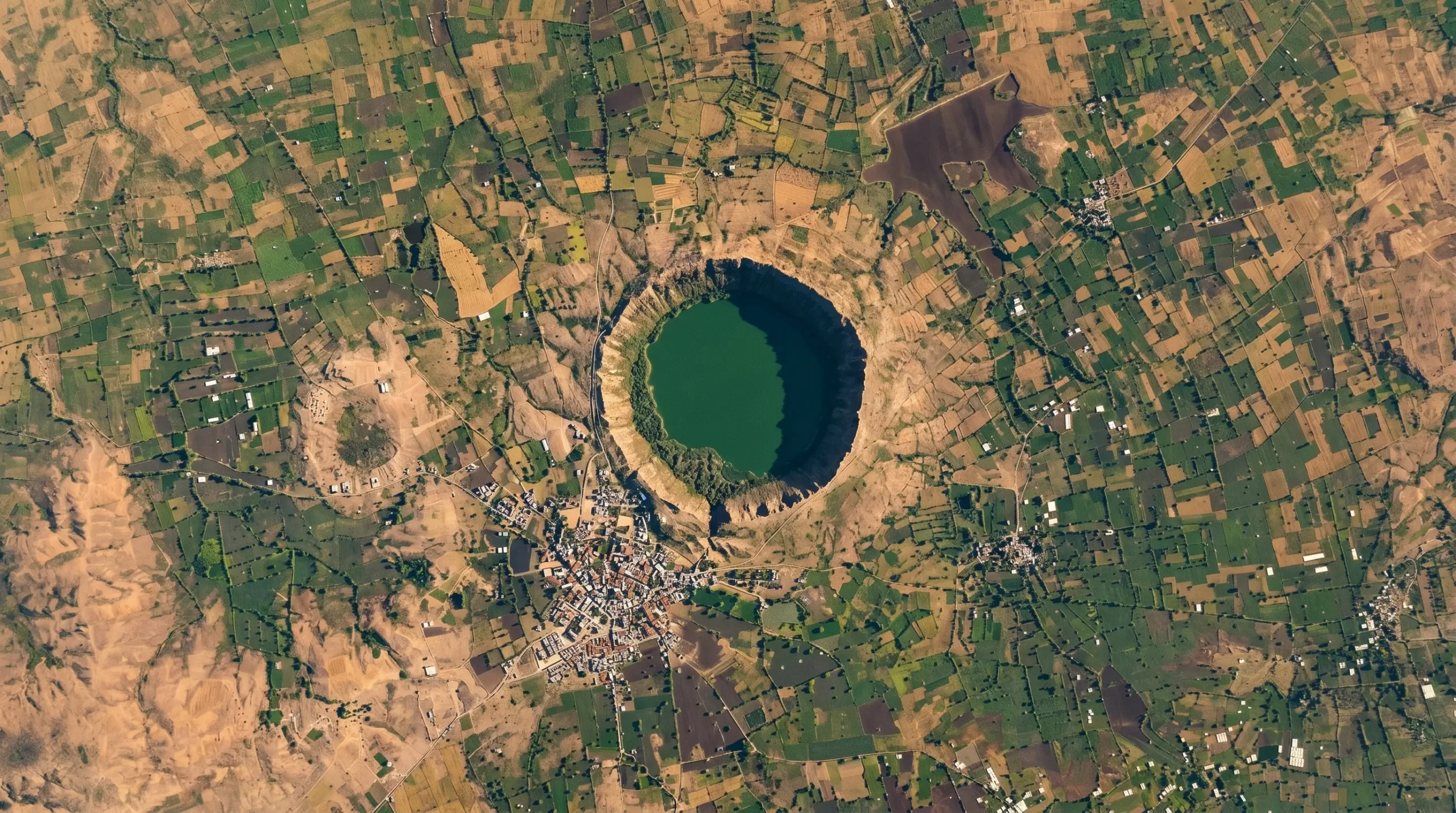
Lonar Crater is one of only four known hyper-velocity meteor impact craters in basaltic rock on Earth, formed approximately 50,000 years ago when a meteor struck the Deccan plateau’s volcanic basalt layer. This combination — impact crater in basalt rather than the more common sedimentary or granitic targets — makes Lonar a site of genuine scientific significance studied by geologists and planetary scientists internationally, including for its parallels to impact craters observed on the Moon and Mars.
The crater itself:
Approximately 1.8 km in diameter and 150 metres deep, with a saline, alkaline lake at its base — a unique water chemistry that supports a distinct micro-ecosystem found nowhere else in India. The lake’s alkalinity is itself a subject of ongoing scientific study.
The temples:
Around the crater rim and within the crater bowl itself sit approximately 12 ancient temples, dating from roughly the 6th to 13th centuries CE — some partially submerged by the lake at various points in its history. The most significant is the Daitya Sudan Temple, dedicated to Vishnu, a notable example of Hemadpanthi architecture (a distinctive Deccan temple-building style using interlocking stone construction without mortar).
The combination:
What I find genuinely unusual about Lonar as a destination is this layering — a rare geological phenomenon of global scientific interest, with over a thousand years of subsequent religious and architectural history built directly into and around it. I cannot think of many places that combine these two dimensions this directly.
💡 Tip: Most visitors I take to Lonar arrive treating it as purely a geological curiosity or purely a temple circuit — engaging with only half of what makes it significant. I always try to walk people through both: the scientific story of the impact, and the temple history built around it over the following thousand years.
Day Trip vs Overnight — The Honest Calculation
Day trip from Chhatrapati Sambhajinagar (Aurangabad):
Technically possible with an early departure (6:00 AM), arriving at Lonar by approximately 9:30–10:00 AM. This allows a reasonable window — roughly 4 to 5 hours — at the crater before a return departure that gets you back to Aurangabad by evening. This works if Lonar is your sole focus for the day.
The honest limitation:
A day trip means you experience Lonar during the harsher midday light and heat, and you miss the crater at dawn or dusk — in my experience, the most rewarding time, when the crater lake catches the early or late light and the temple spires emerge from any morning mist.
Overnight at Lonar:
For travelers who want the crater rim at sunrise — genuinely one of the more extraordinary sunrise views I know of in Maharashtra — an overnight stay is the only way to get it. Lonar has basic accommodation given its status as a recognized destination, though infrastructure is more modest than at major pilgrimage or heritage centers.
Combining with Ajanta on a multi-day loop:
Lonar sits roughly 170 km northwest of Ajanta, making a combined Ajanta-Lonar overnight loop a genuinely compelling option for travelers with 3+ days who want to avoid backtracking through Chhatrapati Sambhajinagar (Aurangabad) for each site separately.
💡 Tip: If photography or the full sunrise experience matters to you, I would not recommend attempting Lonar as a single day trip. The crater’s best light happens precisely when a day-trip schedule from Aurangabad cannot accommodate it — early morning, late evening — without staying over.

Practical Information for the Lonar Visit
What to wear:
Closed shoes with good grip are essential — the rim trail and the descent into the crater bowl involve uneven natural terrain, not the maintained stone pathways you would find at Ajanta or Ellora. This is a genuinely more rugged walk than the cave sites, and I tell every guest this before we leave Aurangabad.
Time needed for a proper visit:
4 to 5 hours minimum to walk a meaningful portion of the rim trail (the full circuit takes 2 to 3 hours alone), descend into the crater bowl to see the Daitya Sudan Temple and the lake up close, and explore at least a few of the other rim temples.
Sun protection:
The crater rim and bowl offer limited shade across most of the trail. Sun protection — hat, sunscreen, sufficient water — is essential, particularly given the longer time commitment compared to a typical cave visit.
Facilities:
Facilities at Lonar are more basic than at Ajanta, Ellora, or the central Aurangabad heritage sites. Carry your own water and snacks; do not expect the same restaurant or amenity infrastructure you find elsewhere in the region.
Local guides:
Local guides are available at Lonar, though the formal licensing infrastructure is less developed than at the ASI-managed UNESCO sites. A knowledgeable local guide can meaningfully add to understanding both the geological story and the temple history, but I would weigh genuine local knowledge over checking for official credentials here.
💡 Tip: Bring more water than you think you need. Between the longer walking distance, the limited shade, and the more basic facilities compared to Ajanta or Ellora, Lonar is more physically demanding in practice than its description as a “day trip” suggests — I have seen more than a few guests underestimate this.
The Scientific Significance — Worth Understanding Before You Go
Lonar’s status as one of only four hyper-velocity impact craters in basaltic rock on Earth is not a minor scientific footnote — it is the primary reason geologists and planetary scientists travel internationally to study the site.
Why basalt matters:
Most studied impact craters on Earth occur in sedimentary or granitic rock, which behaves differently under impact than basalt. Lonar’s basaltic composition makes it directly relevant to understanding impact processes on other basaltic planetary surfaces — including significant portions of the Moon and Mars — making it a genuine planetary science research site, not simply a geological curiosity.
The age and preservation:
At approximately 50,000 years old, Lonar is geologically very young by impact crater standards, and its preservation — relatively undisturbed by erosion or human development until recent centuries — makes it a clearer record of impact dynamics than older, more weathered craters elsewhere.
💡 Tip: If you have any interest in geology or planetary science, ask your guide specifically about the basalt-versus-sedimentary distinction. It is the one fact that explains why Lonar draws international scientific attention, and it is the detail I find most visitors remember long after the trip — more than the temples, even.

The Alternative — Lonar Without the Logistics Gamble
Lonar’s longer distance, more rugged terrain, less developed facilities, and the specific timing needed to see it at its best (dawn or dusk) make it a meaningfully more complex day trip to self-organize than Ellora or even Shirdi.
I build a planned overnight Ajanta-Ellora-Lonar circuit specifically to remove this compromise — proper time at each site, the crater seen at sunrise rather than midday, and transport and accommodation handled as part of one coherent route rather than a rushed, separately-organized add-on.
👉 See Ajanta-Ellora-Lonar 3-Day Tour Details & Book — the complete circuit, including Lonar at its best light, without the single-day routing compromise.
FAQ — Aurangabad to Lonar Crater
Q.1 : What is the distance from Aurangabad to Lonar Crater?
Lonar Crater is approximately 140 km from Chhatrapati Sambhajinagar (Aurangabad), located in Buldhana district. The drive takes approximately 3 to 3.5 hours each way via the route through Jalna and Sindkhed Raja, with no expressway shortcut currently available on this route.
Q.2 : Can I visit Lonar Crater as a day trip from Aurangabad?
Yes, technically possible with an early 6:00 AM departure, allowing 4 to 5 hours at the crater before returning by evening. However, a day trip means experiencing Lonar in harsher midday light and missing the dawn or dusk views considered the most rewarding — an overnight stay is needed for the full sunrise experience.
Q.3 : What makes Lonar Crater scientifically significant?
Lonar is one of only four known hyper-velocity meteor impact craters in basaltic rock on Earth, formed approximately 50,000 years ago. Its basaltic composition makes it directly relevant to understanding impact processes on other basaltic planetary surfaces, including the Moon and Mars, attracting international geological and planetary science research interest.
Q.4 : What temples are at Lonar Crater?
Approximately 12 ancient temples, dating from roughly the 6th to 13th centuries CE, sit around the crater rim and within the crater bowl. The most significant is the Daitya Sudan Temple, dedicated to Vishnu, built in the Hemadpanthi architectural style characteristic of the Deccan region.
Q.5 : Should I combine Lonar Crater with Ajanta or Ellora?
Lonar sits roughly 170 km northwest of Ajanta, making a combined Ajanta-Lonar overnight loop a practical option for travelers with 3 or more days, avoiding the need to backtrack through Chhatrapati Sambhajinagar (Aurangabad) for each site separately. This is generally a better approach than treating Lonar as an isolated day trip.
👉 Related Posts You Might Like:
- Aurangabad to Shirdi – Day Trip Guide
- How Many Days in Aurangabad – 1, 2 or 3?
- Ajanta Caves Nearby Attractions – What to See Around
- Aurangabad Travel Tips – What No One Tells You
- Best Time to Visit Ajanta Caves for Tourists