Bibi ka Maqbara – Complete Visitor Guide 2026 (Local Aurangabad Tips)
Bibi ka Maqbara sits 3 km from the heart of Chhatrapati Sambhajinagar (Aurangabad) and is, by a meaningful margin, the most underrated Mughal monument in India. Built around 1660 CE in direct homage to the Taj Mahal, it carries the inevitable comparison everywhere it goes — and that comparison, handled honestly, is exactly what makes it worth understanding properly rather than dismissing as a lesser copy.
What Bibi ka Maqbara Actually Is
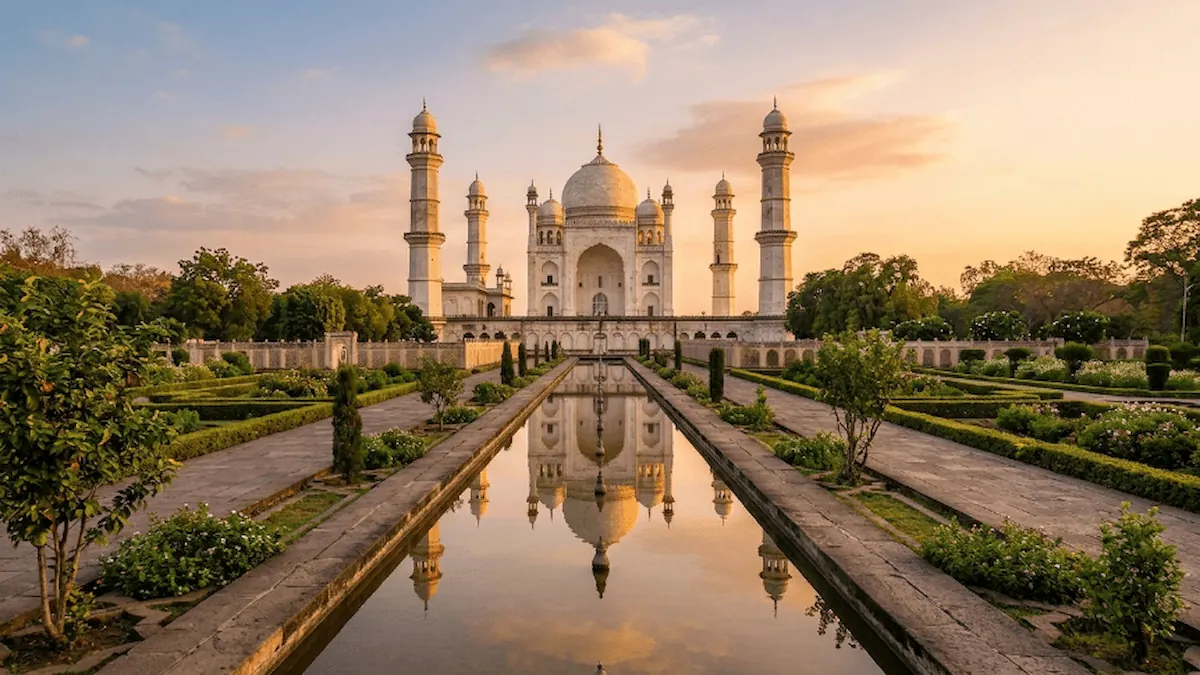
Bibi ka Maqbara is a Mughal mausoleum commissioned by Emperor Aurangzeb in memory of his chief wife, Dilras Banu Begum (posthumously known as Rabia-ul-Daurani), and later looked after and modified by his son, Azam Shah. Construction was substantially complete by 1660 CE — roughly a decade after the Taj Mahal’s completion in Agra — and the structure was deliberately modeled on the Taj: four minarets at the corners, a central domed tomb chamber, and a formal charbagh (four-part) Persian garden with a central water channel.
The intention behind the design was explicit homage, not concealment. The architects of Bibi ka Maqbara were not attempting to disguise the Taj Mahal as their inspiration — they were building within the same architectural tradition for a comparable act of memorial devotion, in a different city, with a different budget and political context.
The honest material comparison:
This is where most descriptions of Bibi ka Maqbara either overstate or understate the truth. Marble was used for the lower portion of the structure — the plinth and the lower walls — while the upper sections, including much of the dome, are finished in lime plaster shaped and polished to resemble marble. This was a budget and resource decision, not a craftsmanship failure.
💡 Tip: Walk close to the lower plinth and place your hand on the surface — you can feel the difference between the cool, smooth marble at the base and the plaster surface above. This single physical detail explains the entire material story of the monument more directly than any amount of reading.
📍 Bibi ka Maqbara on Google Maps
The Honest Taj Mahal Comparison
Every article about Bibi ka Maqbara addresses this comparison, and most do so either too dismissively (“a poor copy”) or too defensively (“just as beautiful, equally significant”). Neither is accurate.
What is genuinely comparable:
The proportional design — the relationship between the dome, the minarets, and the platform — follows the same architectural logic as the Taj Mahal. The garden layout, with its central water channel and quadrant planting, creates a similar processional approach to the tomb. At a distance, particularly in early morning or late afternoon light, the silhouette is genuinely reminiscent of the Taj.
What is genuinely different:
Scale — Bibi ka Maqbara is smaller in nearly every dimension. Material — full marble cladding versus the marble-and-plaster combination here. Site context — the Taj Mahal sits on the Yamuna riverbank with a specific approach sequence that Bibi ka Maqbara’s urban Aurangabad setting does not replicate. Carving density — the pietra dura (inlaid stone) work that makes the Taj’s surface so famous is present at Bibi ka Maqbara only in more limited sections, primarily around the cenotaph itself.
The grave itself — a genuine point of difference:
At the Taj Mahal, the actual lower crypt containing Mumtaz Mahal’s grave is sealed and inaccessible to visitors year-round, except for three days annually around the Urs of Shah Jahan. At Bibi ka Maqbara, the experience is structurally different and, in its own way, more direct: the main floor has an open octagonal opening at its center, looking straight down into the lower level where the actual grave sits, covered in drapes. Visitors stand at this opening and look directly down at the real grave — a more intimate and visible connection to the burial itself than the Taj Mahal offers.
The honest verdict:
Bibi ka Maqbara is not the Taj Mahal, and visiting it expecting that experience will lead to disappointment. Visiting it as what it actually is — a significant, graceful, historically important Mughal monument with its own distinct architectural character — is a genuinely worthwhile heritage experience.
💡 Tip: The local nickname “Mini Taj Mahal” or “Taj of the Deccan” sets expectations that work against the monument. Approach Bibi ka Maqbara as its own thing — a graceful 17th-century Mughal mausoleum with its own history — rather than as a comparison exercise, and the visit becomes considerably more rewarding.
The History Behind the Monument
Dilras Banu Begum:
Aurangzeb’s chief wife, Dilras Banu Begum, died in 1657 CE and was posthumously given the title Rabia-ul-Daurani.
Commissioned by Aurangzeb, maintained by Azam Shah:
Official records and the ASI plaque at the site credit Emperor Aurangzeb with commissioning the mausoleum in his wife’s memory, with construction substantially complete by 1660 CE. His son, Azam Shah, later supervised renovation and maintenance of the monument. Both figures are part of the monument’s history — Aurangzeb as commissioning patron, Azam Shah in a later custodial role.
The architect:
Ata-ullah, son of Ustad Ahmad Lahori — the same Ustad Ahmad Lahori credited as the principal architect of the Taj Mahal — is traditionally credited with Bibi ka Maqbara’s design. This direct architectural lineage explains the structural and proportional similarities between the two monuments far more directly than coincidence or general stylistic influence.
Aurangzeb’s Deccan connection:
Aurangzeb spent significant portions of his reign campaigning in the Deccan, and Chhatrapati Sambhajinagar (Aurangabad) — which takes its historical name from him — served as an important administrative and military base during this period. Bibi ka Maqbara’s location in the city reflects this broader Mughal presence in the Deccan during the empire’s later, more militarily extended phase.
💡 Tip: The connection between Bibi ka Maqbara’s architect and the Taj Mahal’s architect is the single most interesting historical fact most visitors do not know. It explains the design relationship as direct architectural inheritance — a son of the Taj’s architect designing a memorial that consciously echoes his father’s most famous work — rather than simple imitation.
.jpg)
Visiting Bibi ka Maqbara — Practical Information
Timings:
- Open: Daily, 6:00 AM to 10:00 PM
- Bibi ka Maqbara is part of ASI’s Night Tourism initiative, with illumination lighting after dark that gives the monument a completely different character from its daytime appearance. If your schedule allows, an evening visit after sunset is genuinely worth considering alongside or instead of a daytime visit.
Entry Fee (2026, fully digital — cash not accepted):
- Indian nationals (online/QR code): ₹25
- Foreign nationals (online/QR code): ₹300
- SAARC and BIMSTEC citizens: Indian rates apply (₹25)
- Children under 15: Free entry
Photography:
Permitted throughout the complex, including the garden and exterior. Some restrictions may apply close to the cenotaph chamber — follow on-site signage.
Minarets:
Climbing the minarets is strictly prohibited by the ASI for safety and structural conservation reasons. There is no scenario in which access is granted — do not expect or request this on arrival.
Best time to visit:
Early morning, shortly after opening, offers the calmest atmosphere and the most flattering light on the white structure. The evening illumination after dark, given the extended Night Tourism hours, is the other strong option for a genuinely different experience of the same monument.
Time needed:
1.5 to 2 hours for a proper visit, including time in the garden, the main tomb chamber, and a walk around the full perimeter.
💡 Tip: Most visitors only consider Bibi ka Maqbara as a daytime stop. With the site now open until 10:00 PM under Night Tourism, an evening visit to see the illuminated monument is a genuinely different — and far less crowded — experience worth building into your Aurangabad itinerary if your schedule allows.
📍 Bibi ka Maqbara on Google Maps
What to See Inside — A Walking Guide
The main gateway:
Enter through the southern gateway, which frames your first view of the mausoleum across the garden — a deliberate architectural sequence designed to build anticipation, directly inherited from the Taj Mahal’s approach design.
The garden:
Walk the central pathway alongside the water channel rather than moving directly to the tomb. The formal charbagh garden — four quadrants divided by water channels and walkways — is itself a significant element of Mughal garden design philosophy, representing paradise gardens described in Islamic tradition.
The main mausoleum:
The central structure houses the cenotaph of Dilras Banu Begum, enclosed within an octagonal marble lattice screen (jali) that allows light and air into the chamber while maintaining a sense of sacred separation.
The open grave view:
Unlike the Taj Mahal, where the lower crypt is sealed and inaccessible, the main floor at Bibi ka Maqbara has an open octagonal opening at its center, looking directly down into the lower level where the actual grave sits, covered in drapes and visible to visitors from above. Visitors commonly pay respects here by offering a cloth covering or coins toward the grave below.
💡 Tip: Most visitors walk directly to the tomb chamber and miss the deliberate garden approach sequence entirely. Take the slower route along the water channel — it is a five-minute difference in time and a significant difference in how the monument’s design is meant to be experienced.
Combining Bibi ka Maqbara With Other Aurangabad Sites
Bibi ka Maqbara pairs naturally with other heritage sites close to the city center, making it easy to build into a half-day or full-day Aurangabad itinerary.
Bibi ka Maqbara + Aurangabad Caves:
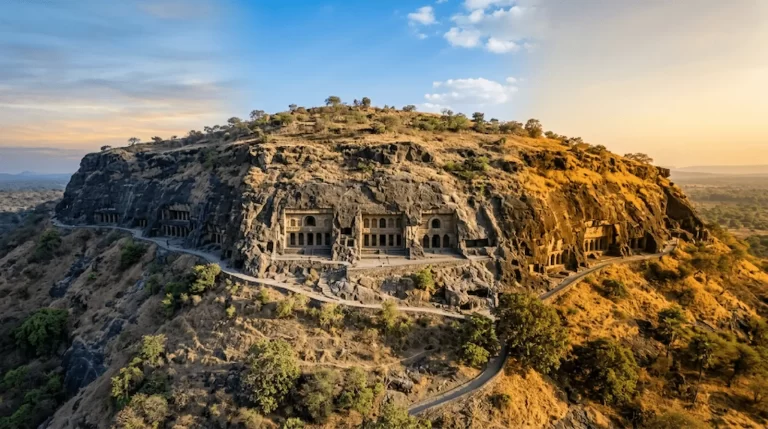
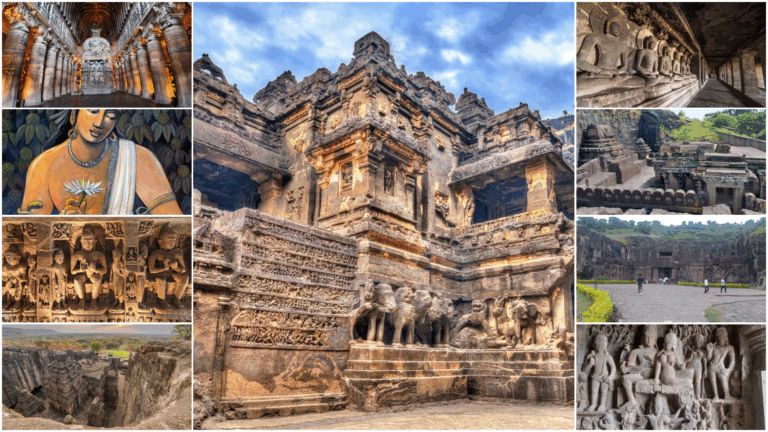
Both sites are within a short drive of each other and the city center. A half-day combining the Mughal mausoleum with the Buddhist rock-cut caves gives a striking contrast — 17th-century Islamic memorial architecture and 5th–6th century Buddhist monastic architecture, separated by over a thousand years but separated by only a few kilometers in the same city.
Bibi ka Maqbara + Panchakki:
Panchakki, a 17th-century water mill and Sufi shrine complex, is another central Aurangabad heritage site that combines naturally with a Bibi ka Maqbara visit for travelers spending a half-day exploring the city itself.
Bibi ka Maqbara as part of a longer Chhatrapati Sambhajinagar (Aurangabad) itinerary:
For travelers spending two or three days in the region primarily for Ajanta and Ellora, Bibi ka Maqbara fits naturally into a morning, afternoon, or evening slot on a day when the main itinerary is lighter — typically the arrival or departure day.
👉 See Aurangabad Heritage Tour Details & Book — Bibi ka Maqbara, Aurangabad Caves, and the city’s central heritage sites in one well-paced day.
The Alternative — Seeing Bibi ka Maqbara With Proper Context
A monument this layered in history — the architect’s lineage to the Taj Mahal, the Aurangzeb-era Deccan context, the specific material decisions, the open grave view most visitors do not understand the significance of — rewards having someone explain what you are looking at, rather than walking through with only a basic information board for context.
A guided city heritage visit means understanding exactly why Bibi ka Maqbara looks the way it does, rather than only registering the surface-level Taj Mahal comparison that most casual visitors leave with.
👉 See Aurangabad Heritage Tour Details & Book — Bibi ka Maqbara with full historical context, paired with the city’s other central heritage sites.
FAQ — Bibi ka Maqbara Complete Guide
Q.1 : Is Bibi ka Maqbara worth visiting?
Yes — as its own significant Mughal monument rather than as a direct substitute for the Taj Mahal. Bibi ka Maqbara has genuine historical importance, was designed by a direct architectural descendant of the Taj Mahal’s architect, and offers a graceful heritage experience, particularly in early morning light or under its evening illumination as part of ASI’s Night Tourism initiative.
Q.2 : Why is Bibi ka Maqbara called the Mini Taj Mahal?
Bibi ka Maqbara is called the Mini Taj Mahal because it was deliberately designed in homage to the Taj Mahal — sharing the same four-minaret, central-dome, charbagh-garden layout — and was designed by Ata-ullah, son of Ustad Ahmad Lahori, the principal architect of the Taj Mahal itself. It is smaller in scale and uses lime plaster rather than full marble cladding on its upper sections.
Q.3 : Who built Bibi ka Maqbara and why?
Bibi ka Maqbara was commissioned by Emperor Aurangzeb in memory of his chief wife, Dilras Banu Begum (Rabia-ul-Daurani), who died in 1657 CE. Construction was substantially complete by 1660 CE. His son, Azam Shah, later supervised the monument’s renovation and maintenance.
Q.4 : Is Bibi ka Maqbara made of marble like the Taj Mahal?
Partially. The lower plinth and portions of the lower walls at Bibi ka Maqbara are genuine marble. The upper sections, including much of the dome, are finished in lime plaster shaped and polished to resemble marble — a budget and resource decision reflecting the more limited treasury allocation available for a Deccan memorial compared to the Taj Mahal in Agra.
Q.5 : What are the current entry fees and timings for Bibi ka Maqbara?
As of 2026, Bibi ka Maqbara is open daily from 6:00 AM to 10:00 PM as part of ASI’s Night Tourism initiative, with evening illumination. Entry is fully digital (cash not accepted): ₹25 for Indian nationals and SAARC/BIMSTEC citizens, ₹300 for foreign nationals, and free for children under 15. Climbing the minarets is strictly prohibited.
👉 Related Posts You Might Like:
- Aurangabad Caves – Complete Guide 2026
- Daulatabad Fort – Complete Guide
- Top 10 Tourist Places in Aurangabad
- Best Weekend Itinerary for Aurangabad in 2 Days
- Ajanta Caves Nearby Attractions – What to See Around