Lonar Crater History – Meteor Impact and Ancient Temples (2026)
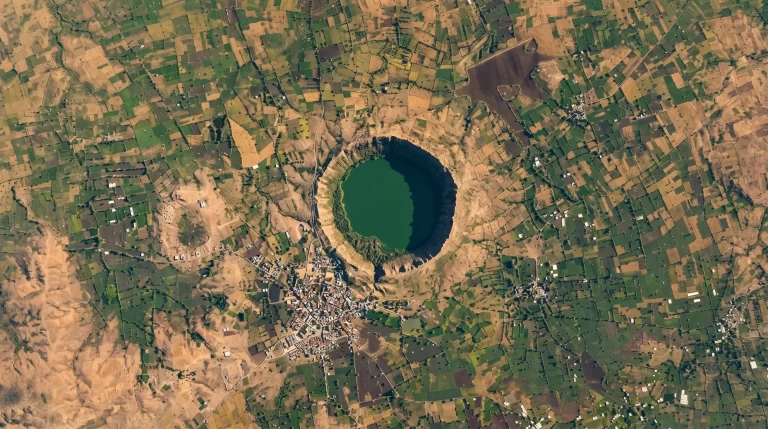
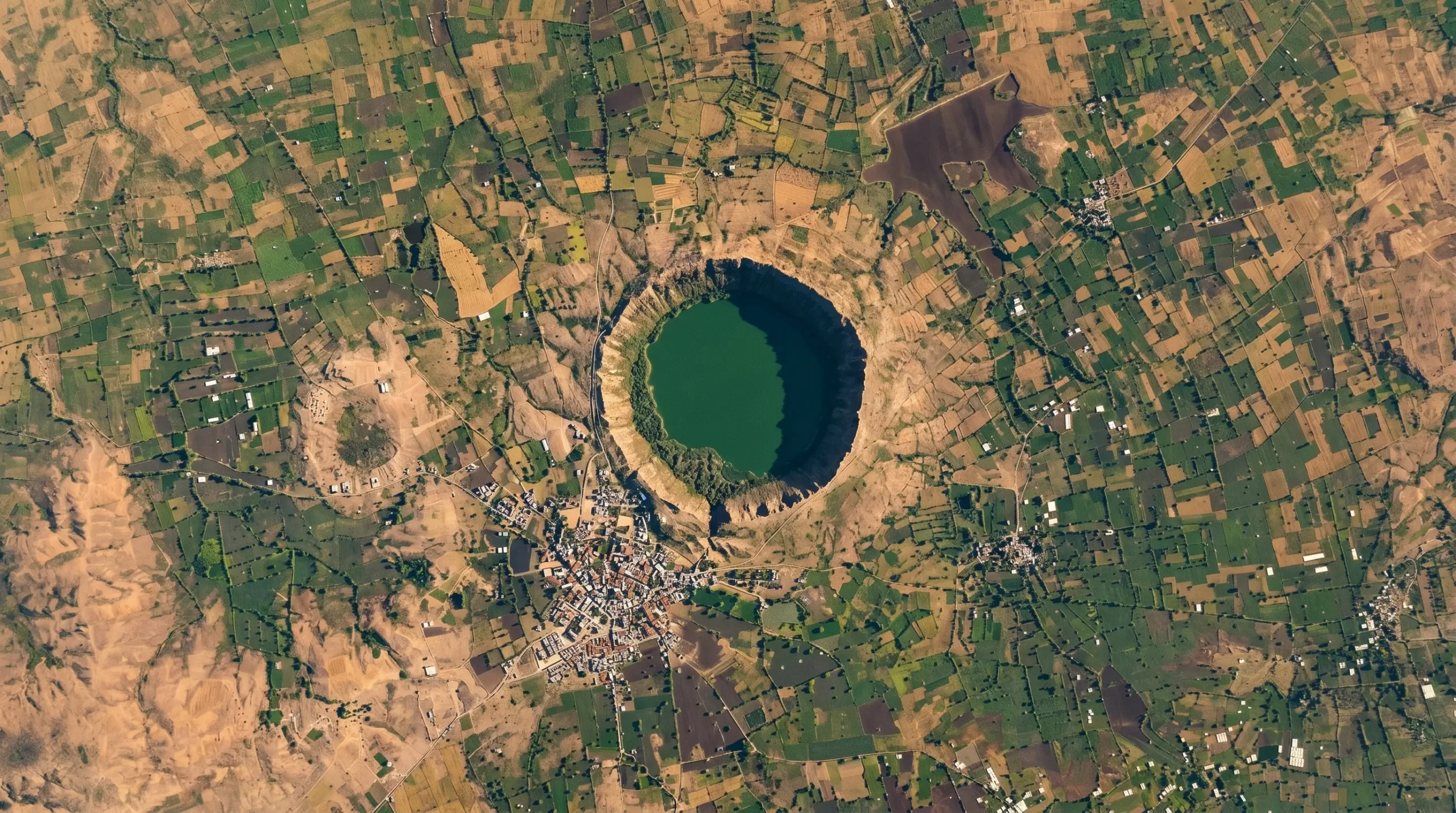
The Lonar Crater history is unlike any other heritage site in Maharashtra. It combines a 50,000-year-old meteor impact, centuries of scientific debate, ancient Hindu temples, local legends, and modern geological discoveries within a single landscape.
Today, Lonar is recognized as one of the world’s most important impact craters formed in basalt rock, but for much of modern history scientists weren’t entirely sure how it formed. This guide explores the complete story behind Lonar Crater — from a meteor strike in prehistoric times to its recognition as a globally significant geological monument.
The Meteor Impact That Created Lonar
The story begins approximately 50,000–52,000 years ago.
A meteorite, estimated to be around 60 metres in diameter and travelling at extraordinary speed, struck the basaltic rock of the Deccan Plateau.
The impact released enormous energy and excavated a crater approximately:
| Feature | Measurement |
|---|---|
| Diameter | 1.8 km |
| Depth | Approximately 150 metres |
| Rim Height | Around 20 metres above surrounding plain |
| Estimated Age | 50,000–52,000 years |
Over thousands of years, rainwater accumulated inside the crater, creating the saline and alkaline lake seen today.
Unlike most impact craters worldwide, Lonar formed entirely in basalt rock, making it exceptionally valuable to scientists studying impact processes on volcanic planetary surfaces.
Why Scientists Were Confused for 150 Years
The crater was formally documented in 1823 by British officer C.J.E. Alexander.
Because Lonar sits within the Deccan Traps — one of the world’s largest volcanic provinces — early researchers assumed the crater had volcanic origins.
For nearly 150 years, scientists debated whether Lonar was:
- A volcanic crater
- A collapsed geological structure
- A meteor impact crater
The circular shape strongly suggested an impact origin, but conclusive evidence remained elusive.
The Discovery That Solved the Mystery
Everything changed in 1973.
Researchers identified maskelynite inside rock samples collected from Lonar.
Maskelynite is a natural glass produced only when rock experiences the extreme pressure generated by a high-velocity meteor impact.
Its presence provided definitive proof that Lonar was created by a meteorite strike rather than volcanic activity.
This discovery transformed Lonar from a regional curiosity into one of the world’s most important impact-crater research sites.
Lonar and the Story of Mars
One reason Lonar attracts international scientific attention is its similarity to certain landscapes observed on Mars.
Scientists study Lonar because it combines:
- Basalt rock
- Impact crater formation
- Saline water
- Extreme microbial ecosystems
These conditions resemble environments found on volcanic planetary surfaces elsewhere in the solar system.
Researchers from Indian institutions and international organizations continue to use Lonar as a natural laboratory for understanding planetary geology.
Ancient Human History Around the Crater
Long after the meteor impact, human settlements developed around the crater.
The region came under the influence of several major dynasties including:
- Mauryas
- Chalukyas
- Rashtrakutas
- Yadavas
- Kakatiyas
- Mughals
- Nizam of Hyderabad
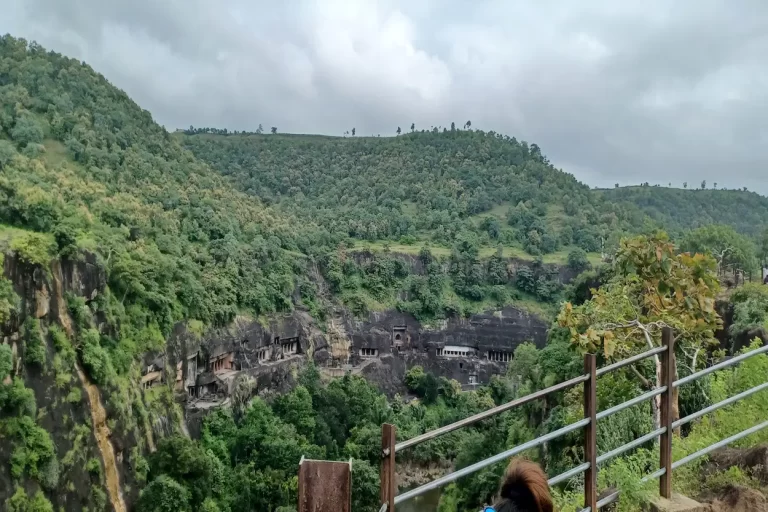
These successive kingdoms left cultural and religious influences across the region, particularly through temple construction around the crater.
The Legend of Lonasura
Alongside its geological story, Lonar also has a powerful mythological tradition.
According to local legend, a demon named Lonasura terrorized the region.
Lord Vishnu descended to defeat him and struck him with such force that the impact created the crater itself.
The demon’s name is believed to be the origin of the modern name “Lonar.”
While mythology and geology tell very different stories, both remain deeply connected to how local communities understand the site today.
Daitya Sudan Temple and Lonar’s Religious Heritage
The most important temple associated with Lonar is the Daitya Sudan Temple.
Dedicated to Lord Vishnu, the temple dates to the Chalukya-Yadava period and is considered one of the finest surviving examples of Hemadpanthi architecture in Maharashtra.
The temple’s carvings depict scenes connected to the Lonasura legend and continue to attract pilgrims alongside heritage travelers.

The Temples Around Lonar Crater
Historical surveys have recorded approximately 32 temples around the crater.
Today, around 19 of these structures are protected by the Archaeological Survey of India.
Some remain active places of worship while others survive as archaeological ruins.
Notable examples include:
- Daitya Sudan Temple
- Kamalja Devi Temple
- Ramgaya Temple
- Kumareshwar Temple
- Various smaller shrines around the crater rim and lake edge
Several temples near the crater floor are partially submerged during monsoon when lake levels rise.
Lonar Lake Turns Pink
One of the most unusual chapters in recent Lonar Crater history occurred in 2020.
The crater lake suddenly turned bright pink.
Scientists later determined that the colour change was caused by a bloom of salt-loving microorganisms thriving in altered water conditions.
The phenomenon attracted international media attention and renewed scientific interest in Lonar’s unique ecosystem.

National and International Recognition
Lonar’s importance continues to grow.
Major milestones include:
- Declared a National Geo-Heritage Monument by the Geological Survey of India
- Recognized as a Ramsar Site in November 2020
- International scientific research destination
- One of the world’s few known basaltic impact craters
These recognitions acknowledge both the crater’s scientific importance and its ecological value.
Why Lonar Crater History Matters
Lonar is one of the rare places where geology, mythology, archaeology, ecology, and history overlap.
Within a single location you can experience:
- A meteor impact from prehistoric times
- Ancient temple architecture
- Living religious traditions
- Globally significant scientific research
- One of India’s most unusual lake ecosystems
Few destinations in India offer such a combination of natural and cultural heritage.
FAQ — Lonar Crater History
Q1: Who discovered Lonar Crater?
British officer C.J.E. Alexander formally documented Lonar Crater in 1823, although local communities had known about the site for centuries.
Q2: When was Lonar confirmed as a meteor impact crater?
Scientists confirmed its impact origin in 1973 after discovering maskelynite, a glass formed only under extreme meteor-impact pressure.
Q3: Why is Lonar Crater called Lonar?
According to local legend, the crater is named after the demon Lonasura, who was defeated by Lord Vishnu at this location.
Q4: How many temples are around Lonar Crater?
Historical records mention around 32 temples, with approximately 19 currently protected by the Archaeological Survey of India.
Q5: Why did Lonar Lake turn pink?
In 2020, the lake briefly turned pink due to a bloom of salt-loving microorganisms triggered by changing water conditions.
Related Posts You Might Like
- Lonar Crater – Complete Guide
- Lonar Crater Temples – Complete Guide
- Lonar Lake – Saline and Alkaline Lake Explained
- How to Reach Lonar Crater from Aurangabad
- Best Time to Visit Lonar Crater