Lonar Lake – Saline Alkaline Lake Explained (2026)
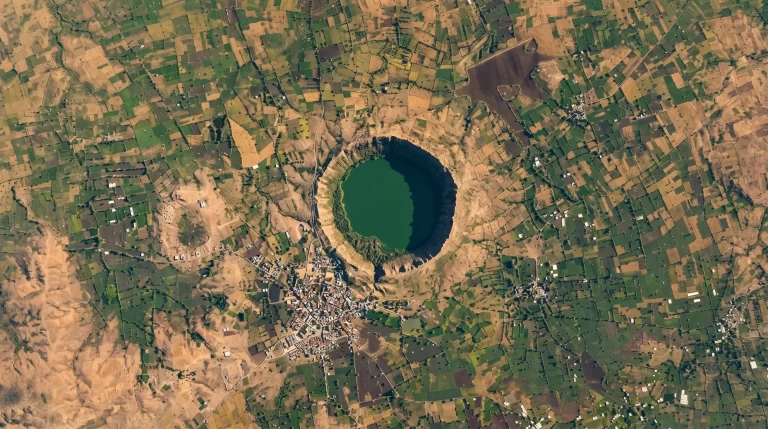
The Lonar Lake saline alkaline ecosystem is one of the main reasons scientists from around the world study Lonar Crater. Located at the center of a 50,000-year-old meteor impact crater, Lonar Lake is India’s only known basaltic soda lake and one of the world’s most unusual natural laboratories.
Its highly alkaline water, extreme microbial life, and rare geological setting make it very different from ordinary lakes found elsewhere in Maharashtra or India.
Quick Facts
| Fact | Details |
|---|---|
| Lake Type | Saline alkaline soda lake |
| Location | Lonar Crater, Maharashtra |
| Diameter | Approximately 1.8 km |
| Maximum Depth | Approximately 137 metres |
| pH Level | Up to 9.4 recorded |
| Water Outlet | None |
| Scientific Significance | India’s only basaltic soda lake |
What Makes Lonar Lake Unique?
Lonar Lake sits inside a meteor impact crater formed approximately 50,000 years ago.
Unlike most lakes, it exists within a closed basin, meaning water enters through rainfall and seasonal runoff but does not flow out through rivers or streams.
Over thousands of years, minerals dissolved from the surrounding basalt accumulated inside the lake, creating highly saline and alkaline conditions.
This unusual combination is what makes Lonar one of the most scientifically important lakes in India.
Why Is Lonar Lake Saline and Alkaline?
The answer lies in the lake’s geography.
Because the crater forms a closed natural basin:
- Rainwater enters the lake
- Small seasonal streams feed the lake
- Water evaporates over time
- Minerals remain trapped inside
Unlike rivers and freshwater lakes, there is no natural outlet carrying these dissolved minerals away. Over thousands of years, this process increased:
- Salinity
- Alkalinity
- Mineral concentration
- Total dissolved solids
The result is a rare soda lake ecosystem with chemistry very different from ordinary freshwater environments.
The Extreme Microbial Life
The lake supports organisms known as extremophiles.
These microorganisms have adapted to survive in conditions that would be hostile to most forms of life.
Scientists have identified:
- Haloalkaliphilic bacteria
- Salt-tolerant archaea
- Nitrogen-fixing microorganisms
- Rare algae species
- Unique fungal species
One fungal species discovered within the lake sediment was formally named Curvularia lonarensis, directly after Lonar itself.
These organisms make the lake important for research into microbial evolution and life in extreme environments.
The Famous Pink Lake Event of 2020
In 2020, Lonar Lake suddenly turned bright pink.
The event attracted national and international attention.
Researchers determined the color change was caused by blooms of haloarchaea — salt-loving microorganisms capable of producing red and orange carotenoid pigments.
Changes in water chemistry, evaporation rates, and microbial activity created conditions that allowed the lake to temporarily change color.
The phenomenon was even visible in satellite imagery.

A Lake That Continues to Change
Scientific studies show that Lonar Lake is not a static ecosystem.
Researchers comparing water samples across different years have documented changes in:
- Salinity
- Alkalinity
- pH levels
- Microbial populations
- Water quality
Some studies suggest that sedimentation and human activity around the crater have influenced these changes over time.
Because Lonar is a closed ecosystem, even small environmental shifts can have noticeable effects.
Wildlife Around Lonar Lake
The crater ecosystem supports much more than microorganisms.
The forested slopes surrounding the lake provide habitat for:
- Peacocks
- Parakeets
- Migratory birds
- Langurs
- Deer
- Wild boar
- Reptiles
Winter is particularly rewarding for birdwatchers, as migratory species arrive in larger numbers.
The combination of forest, water, and wetland habitat creates one of the richest biodiversity zones in the region.
Why Scientists Study Lonar Lake
Several factors make Lonar globally significant:
Basaltic Environment
Most impact craters occur in sedimentary or granitic rock. Lonar formed entirely in basalt.
Extreme Chemistry
The lake’s high alkalinity and salinity create unusual biological conditions.
Meteor Impact Origin
Few crater lakes worldwide formed through meteor impacts in volcanic rock.
Planetary Research
Researchers often compare Lonar to geological environments found on Mars and other volcanic planetary surfaces.
For these reasons, Lonar remains one of India’s most important natural research sites.
Is Lonar Lake Worth Seeing?
Absolutely.
Most visitors come for the crater itself, but understanding the lake adds a completely different dimension to the experience.
Very few places in the world combine:
- A meteor impact crater
- A saline alkaline lake
- Rare microorganisms
- Ancient temples
- Rich biodiversity
within a single landscape.
Lonar Lake is one of those rare places where geology, biology, and history intersect.
FAQ — Lonar Lake Saline Alkaline Explained
Q1: Why is Lonar Lake saline and alkaline?
Because the lake has no outlet. Minerals dissolved from surrounding basalt rock accumulate over thousands of years instead of being washed away.
Q2: What is the pH level of Lonar Lake?
Studies have recorded pH levels as high as 9.4, making it a highly alkaline soda lake.
Q3: Why did Lonar Lake turn pink?
A bloom of haloarchaea microorganisms produced red-orange pigments that temporarily changed the lake’s color in 2020.
Q4: What makes Lonar Lake scientifically important?
It is India’s only basaltic soda lake and supports rare extremophile microorganisms within a meteor impact crater environment.
Q5: Does Lonar Lake support wildlife?
Yes. The surrounding crater ecosystem supports birds, langurs, deer, wild boar, reptiles, and numerous migratory species.
Related Posts You Might Like
- Lonar Crater – Complete Guide
- Lonar Crater History – Meteor Impact and Ancient Temples
- Lonar Crater Temples – Complete Guide
- Best Time to Visit Lonar Crater
- Lonar Crater Photography Guide