Bhaja Caves – Complete Guide 2026
Bhaja Caves sits a short drive from its better-known neighbour Karla, on a hillside above Bhaja village in the Maval region near Lonavala, and I think it deserves to be talked about as its own destination rather than simply “the other caves near Karla.” Among its 22 rock-cut excavations is a carved panel that may be the earliest physical evidence of the tabla anywhere in India, and a cemetery of 2,200-year-old monk memorials still bearing the names of the dead — two details most visitors to this region never even hear about, let alone see.
What Bhaja Caves Actually Is
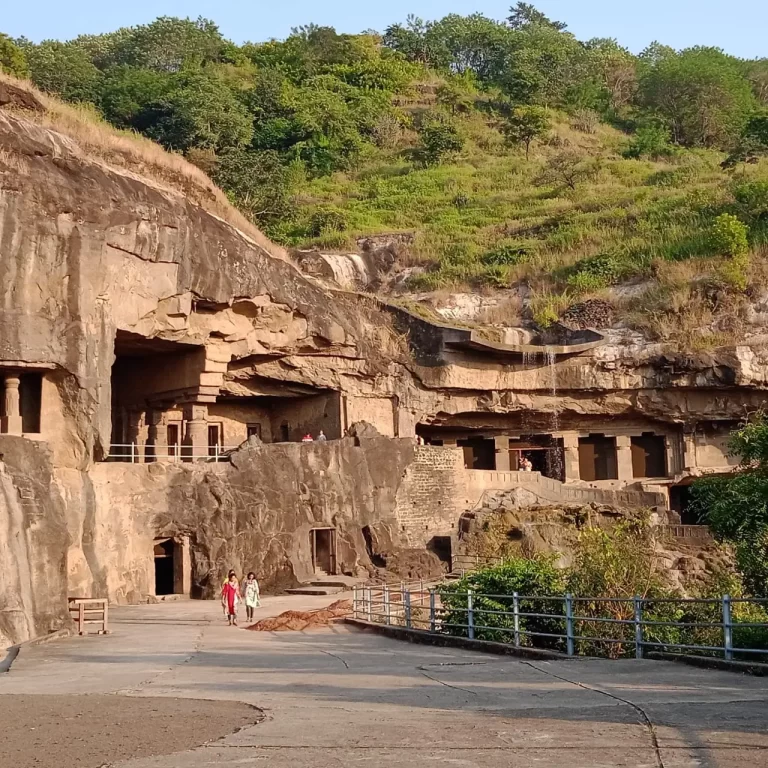
Bhaja Caves — sometimes spelled Bhaje — is a complex of 22 rock-cut Buddhist caves carved into a hillside roughly 400 feet above Bhaja village, dating to approximately the 2nd century BCE, making them among the oldest surviving Buddhist rock-cut sites in western India. Like Karla, the site sits along the ancient trade route running from the Arabian Sea coast eastward into the Deccan plateau, and the caves served the same dual purpose common to this entire regional tradition — monastic retreat for resident monks, and lodging for merchants and travelers passing through.
Cave 12 — the Chaitya:
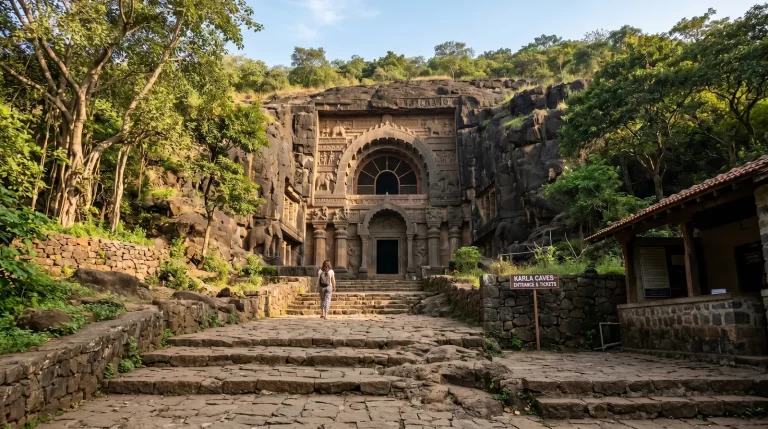
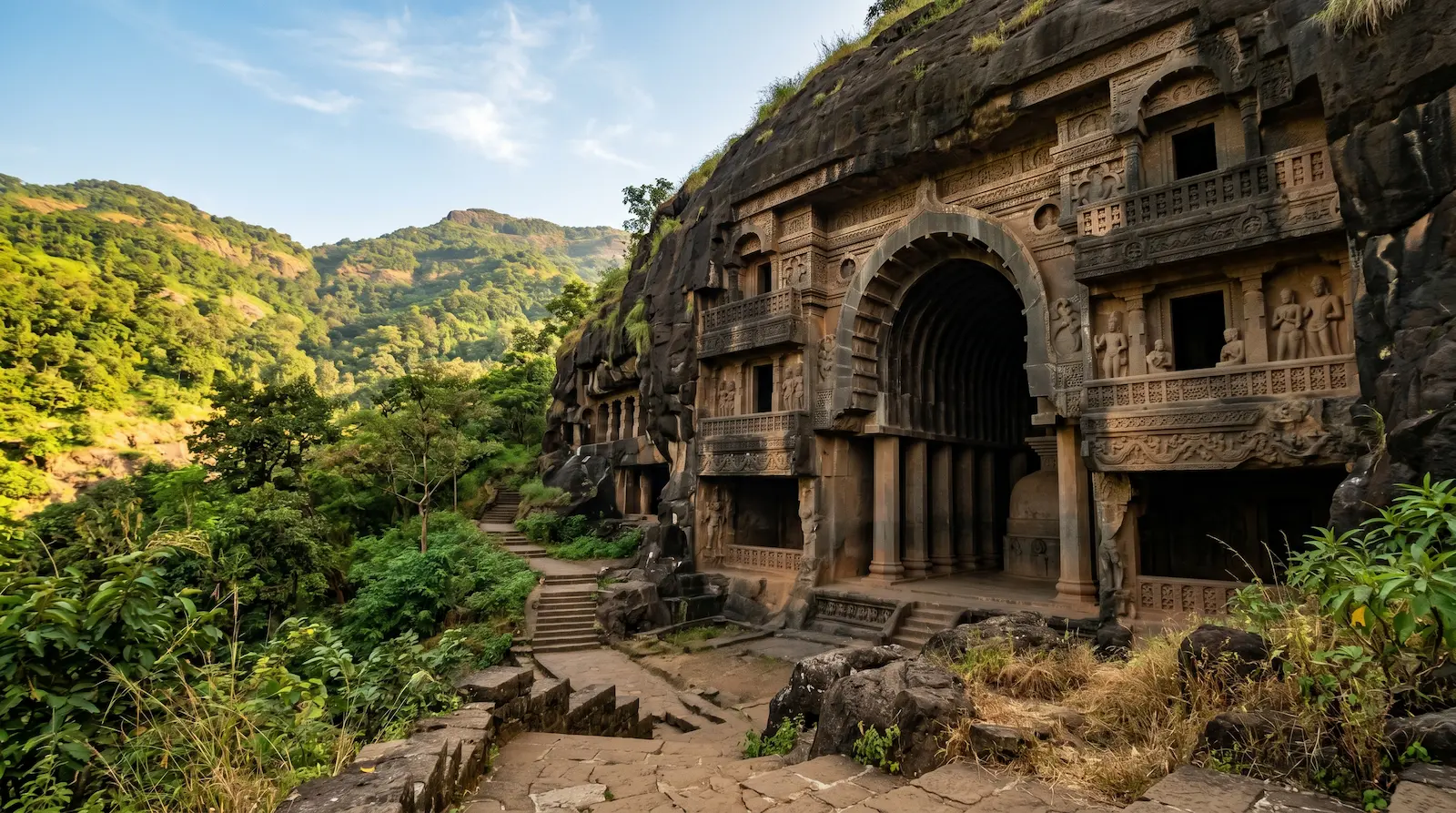
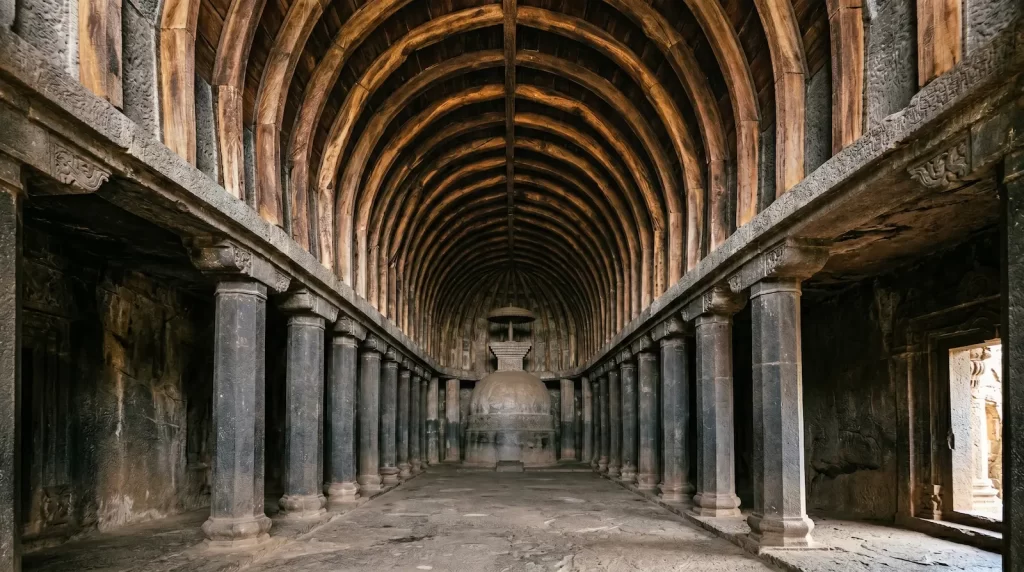
The site’s principal structure is its chaitya griha (prayer hall), an apsidal hall supported by 27 octagonal pillars, with a vaulted ceiling that still carries its original wooden rafters — a genuinely rare survival given how vulnerable timber is to two thousand years of monsoon humidity. A stupa sits at the rear of the hall, and the facade above the entrance is carved to resemble a multi-storeyed building, complete with carved balconies from which stone figures appear to look out over the entrance below.
💡 Tip: That carved facade detail — the figures positioned as if watching from upper-floor balconies — is easy to miss if you walk straight in. Step back before entering and look up at the full facade composition; it’s one of the more unusual architectural details at any Deccan cave site.
The Panel That Makes Bhaja Worth a Dedicated Visit

This is the detail I think most generic Lonavala travel content underplays, and it’s the single reason I’d specifically send someone to Bhaja rather than treating it as an optional add-on to a Karla trip.
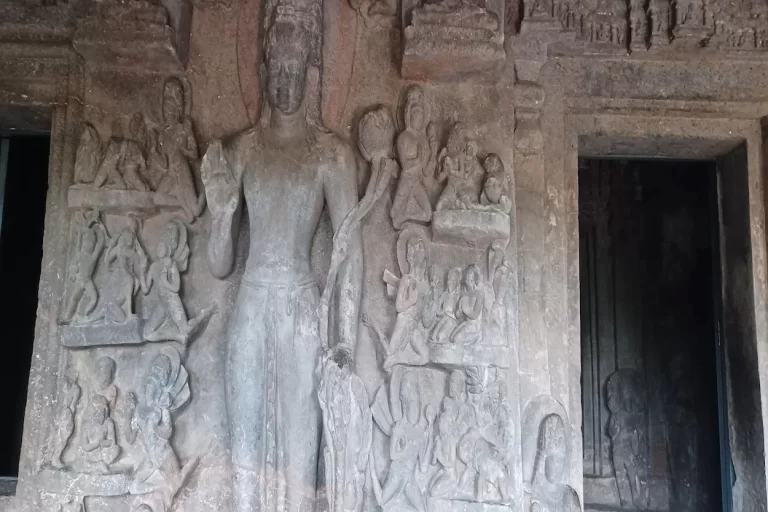
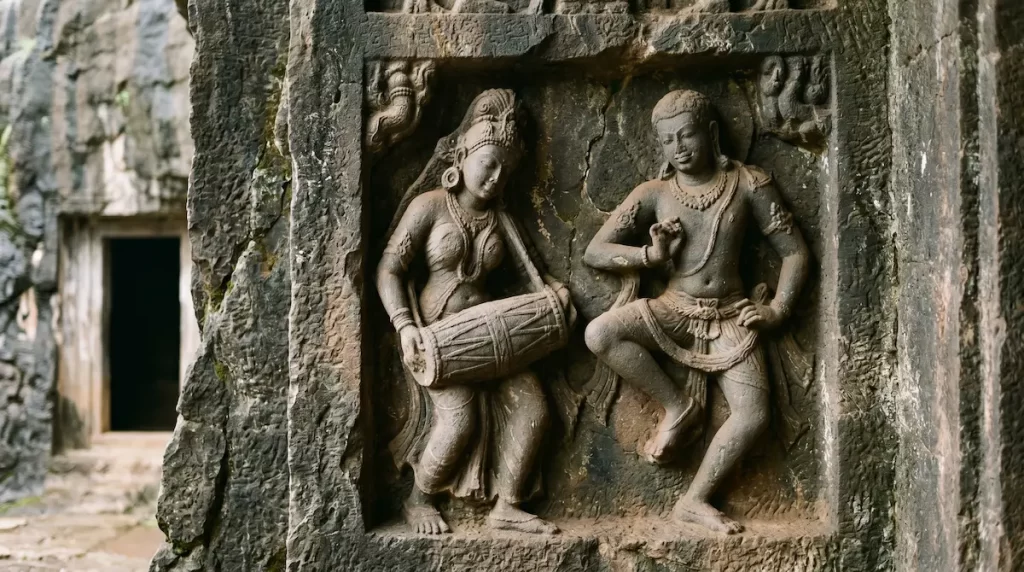
In one of the viharas near the main chaitya — sources place it in the cave numbered either 18 or 19 depending on the source, so I’d treat the exact number as secondary to the content itself — a carved relief shows a woman playing a percussion instrument widely interpreted as an early form of the tabla, alongside a dancing figure. This sculpture is frequently cited as the earliest physical evidence of the tabla’s presence in India, directly challenging older theories that the instrument was a later foreign import. In the same vihara, additional panels depict the sun god Surya driving his chariot and Indra mounted on his vehicle — mythological imagery woven into an otherwise Buddhist monastic context.
💡 Tip: If you only have time to find one specific carving at Bhaja, make it this one. I’d ask whichever local guide or caretaker is on-site to point you directly to the musician-and-dancer panel — it’s the detail that turns a quick walk-through into something you actually remember afterward.
The Rest of the Complex — Viharas, Stupas, and the Waterfall
The viharas: Most of Bhaja’s 22 excavations are viharas — monastic cells, several with a raised stone platform cut directly into the rock to serve as a sleeping surface. A number of these are arranged on two levels, with a few genuinely double-storeyed examples. Unlike the heavily decorated chaitya facade, most of these cells are plain, functional spaces — useful for understanding the working monastery this site actually was, beyond its more famous single sculptural panel.
The waterfall: Near the final cave in the sequence, a seasonal waterfall cascades down into a small pool below — active primarily during monsoon, and a genuinely pleasant, unexpected feature for a heritage site of this kind.
💡 Tip: The waterfall is worth timing your visit around if you’re coming specifically in monsoon — it’s a feature that simply doesn’t exist for the rest of the year, and it adds a sensory dimension (the sound of water, the cooler air near the pool) that the dry-season visit doesn’t have.
The Cemetery Stupas — Cave 20
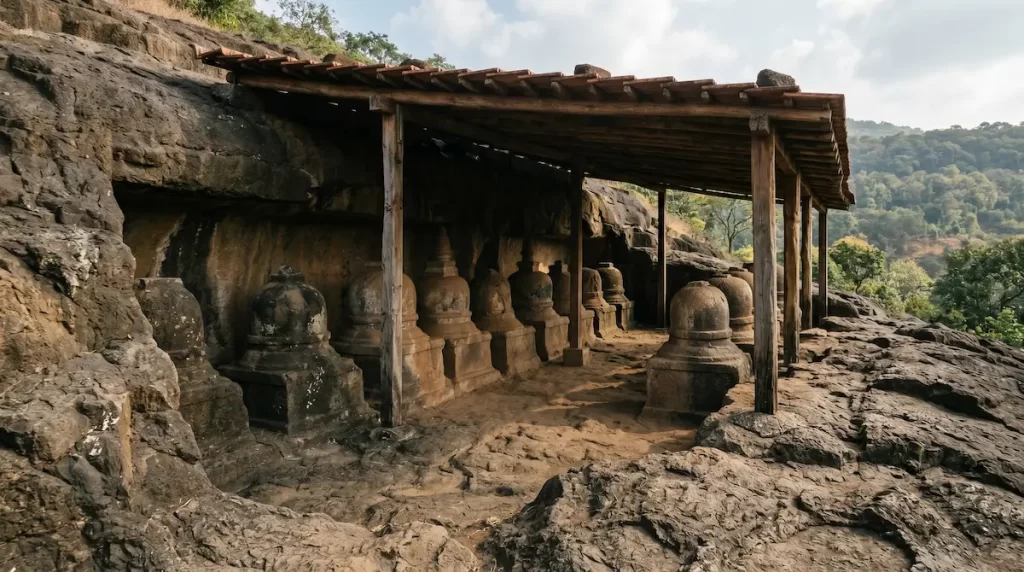
At the southern end of the complex sits a genuinely moving feature that most visitors walk straight past: a group of 14 rock-cut stupas, five sheltered inside a small excavation and nine standing exposed under open sky. These are not the large communal worship stupas you find inside the main chaitya hall — they are individual memorials, each commemorating a specific monk who lived and died at Bhaja.
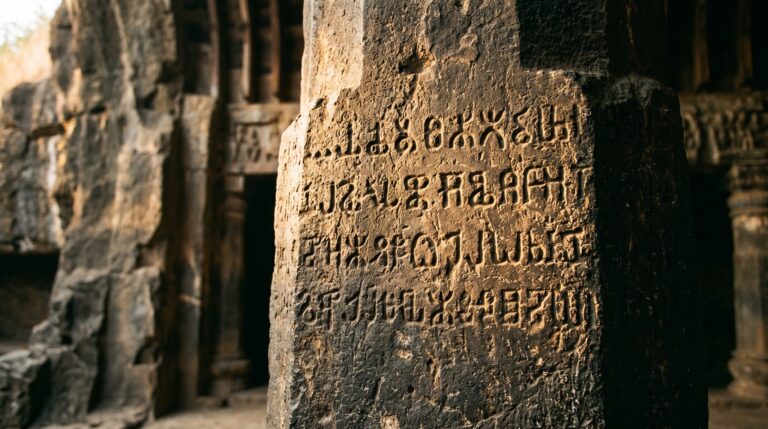
Brahmi inscriptions on several of the stupas name three of these monks directly: Ampinika, Dhammagiri, and Sanghdina, each given the title Thera. One stupa carries the inscription Stavirana Bhadanta — “the venerable reverend.” Two of the stupas include a carved relic box on their upper surface, which likely once held the physical remains of the monk being honoured. ASI has installed a protective shed above the group to shield the stupas from weathering.
I find this corner of Bhaja genuinely affecting in a way the more celebrated chaitya hall and musician panel are not — it is a 2,200-year-old cemetery with the actual names of the people buried there still legible in stone.
💡 Tip: If you have made it as far as the main chaitya and the musician panel, the extra few minutes to the southern end of the complex for the cemetery stupas is worth it. Reading the names aloud, knowing these were real individuals commemorated by their own community, is a different kind of experience from admiring carved architecture for craftsmanship alone.
Visiting Bhaja Caves — Practical Information
Timings: Generally 9:00 AM to 5:30 PM or 6:00 PM depending on the source — open daily, with no weekly closure reported. I’d confirm current hours locally given the inconsistency across sources.
Entry fee: Based on the official ASI e-ticketing portal, approximately ₹20 for Indian, SAARC, and BIMSTEC nationals, and ₹250 for other foreign nationals — noticeably lower than Karla’s fee, consistent with Bhaja’s smaller scale and lower visitor volume. Several older travel sites still list ₹5 or ₹15, which appear to be outdated figures.
The climb: A shorter, less strenuous staircase than Karla’s — most sources describe it as a “short but steady” climb, manageable for most visitors including reasonably fit seniors and children, with rest breaks.
Photography: General photography is permitted at no charge; professional videography may require separate ASI permission.
Time needed: 1.5 to 2.5 hours, including the climb.
💡 Tip: If you’re choosing between doing Karla or Bhaja first in the same day, I’d do Bhaja first while you’re fresh — it’s the shorter, easier climb, and arriving at Karla’s more demanding staircase second, once you’ve warmed up, tends to feel more manageable than the reverse order.
How to Reach Bhaja Caves
From Mumbai: Approximately 100-110 km via the Mumbai-Pune Expressway, roughly 2 to 2.5 hours by car.
From Pune: Approximately 55-60 km, roughly 1.5 hours by car.
From Lonavala: Approximately 10-12 km — a short taxi or auto ride.
From Malavli railway station: The nearest railway station, approximately 2-3 km away, served by regular Pune-Lonavala local trains. From the station, the caves are a short auto ride or a walkable distance for those comfortable with the approach on foot.
Combining with Karla Caves: Bhaja and Karla sit roughly 7 km apart via the junction near Malavli, making them the standard single-day pairing for this region — most visitors do both in one outing.
💡 Tip: Malavli station is genuinely the practical hub for this entire region — Bhaja Caves, Karla Caves, and the trailheads for both Lohagad and Visapur Forts are all accessible from this single point. If you’re arriving by train from Mumbai or Pune, this is where you get off, not Lonavala itself.
Bhaja vs Karla — Which One First, or Both?

I get asked this enough that it’s worth addressing directly. Karla has the scale — the largest chaitya hall of its period in India, a genuinely awe-inspiring single space. Bhaja has the more intimate, specific detail — the tabla panel, the cemetery stupas with names of real monks, plus a quieter, less crowded atmosphere given its lower profile relative to its more famous neighbour.
My honest take: do both, in the same day, given how close they sit to each other. If you can only choose one, Karla’s chaitya hall is the more immediately impressive single experience. But Bhaja’s musician panel and cemetery stupas are the details I find myself telling people about more often afterward — they have a kind of specific, surprising historical weight that the sheer scale of Karla’s hall doesn’t quite replicate.
💡 Tip: I’d allocate roughly equal time to both rather than treating Bhaja as a quick afterthought once you’ve already seen Karla’s more dramatic hall — the temptation to rush Bhaja after Karla’s scale is real, and it means missing the detail that actually makes Bhaja distinctive.
FAQ — Bhaja Caves Complete Guide
Q1: What is Bhaja Caves famous for?
Bhaja Caves is known for its early chaitya hall (Cave 12) with original wooden ceiling beams, a carved panel depicting a woman playing what is believed to be an early form of the tabla, and a cemetery group of 14 stupas at the southern end of the complex, several inscribed with the names of the monks they commemorate.
Q2: How far is Bhaja Caves from Karla Caves?
Bhaja and Karla Caves sit approximately 7 km apart via the junction near Malavli station, making them a natural single-day pairing. Most visitors to this region combine both in one trip.
Q3: What is the entry fee for Bhaja Caves?
Based on the official ASI e-ticketing portal, approximately ₹20 for Indian, SAARC, and BIMSTEC nationals, and ₹250 for other foreign nationals. Some older travel sites list lower, outdated figures — confirm the current rate at the gate.
Q4: What are the cemetery stupas at Bhaja Caves?
A group of 14 rock-cut stupas at the southern end of the complex (Cave 20), five inside a small excavation and nine in the open. These are individual memorials to monks who lived and died at Bhaja, with Brahmi inscriptions naming three of them — Ampinika, Dhammagiri, and Sanghdina.
Q5: Is there a waterfall at Bhaja Caves?
Yes — a seasonal waterfall near the final cave in the complex is active primarily during monsoon, cascading into a small pool below. It is not present for the rest of the year, making monsoon a particularly rewarding season for a Bhaja visit specifically.
👉 Related Posts You Might Like:
- Karla Caves – Complete Guide 2026
- Karla and Bhaja Caves – One Day Trip Guide
- Buddhist Caves Near Mumbai – Complete List
- Karla and Bhaja Caves from Mumbai – Day Trip Guide
- India’s Top 10 Rock-Cut Cave Sites – Complete Ranking