Karla Caves – Complete Guide 2026
Karla Caves sits about 11 km from Lonavala, roughly 60 km from Pune and around 100 km from Mumbai — a different part of Maharashtra entirely from the Ajanta-Ellora region I usually write about, but a site I think deserves real attention from anyone serious about India’s rock-cut Buddhist heritage. This is home to the largest and best-preserved chaitya hall — prayer hall — in the country, and it is genuinely as architecturally significant as it sounds, despite being far less visited than Ajanta or Ellora.
What Karla Caves Actually Is
Karla Caves — also known as Karli or Karle Caves — is a complex of 16 rock-cut Buddhist excavations carved into a hillside above Karli village, near Lonavala in Pune district. The earliest sections date to around the 2nd century BCE, with later additions continuing over subsequent centuries, placing the site’s full development across a similar broad window as Ajanta and Ellora — though Karla developed independently, in a different part of Maharashtra, along a different ancient trade route running from the Arabian Sea coast eastward into the Deccan plateau.
The Grand Chaitya — Cave 8:
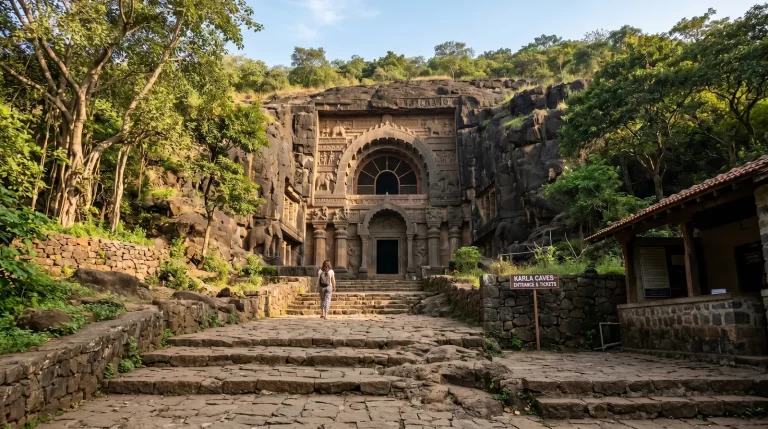
The site’s defining achievement is its main chaitya hall, widely regarded as the largest and most completely preserved chaitya hall of its period anywhere in India. The hall measures roughly 38 metres deep, 14 metres wide, and 14 metres high — proportions that make it genuinely cathedral-like in scale. A row of carved pillars lines the interior, leading to a stupa at the rear beneath a vaulted ceiling that still retains its original wooden ribbing, a rare survival given the material’s vulnerability over two millennia.
💡 Tip: Most visitors photograph the facade and move quickly through the interior. I’d resist that instinct here — walk the full length of the hall to the stupa at the back, then turn around and look at the proportions from that end. The scale of the space only really registers once you’ve stood at both ends of it.

Beyond the Chaitya Hall — The Other 15 Caves
Most visitors arrive, see the Grand Chaitya, and leave — entirely reasonable given how dominant that single structure is, but Karla’s remaining excavations deserve at least a brief mention since they tell the rest of the site’s story.
The viharas: Surrounding the main chaitya hall, smaller monastic cells — viharas — housed the monks who maintained the site and served travelers passing along the trade route below. These are simpler, undecorated spaces compared to the chaitya hall’s elaborate carving, but walking through them gives a useful sense of the working monastery this complex actually was, beyond its single famous prayer hall.
The unfinished excavations: As at several other Deccan cave sites, a handful of excavations at Karla were begun but never completed — useful, if you’re interested in the mechanics of rock-cut carving, for the same reason Ellora’s Chhota Kailasa is interesting: they show process rather than only finished result.
💡 Tip: I wouldn’t budget more than 15-20 minutes for the smaller caves beyond the Grand Chaitya — they’re worth a walk-through for context, but the chaitya hall and the facade sculpture are genuinely where Karla’s significance concentrates.
The Sculpture — What to Look For
The entrance pillars and lion capitals:
Outside the chaitya hall, large freestanding pillars once stood at the entrance — sculpted with lion capitals, in a style that echoes the Ashokan pillar tradition. Only one of the original pair survives intact today.
The donor couples:
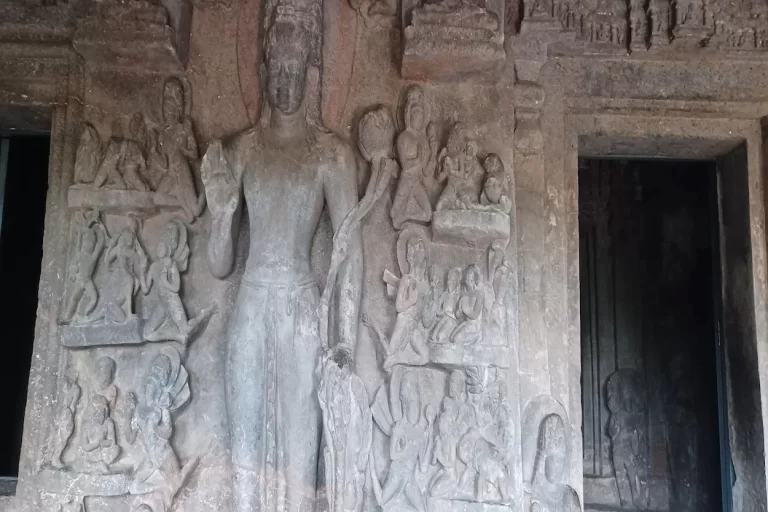
On the facade and inside the entrance porch, carved relief panels show pairs of donor figures — men and women shown together, richly ornamented, often interpreted as the wealthy merchants and patrons whose donations funded the excavation. Their presence on the monument itself is a direct physical record of who financed Buddhist monastic architecture in this period.
Elephant and animal carvings:
The base of several pillars and sections of the facade carry carved elephants, along with other animal figures — work that several sources describe as exceptionally fine for the period, comparable to the best Satavahana-era stone carving anywhere in the Deccan.
Brahmi inscriptions:
Pillars throughout the complex carry inscriptions in Brahmi script and Prakrit language, recording the names of donors — individuals from as far away as Sopara on the Konkan coast — giving a genuine sense of how widely this site’s patronage network extended.
💡 Tip: The donor couple panels are easy to walk past quickly, but they’re one of the more historically interesting details at Karla — direct evidence of who paid for what you’re standing inside, carved into the monument itself rather than reconstructed from separate records.
The Ekvira Devi Temple
A working Hindu temple dedicated to the goddess Ekvira Devi sits within the cave complex, near the chaitya hall — a later addition that has made Karla a living pilgrimage site as well as a heritage monument. Ekvira is particularly revered by the Koli fishing community of the Mumbai coast, and the temple draws a steady stream of devotees independent of the heritage tourist traffic.
This is, structurally, a similar situation to Grishneshwar Temple sitting beside the Ellora Caves — an active religious site layered onto or beside an ancient Buddhist monument, creating the same kind of living-and-historical continuity I find genuinely adds something to a heritage visit.
💡 Tip: If you visit on a day with active temple activity, expect a livelier, more crowded atmosphere near the entrance than the quiet, contemplative interior of the chaitya hall itself suggests. The two parts of the same site can feel like genuinely different experiences depending on timing.
Best Time of Day and Season to Visit
Time of day: Several local accounts specifically recommend visiting in the afternoon rather than morning — the sun falls more directly onto the chaitya hall facade later in the day, bringing out the carved detail more clearly than the flatter early-morning light. This is the opposite of my usual advice for Ajanta or Ellora, where early morning is almost always better, and it’s worth knowing before you plan your day.
Season:
| Season | Conditions | Notes |
|---|---|---|
| October–February | Cool, dry, clearest visibility | The most comfortable season for the climb |
| March–June | Hot, especially on the exposed staircase | Start early if visiting in summer |
| July–September | Lush, with seasonal waterfalls in the surrounding hills | The single most popular season locally — the Sahyadri hills around Karla turn vivid green, and nearby trekking routes (Visapur, Lohagad) become genuinely spectacular, though the stone steps get slippery |
💡 Tip: Monsoon is, by a clear margin, the season most local visitors specifically choose for this region — not despite the rain but because of it. If you can handle wet stone steps with proper footwear, July through September shows you a version of the Sahyadri hills around Karla that the dry season simply doesn’t offer.
Visiting Karla Caves — Practical Information
Timings: Generally 9:00 AM to 5:00 PM, open daily with no weekly closure reported — though I’d confirm current hours locally given some seasonal variation noted across sources.
Entry fee: Indian nationals approximately ₹25, foreign nationals approximately ₹300 — these figures align with standard current ASI pricing, though as flagged above, older listings online still show outdated lower amounts. Children under 15 typically free. Confirm current rate at the gate.
The climb: A flight of stairs — variously reported between roughly 150 and 350 steps depending on where you start counting from — leads up to the cave complex from the parking area. This is a genuine, sustained climb, not a casual stroll.
Photography: General still photography is permitted. Tripod use requires prior ASI permission — worth arranging in advance if serious photography is your purpose for visiting.
Time needed: 2 to 3.5 hours, including the climb, depending on how much time you spend with the carvings and inscriptions versus simply viewing the chaitya hall.
💡 Tip: The climb up is genuinely the main physical demand of a Karla visit — more strenuous than Ajanta or Ellora’s flat pathways, closer in character to the Daulatabad Fort ascent I describe in my Aurangabad guides. Closed shoes with grip, and a water bottle, are not optional here.
How to Reach Karla Caves
From Mumbai: Approximately 100 km via the Mumbai-Pune Expressway or the older Mumbai-Pune highway, roughly 2 to 2.5 hours by car depending on traffic — this stretch carries notoriously heavy weekend traffic, so a weekday visit is meaningfully easier.
From Pune: Approximately 60 km, roughly 1.5 hours by car via the same expressway corridor.
From Lonavala: The nearest railway station, approximately 11 km away — trains run regularly from both Mumbai and Pune to Lonavala. From the station, local buses, shared autos, or a taxi cover the final stretch to the caves.
Combining with Bhaja Caves: Karla and Bhaja sit roughly 7 km apart via the junction near Malavli, making them a natural single-day pairing rather than two separate trips.
💡 Tip: If you’re coming from Mumbai or Pune specifically for the caves rather than as part of a broader Lonavala holiday, I’d genuinely recommend treating this as a half-day dedicated trip rather than squeezing it in alongside Lonavala’s more conventional tourist stops (waterfalls, viewpoints) — the climb and the site itself deserve unhurried attention, the same philosophy I apply to every heritage site I write about.
Combining Karla With Lohagad Fort, Visapur Fort, and Pawna Lake
This region around Malavli rewards a longer day than just the caves, and several attractions sit close enough together to combine sensibly.
Lohagad Fort: Approximately 10-13 km from Karla, accessible via Malavli station, with the trek itself taking 3-4 hours round trip. The fort’s “scorpion tail” ridge approach (Vinchu Kada) is its signature feature, and the summit offers views back over Karla, Bhaja, and Pawna Lake.
Visapur Fort: A short distance from Lohagad via a connecting trail, larger and more strenuous than its twin, with multiple trek routes of varying difficulty starting from Bhaja village or Malavli station.
Pawna Lake: Roughly 20 km from Lohagad, a scenic reservoir popular for lakeside camping and a relaxed counterpoint after a heritage- or trek-heavy day.
💡 Tip: Trying to combine Karla, Bhaja, and a fort trek in a single day is genuinely ambitious — I’d treat this as a two-day regional visit if forts are part of your plan: one day for the caves at an unhurried pace, a second day for Lohagad or Visapur if you have the legs and the time for it.
Karla in the Wider Story of Indian Rock-Cut Architecture
I think about Karla as occupying a genuinely important place in the broader history that Ajanta and Ellora are usually credited with — it is one of the clearest, best-preserved examples of how the chaitya hall form developed during the Hinayana phase of Buddhist architecture, before the later Mahayana painting tradition at Ajanta or the monumental Hindu ambitions at Ellora’s Kailasa Temple. Several sources describe Karla’s main hall as architecturally comparable in quality and ambition to anything at Ajanta or Ellora — simply less famous because it sits in a different part of Maharashtra, closer to Mumbai and Pune’s day-trip radius than to the established Ajanta-Ellora heritage circuit.
💡 Tip: If you’ve already spent time at Ajanta and Ellora and want to understand the fuller picture of Buddhist rock-cut architecture across Maharashtra, Karla is a genuinely worthwhile addition — not a substitute, but a different chapter of the same story, carved in a different region under different patrons.
FAQ — Karla Caves Complete Guide
Q1: What is Karla Caves famous for?
Karla Caves is famous for housing the largest and best-preserved chaitya hall — Buddhist prayer hall — in India, carved into a hillside near Lonavala, Maharashtra. The hall’s scale, intact wooden ceiling ribbing, and fine sculptural detail make it one of the most significant Hinayana-period Buddhist monuments in the country.
Q2: How far is Karla Caves from Mumbai and Pune?
Karla Caves is approximately 100 km from Mumbai (roughly 2 to 2.5 hours by car) and approximately 60 km from Pune (roughly 1.5 hours), both via the Mumbai-Pune Expressway corridor. The nearest railway station is Lonavala, about 11 km away.
Q3: What is the entry fee for Karla Caves?
Current sources indicate approximately ₹25 for Indian nationals and ₹300 for foreign nationals, consistent with standard ASI pricing at comparable sites, though listings online vary considerably — confirm the exact current rate locally or via the official ASI booking portal before traveling.
Q4: Can Karla and Bhaja Caves be visited in one day?
Yes — Karla and Bhaja Caves sit approximately 7 km apart near Malavli junction, making them a natural single-day pairing. Most visitors combine both, along with a visit to the Ekvira Devi temple at Karla. Adding Lohagad or Visapur Fort to the same day is possible but ambitious — a second day works better if forts are part of your plan.
Q5: How difficult is the climb to Karla Caves?
The climb involves a sustained flight of stairs from the parking area to the cave complex — reported as anywhere from roughly 150 to 350 steps depending on starting point. This is a genuine physical climb requiring closed, grippy footwear, more demanding than the flat pathways at Ajanta or Ellora.
👉 Related Posts You Might Like:
- Bhaja Caves – Complete Guide 2026
- Karla and Bhaja Caves – One Day Trip Guide
- Buddhist Caves Near Mumbai – Complete List
- Best Caves Inside Ajanta – Cave 1, 2, 16, 17 and 26 Explained
- India’s Top 10 Rock-Cut Cave Sites – Complete Ranking