Aurangabad Caves – Complete Guide 2026
Aurangabad Caves sits on a hillside just 5 km from the city center, and in all my years guiding people through this region, it remains the site I most consistently have to convince visitors to add to their itinerary. After Ajanta and Ellora, people assume there is nothing left to see in the cave department. I understand the instinct — but it is wrong, and this guide is my honest case for why.
What Aurangabad Caves Actually Is
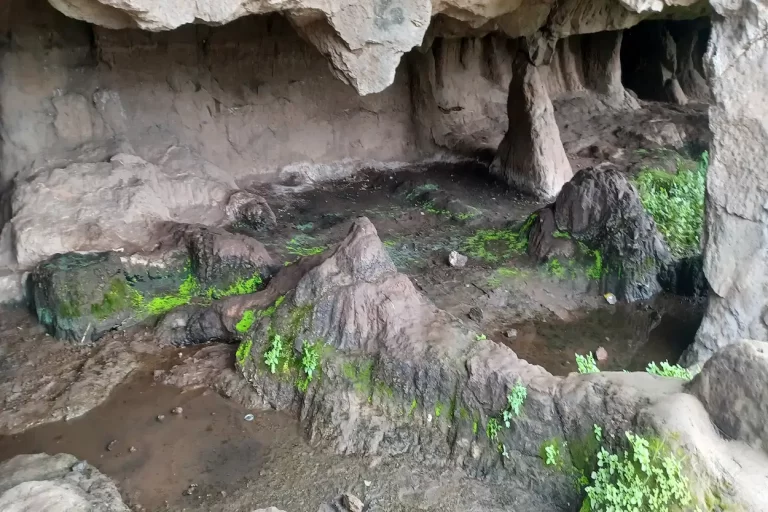
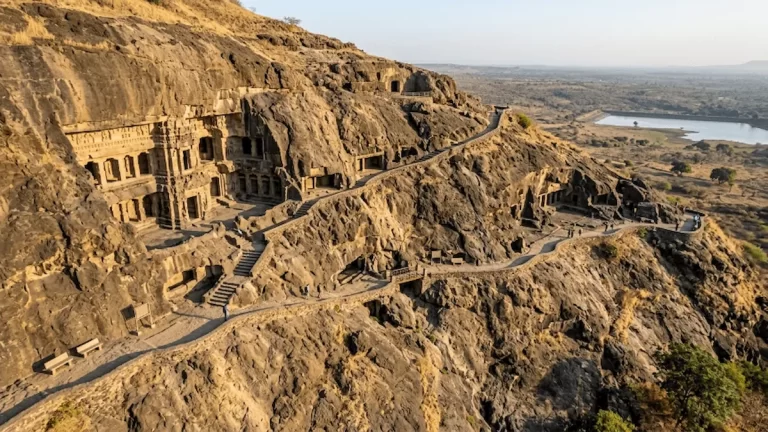
Aurangabad Caves is a complex of 12 rock-cut Buddhist caves, carved in two geographically separate groups on a hillside on the city’s northern edge, dating from approximately the 2nd to 6th century CE. The caves are divided into a Western Group (Caves 1-5) and an Eastern Group (Caves 6-9, plus a few additional smaller excavations), separated by a short walk along the hillside.
Why these caves exist where they do:
The site’s location, overlooking the ancient trade routes through the region, placed it on the same broad Buddhist monastic network that produced Ajanta and Ellora — sharing artistic and architectural influences with both, while remaining distinctly its own smaller-scale achievement.
The honest scale comparison:
I will not pretend Aurangabad Caves competes with Ajanta or Ellora in scale or fame — it does not, and treating it as equivalent does visitors a disservice. What it offers instead is genuine artistic and historical significance at an intimate scale, viewed in near-total solitude, a combination that has become increasingly rare at India’s more famous heritage sites.
💡 Tip: I tell first-time visitors to think of Aurangabad Caves as the site that rewards people who have already fallen in love with Ajanta and Ellora and want to understand the fuller picture of Buddhist cave architecture in this region — not as a replacement for either, but as a meaningful addition to the story.
📍 Aurangabad Caves on Google Maps
The Western Group — Caves 1 to 5
The Western Group is generally considered the more significant of the two clusters, anchored by Cave 3, which carries the finest sculpture at the site.
Cave 3:
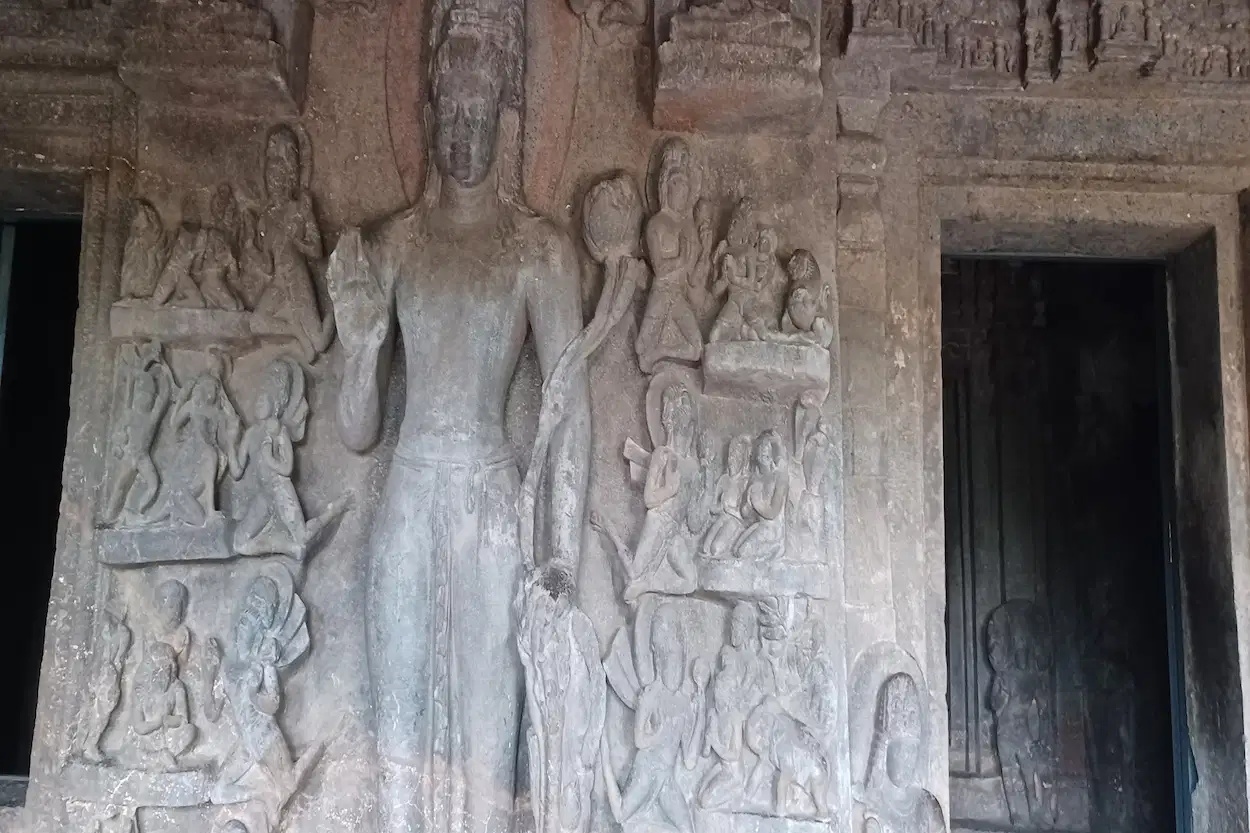
The standout cave at Aurangabad. A pillared vihara with an elaborately carved facade featuring Bodhisattva figures and celestial beings in a style that art historians often describe as bridging the Ajanta and Ellora periods — later than Ajanta’s primary painting phase, earlier than Ellora’s most developed sculptural ambitions. The interior shrine carries a seated Buddha flanked by attendant figures, executed with a level of craftsmanship that, in my opinion, deserves far more visitor attention than it receives.
Caves 1, 2, 4, and 5:
Simpler viharas in various states of completion and preservation, offering historical and architectural context for Cave 3’s more developed achievement, but not individually essential viewing if your time is limited.
💡 Tip: If you only have thirty minutes at Aurangabad Caves, spend all of it at Cave 3. It is, without question, the reason to visit this site, and I would rather a visitor spend real time there than rush through all five caves in the Western Group superficially.
The Eastern Group — Caves 6 to 9
The Eastern Group, a short walk from the Western Group along the hillside, contains the single most famous individual sculpture at Aurangabad Caves — and it is not the one most generic guides lead with.
Cave 7:
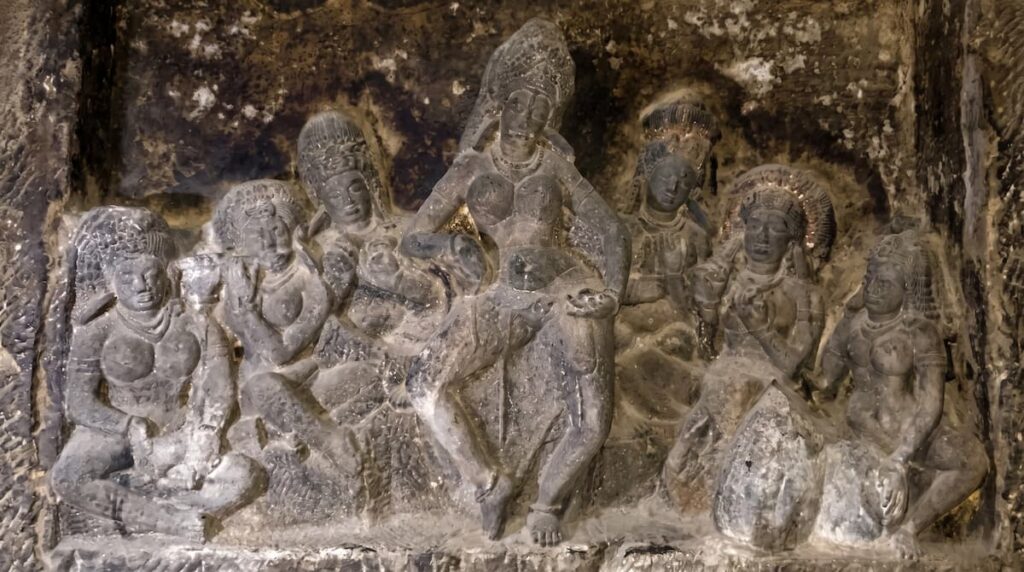
This is, for me, the real reason to make the walk to the Eastern Group. Cave 7 holds two genuinely significant sculptural panels. The Tantric goddess Tara sits beside the main sanctum — considered one of the earliest representations of Tantric Buddhist imagery anywhere in India. But the panel I always bring visitors to first is the world-famous Dancing Panel: a female dancer in central position, surrounded by six female musicians playing instruments including a dholak and flute. It is widely regarded as one of the most important architectural records of ancient Indian classical dance — a Bharatanatyam-style composition frozen in stone, with a sense of rhythm and movement that is genuinely rare to find this well preserved.
Caves 6, 8, and 9:
Less individually significant, but contributing to the overall picture of the site’s development across its two phases of excavation.
💡 Tip: Stand directly in front of the Dancing Panel and let your eye follow the dancer’s posture out to each musician in turn — the composition was clearly carved with a specific rhythm in mind, and most visitors who only glance at it miss the choreography embedded in the stone.
Visiting Aurangabad Caves — Practical Information
Timings:
Open daily, Monday to Sunday, 6:00 AM to 6:00 PM. Unlike Ajanta and Ellora, Aurangabad Caves does not have a weekly closure day — it is open all seven days.
Entry Fee (2026, fully digital — cash counters closed):
- Indian nationals, SAARC, and BIMSTEC citizens (online/QR code): ₹25
- Foreign nationals (online/QR code): ₹300
- Payment is via QR code scan or online booking — cash is not accepted at the gate
Time needed:
1.5 to 2 hours for a proper visit covering both groups, including the walk between them.
Crowds:
This is, honestly, the site’s biggest draw for me personally. I have visited Aurangabad Caves dozens of times and rarely encounter more than a handful of other visitors, even compared to a quiet day at Ellora. If you want the experience of standing alone in front of genuinely significant 1,500-year-old sculpture, this is where I send people.
Getting there:
5 km from the city center — a short auto-rickshaw or taxi ride. The scenic road leading up to the caves cuts directly through the campus of Dr. Babasaheb Ambedkar Marathwada University (BAMU), which adds a pleasant academic calm to the approach drive. Out-of-town drivers occasionally get confused when Google Maps routes them toward the university’s main gate rather than the caves directly — if your driver seems unsure, mention BAMU campus as a landmark.
⚠️ Local warning for solo travelers: While getting an auto-rickshaw or taxi up to the caves from the city is easy, the site sits on an isolated hillside with no regular passing traffic — finding a return ride from the top is genuinely difficult, and app-based cabs rarely accept pickups from there quickly. Always book your auto or taxi as a round trip and ask the driver to wait, or agree to waiting charges in advance. Do not assume you will simply find a ride back.
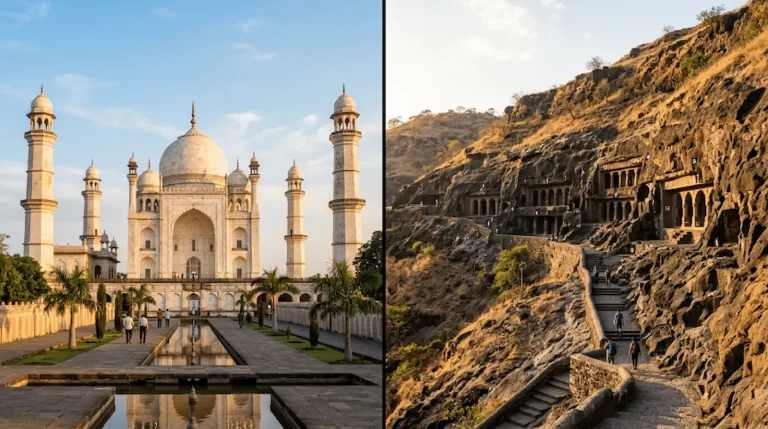
💡 Tip: I usually recommend Aurangabad Caves as a morning add-on alongside Bibi ka Maqbara, given both sites’ proximity to the city center and to each other. Together they make a genuinely satisfying half-day that most multi-day Ajanta-Ellora itineraries have room for — and with a pre-arranged round-trip car, the isolated-hillside return issue simply does not come up.
📍 Aurangabad Caves on Google Maps
How Aurangabad Caves Fits Into the Bigger Picture
I think about Aurangabad Caves as the connective tissue between Ajanta and Ellora — chronologically and artistically.
Ajanta represents the high point of Buddhist painting in the region, primarily 5th century CE. Ellora’s Buddhist section represents Buddhist architecture’s later, more monumental ambitions, extending into the 8th century CE. Aurangabad Caves, dating across a similar broad window but with its own distinct character, shows the same broad artistic tradition expressing itself at a different scale, in a different specific location, with its own particular highlights — Cave 3’s facade, Cave 7’s Tara sculpture and Dancing Panel — that exist nowhere else.
Understanding all three sites together gives you a genuinely more complete picture of Buddhist rock-cut art in this region than seeing only the two famous UNESCO sites.
💡 Tip: If you have the time, I would visit Aurangabad Caves after Ajanta and Ellora rather than before — the comparison lands more meaningfully once you have the two larger sites as reference points already in mind.
The Alternative — Aurangabad Caves Without the Skip
Most travelers I meet did not even know Aurangabad Caves existed until someone mentioned it to them directly — it simply does not appear on the generic Ajanta-Ellora itinerary templates that circulate online. I always make a point of bringing this site up specifically, because I genuinely believe most visitors who skip it are missing something worthwhile — the Dancing Panel alone is reason enough.
A guided city heritage day means Aurangabad Caves gets folded in naturally alongside Bibi ka Maqbara, with transport arranged as a proper round trip so the isolated-hillside return is never a concern.
👉 See Aurangabad Heritage Tour Details & Book — Aurangabad Caves, Bibi ka Maqbara, and the city’s central heritage sites in one well-paced day.
FAQ — Aurangabad Caves Complete Guide
What are the Aurangabad Caves and what are the timings?
Aurangabad Caves is a complex of 12 rock-cut Buddhist caves, carved in two groups — Western (Caves 1-5) and Eastern (Caves 6-9) — on a hillside 5 km from Chhatrapati Sambhajinagar (Aurangabad) city center, dating from approximately the 2nd to 6th century CE. The site is open daily, all seven days, from 9:00 AM to 5:00 PM, with no weekly closure.
Is Aurangabad Caves worth visiting after Ajanta and Ellora?
Yes — while smaller in scale than either UNESCO site, Aurangabad Caves offers genuine artistic and historical significance, particularly Cave 3’s facade sculpture and Cave 7’s Tara figure and famous Dancing Panel, viewed in near-total solitude given how few visitors know about the site.
How far is Aurangabad Caves from the city center, and is transport easy?
Aurangabad Caves is approximately 5 km from Chhatrapati Sambhajinagar (Aurangabad) city center — a short auto-rickshaw or taxi ride there. However, the site is on an isolated hillside with no regular passing traffic, so finding a return ride is difficult. Always book a round-trip auto or taxi and have the driver wait rather than assuming you can find transport back.
What is the famous sculpture at Aurangabad Caves?
Cave 7 in the Eastern Group holds two major sculptures: a Tara figure beside the main sanctum, among the earliest Tantric Buddhist imagery in India, and the celebrated Dancing Panel — a female dancer surrounded by six female musicians playing ancient instruments, considered one of the most important architectural records of ancient Indian classical dance.
What is the entry fee for Aurangabad Caves?
As of 2026, entry is ₹25 for Indian nationals, SAARC, and BIMSTEC citizens, and ₹300 for foreign nationals, paid via QR code or online booking — cash is not accepted at the gate.
👉 Related Posts You Might Like:
- Bibi ka Maqbara – Complete Visitor Guide
- Best Caves Inside Ajanta – Cave 1, 2, 16, 17 and 26 Explained
- Ellora Caves Buddhist Section – Complete Guide to Caves 1–12
- How Many Days in Aurangabad – 1, 2 or 3?
- Aurangabad Travel Tips – What No One Tells You