Best Caves Inside Ajanta – Cave 1, 2, 16, 17 & 26 Explained (Local Guide)
Ajanta has 30 caves. The best caves inside Ajanta are not evenly distributed — five of them contain the paintings and sculptures that make this a UNESCO World Heritage Site of genuine global significance. The remaining 25 range from historically important to largely structural. This guide tells you exactly which caves deserve your full attention, what to look for inside each one, and why most visitors walk past the most important details without seeing them.
How to Read Ajanta Caves Before You Enter
Before the cave-by-cave breakdown, one essential piece of context.
Ajanta was carved in two distinct phases separated by centuries. The earliest caves — Caves 9, 10, 12, 13, and 15A — date to the 2nd century BCE and belong to the Hinayana (Theravada) Buddhist tradition. These are simpler in form: chaitya halls (prayer halls with a stupa at the end) and viharas (monk residences). The paintings in these early caves are minimal.
The later caves — most of what visitors remember from Ajanta — date to the 5th century CE and belong to the Mahayana Buddhist tradition. These are the painted caves. The Bodhisattva figures, the Jataka tales, the celestial scenes — all of this is Mahayana, all carved and painted within roughly 100 years during the Vakataka dynasty.
Knowing which phase a cave belongs to changes what you look for inside it.
💡 Tip: When your guide mentions a cave is “Hinayana” or “Mahayana,” this is not academic terminology — it tells you exactly what you will and will not find inside. Hinayana caves have no Bodhisattva paintings. Mahayana caves do. This is the single most useful piece of context for reading Ajanta.
Cave 1 — The Finest Paintings at Ajanta
Cave 1 is a Mahayana vihara dating to the 5th century CE. It is the cave most visitors are directed to first — and correctly so. The paintings here are the finest surviving examples of ancient Indian art anywhere in the world.
What to look for:
The Bodhisattva Padmapani — on the left wall of the antechamber as you enter. A Bodhisattva is an enlightened being who delays his own nirvana to guide others toward liberation. Padmapani — the lotus-bearer — is shown with a jeweled crown, a lotus flower held in one hand, and an expression of profound compassion that has been studied by art historians for over a century. The painting is approximately 1,500 years old. The pigments are mineral — lapis lazuli, cinnabar, kaolin — and in the fiber-optic light they retain a depth and richness that is genuinely startling.
The Bodhisattva Vajrapani — on the right wall, balancing Padmapani. Darker in complexion, more powerful in bearing, holding a thunderbolt. The two figures frame the entrance to the inner shrine and are among the most reproduced images in Indian art history.
The ceiling paintings — look up. The ceiling of Cave 1 carries an elaborate program of floral, animal, and narrative designs that is among the most complete ceiling paintings at Ajanta. Most visitors never look up.
The Mahajanaka Jataka — on the rear wall of the main hall. One of the most complete Jataka narrative paintings at Ajanta — the story of a king who renounces his kingdom. Your guide will identify the individual panels.
💡 Tip: Stand at the entrance of Cave 1 for two full minutes before moving. Let your eyes adjust fully to the fiber-optic light. The paintings do not announce themselves — they reveal themselves slowly to eyes that have adjusted. Visitors who walk straight in from bright daylight and immediately move through miss the most important details.

Cave 2 — The Ceiling Most Visitors Miss
Cave 2 is immediately adjacent to Cave 1 and is its equal in painting quality — but receives a fraction of the attention because most visitors arrive at Cave 2 already mentally satisfied from Cave 1 and move through it too quickly.
What to look for:
The ceiling — this is why Cave 2 exists in any serious Ajanta itinerary. The ceiling carries a complete mandala-like program of geometric, floral, and figural designs that is the most elaborate ceiling painting at Ajanta. Octagonal and square panels filled with lotuses, geese, elephants, and celestial figures — all painted in mineral pigments that retain their depth after 1,500 years. Stand in the center of the hall and look directly up.
The Jataka paintings on the walls — Cave 2 carries multiple Jataka narratives including the Vidhura Pandita Jataka and the Hamsa Jataka (the story of the golden goose). Your guide will identify which panels correspond to which story.
The shrine figure — the inner sanctum of Cave 2 contains a seated Buddha in the dharmachakra mudra (the gesture of teaching). The figure is serene and well-preserved.
💡 Tip: After Cave 1, most visitors feel they have already seen Ajanta’s best. Cave 2 is where the ceiling proves them wrong. Specifically ask your guide to spend time on the ceiling program in Cave 2 — it is the one element most guides move past too quickly.
Cave 10 — The Oldest Cave at Ajanta
Cave 10 is not one of the five essential caves for painting — but it deserves a specific mention because it is the oldest cave at Ajanta, dating to the 2nd century BCE. It is a Hinayana chaitya hall — a prayer hall — and its age alone makes it significant.
What to look for:
The timber-effect ceiling ribbing — the stone ceiling of Cave 10 is carved to replicate the appearance of a wooden barrel-vaulted ceiling, including simulated wooden ribs. This is a direct record of the wooden architecture that preceded the rock-cut caves — the craftsmen carved stone to look like wood because that was the building tradition they knew. It is one of the most quietly extraordinary technical achievements at Ajanta.
The stupa at the end of the hall — all Hinayana chaitya halls end in a stupa. The one in Cave 10 is one of the earliest surviving examples in Maharashtra.
💡 Tip: Cave 10 is often walked through quickly because it lacks the figural paintings of the later Mahayana caves. Ask your guide to explain the timber-effect ceiling before you move through — once you understand what you are looking at, it becomes one of the most interesting structural moments at Ajanta.
Cave 16 — The Dying Princess
Cave 16 is a Mahayana vihara and contains one of the most emotionally powerful paintings in all of Indian art.
What to look for:
The Dying Princess — on the left wall as you enter, in the section depicting the conversion of Nanda (the Buddha’s half-brother) to the monastic life. The painting shows Nanda’s wife — Sundari — collapsing upon learning that her husband is leaving for the monastery. The expression on her face, and the expressions of the attendants around her, achieve a level of emotional specificity that rivals anything produced in the European Renaissance a thousand years later.
This is not an exaggeration made for tourism purposes. Art historians who have studied Ajanta for decades single out the Dying Princess as one of the great paintings of world art.
The interior light — Cave 16 has notably low interior light even by Ajanta standards. Give your eyes a full two minutes to adjust after entering — longer than any other cave. The Dying Princess does not reveal itself to eyes that have not adjusted. Flash photography is strictly prohibited. Patience with the lighting is not optional here.
💡 Tip: When you find the Dying Princess panel, stop moving. Do not photograph immediately. Stand in front of it for at least three minutes. The emotional content of the painting — the specific grief on Sundari’s face — reveals itself only to viewers who give it time. This is a painting that rewards stillness in a way that almost nothing else at Ajanta does.
Cave 17 — The Complete Narrative
Cave 17 is the largest painted vihara at Ajanta and contains the most complete narrative painting cycle of any cave at the site. If Cave 1 has the finest individual paintings, Cave 17 has the fullest story.
What to look for:
The Visvantara Jataka — covering much of one wall, this is the story of Prince Visvantara, who gives away everything he possesses — his kingdom, his elephants, his children, his wife — as acts of generosity leading to his eventual enlightenment as the Buddha. The narrative sequence runs across multiple panels and is the longest single Jataka story depicted at Ajanta.
The flying apsaras on the ceiling — celestial beings in flight, painted with a freedom of line and sense of movement that is extraordinary. The apsaras of Cave 17 are among the most reproduced images from Ajanta outside of the Bodhisattva figures in Cave 1.
The donor portraits near the entrance — portraits of the patrons who funded the cave’s construction, depicted in contemporary 5th-century CE court dress. These are among the few secular portraits in the Ajanta painting program and provide a direct window into what Vakataka-era aristocracy looked like.
💡 Tip: Cave 17 is where your guide’s explanation pays off most completely. Ask them specifically to walk you through the Visvantara Jataka sequence panel by panel before you examine individual paintings. Understanding the story first changes everything about what you see on the wall.
.jpg)
Cave 26 — The Great Parinirvana
Cave 26 is a Mahayana chaitya hall — a prayer hall, not a vihara — and it contains the defining sculptural image of Ajanta: the Great Parinirvana Buddha.
What to look for:
The Parinirvana sculpture — the reclining Buddha at the moment of his final passing into nirvana. The figure is approximately 7 meters long, carved directly from the living rock of the cave. What makes this sculpture extraordinary is not just its scale but its expression — the Buddha’s face carries a specific quality of peace that is unlike any other representation of this subject in Indian art. The mourning figures carved in relief along the base of the platform — both human and divine — surround him in grief that contrasts completely with his expression.
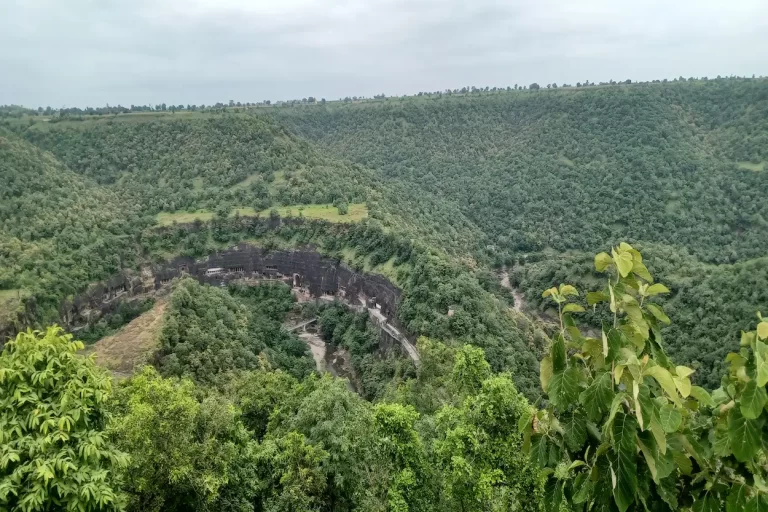
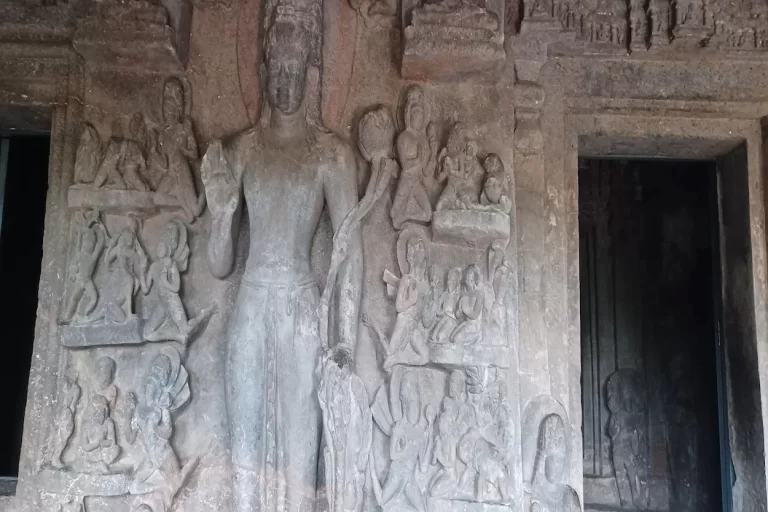
The chaitya arch and facade — Cave 26 has the most elaborate carved facade of any cave at Ajanta. The horseshoe-shaped chaitya arch above the entrance, the decorative pilasters, the narrative reliefs around the doorway — this is the exterior most often photographed at Ajanta after the cliff-face panorama itself.
The stupa inside — at the far end of the chaitya hall, the decorated stupa with a standing Buddha figure carved into its drum is one of the finest examples of Vakataka-period sculpture at the site.
💡 Tip: End your Ajanta visit at Cave 26. It is not just the last major cave — the Parinirvana Buddha is the correct final image to carry out of Ajanta. The Buddha at the moment of his passing, entirely at peace, is the conclusion the painting program of the entire site has been building toward.
The Complete Cave Priority List
For visitors with limited time, this is the order of priority:
| Priority | Cave | What It Contains | Time to Spend |
|---|---|---|---|
| Essential | Cave 1 | Bodhisattva Padmapani, finest paintings | 25–30 min |
| Essential | Cave 2 | Mandala ceiling, Jataka narratives | 20–25 min |
| Essential | Cave 16 | Dying Princess, emotional masterwork | 20 min |
| Essential | Cave 17 | Visvantara Jataka, complete narrative cycle | 25–30 min |
| Essential | Cave 26 | Parinirvana Buddha, chaitya hall | 20 min |
| Worthwhile | Cave 10 | Oldest cave, timber-effect ceiling | 10–15 min |
| Worthwhile | Cave 19 | Elaborate chaitya facade, fine sculpture | 10–15 min |
| Worthwhile | Cave 4 | Largest vihara at Ajanta | 10 min |
| Structural | Caves 3–9 | Early Hinayana phase, historical context | 5 min each |
| Structural | Caves 11–15 | Transitional phase viharas | 5 min each |
The Alternative — Seeing Ajanta Properly With a Guide
Reading about the Bodhisattva Padmapani and standing in front of it in Cave 1 while someone who has explained it a thousand times points to exactly the details that matter — these are two different experiences.
A private guided tour means arriving at Cave 1 at 9:00 AM before the groups, having the narrative explained in full before you enter each cave, and finishing at Cave 26 with a complete picture of what Ajanta actually is. No guide negotiation at the booth on arrival. No uncertainty about whether your guide actually knows the Visvantara Jataka or is reading from a pamphlet.
👉 See Ajanta Private Day Tour Details & Book — all 30 caves, early morning start, everything sorted before you arrive.
FAQ — Best Caves Inside Ajanta
Q.1 : Which are the best caves inside Ajanta to visit?
The best caves inside Ajanta are Caves 1, 2, 16, 17, and 26. Cave 1 has the finest paintings including the Bodhisattva Padmapani. Cave 2 has the most elaborate ceiling. Cave 16 has the Dying Princess. Cave 17 has the most complete narrative painting cycle. Cave 26 has the Great Parinirvana reclining Buddha sculpture. These five caves contain the core of what makes Ajanta a UNESCO World Heritage Site of global significance.
Q.2 : How long should I spend in each cave at Ajanta?
The five essential caves — 1, 2, 16, 17, and 26 — each deserve 20–30 minutes of focused attention with a guide. Cave 16 requires additional patience for eye adjustment to the low interior light. The remaining 25 caves range from 5–15 minutes each depending on your interest in the structural and historical context.
Q.3 : Can I understand the Ajanta paintings without a guide?
The paintings are visible without a guide — but the content is not. The Jataka narratives, Bodhisattva iconography, and narrative sequences across cave walls require explanation to be legible. Most visitors without a guide see beautiful shapes and colors in the fiber-optic light. Visitors with a licensed guide understand what they are standing inside. The difference is significant.
Q.4 : What is the Dying Princess painting in Ajanta Cave 16?
The Dying Princess is a painting in Cave 16 depicting Sundari — wife of Nanda, the Buddha’s half-brother — collapsing upon learning that her husband is leaving for the monastery. It is considered one of the great paintings of world art for the emotional specificity of the faces — both Sundari’s grief and the distress of her attendants. Cave 16 has very low interior light; allow your eyes two full minutes to adjust before examining the painting.
Q.5 : What is special about Ajanta Cave 26?
Cave 26 contains the Great Parinirvana Buddha — a 7-meter reclining sculpture carved directly from the living rock, depicting the Buddha at the moment of his final passing into nirvana. The expression of absolute peace on the Buddha’s face, contrasted with the grief of the mourning figures carved around the base, makes this one of the most powerful sculptures in Indian art. Cave 26 also has the most elaborate carved facade of any cave at Ajanta.
👉 Related Posts You Might Like:
- Ajanta Caves Photography Guide – Capture Timeless Art Like a Pro
- Ajanta Caves for Solo Travelers – Complete Honest Guide
- How Many Days for Ajanta Caves – 1 Day or 2?
- Ajanta Caves at Sunrise – Early Morning Entry Guide
- Ajanta vs Ellora – Which Caves Should You Visit First?