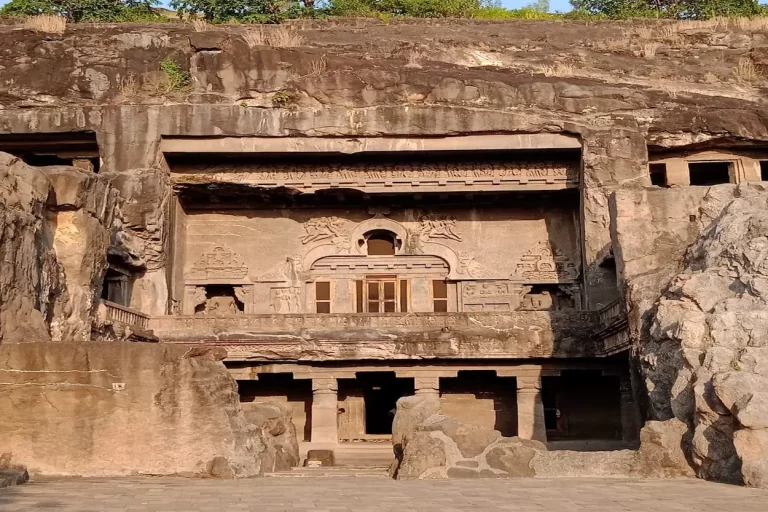
Ellora Caves Jain Section – Complete Guide to Caves 30–34 (2026)
The Ellora Caves Jain section — Caves 30 through 34 — is the part of Ellora that the largest number of visitors never reach. It sits roughly 1 km north of the Kailasa Temple, past Cave 29, and by the time most tour groups arrive there, energy and time have both run out. This is the biggest missed opportunity at Ellora. The Jain caves contain some of the most refined and intricately detailed sculpture anywhere in the complex — smaller in scale than Kailasa, but extraordinary in precision. This guide tells you why the walk north is worth it.
Context — Jainism at Ellora
The Jain caves at Ellora were carved later than both the Buddhist and Hindu sections — primarily during the 9th and 10th centuries CE, under the patronage of the Rashtrakuta dynasty in its later period and subsequent regional rulers. This makes the Jain section the final major construction phase at Ellora, representing the last sustained period of monumental rock-cut activity at the site before the tradition declined across the Deccan.
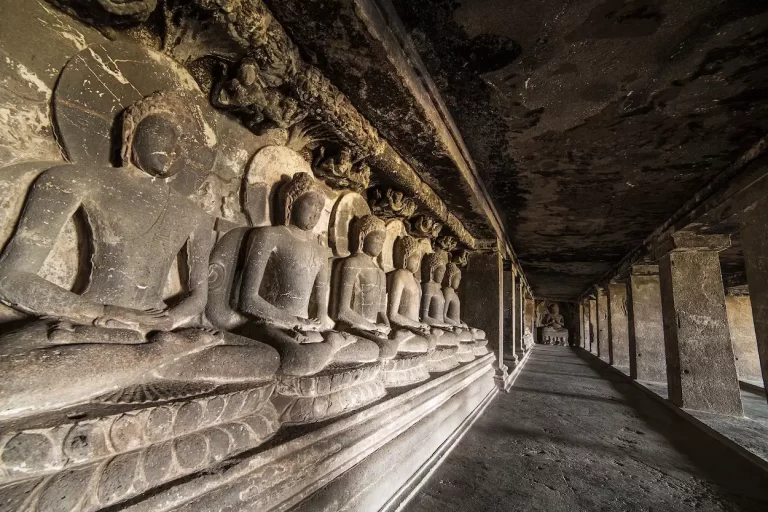
Jain temple art has a distinct visual character from both the Buddhist and Hindu sections. Where the Hindu caves favor dynamic, dramatic compositions — Shiva piercing demons, Ravana straining against the mountain — Jain sculpture at Ellora is characterized by serenity, symmetry, and an almost obsessive density of decorative detail. The Tirthankaras — the 24 enlightened teachers central to Jain belief — are depicted in meditative postures, seated or standing in calm contemplation, surrounded by elaborately carved architectural framing.
The difference in artistic temperament between the Hindu and Jain sections, seen within a single afternoon, is one of the most interesting aspects of visiting Ellora properly.
💡 Tip: If you visit only the Kailasa Temple and turn back, you experience Ellora’s dramatic register — gods battling demons, cosmic forces in motion. The Jain section shows you the opposite register entirely — stillness, precision, contemplative calm. Seeing both in one day gives you the complete emotional range of Ellora’s sculptural tradition. Skipping the Jain section means seeing only half of what Ellora is.
Cave 30 — Chhota Kailasa (Little Kailasa)
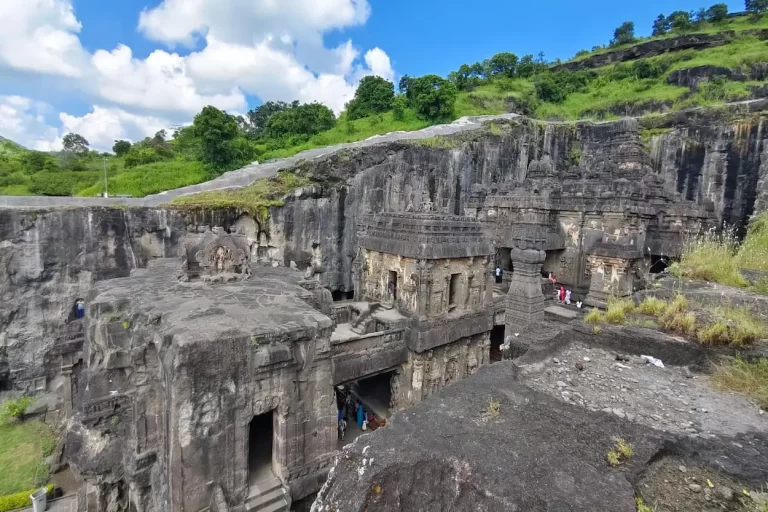
Cave 30 is known as Chhota Kailasa — Little Kailasa — because it was conceived as a smaller-scale echo of the great Kailasa Temple, using the same monolithic excavation technique.
What it is:
A freestanding rock-cut shrine carved using the same top-down subtractive method as the Kailasa Temple, but at a fraction of the scale and left architecturally incomplete. Cave 30 is significant precisely because it demonstrates the Kailasa Temple’s construction technique in a more comprehensible, human scale — and because its incomplete state reveals something of the working process that the finished Kailasa Temple conceals.
What to look for:
The unfinished sections of Cave 30 — areas where the rough excavation marks are still visible, not yet smoothed into final sculptural form — are genuinely instructive. You can see chisel marks, the rough stages of carving before the final polish, the working process frozen mid-completion. This is the closest you will get at Ellora to seeing how the monolithic carving technique actually worked, step by step.
💡 Tip: Spend time at the unfinished sections of Cave 30 specifically. The contrast between the polished final sculpture and the rough excavated rock nearby tells you more about how Kailasa Temple was actually carved than any amount of reading. This is a rare opportunity to see process rather than only result.
Cave 31 — A Single Shrine
Cave 31 is a small single shrine cave, modest in scale, primarily significant as part of the sequence leading to the major Jain monument of Cave 32. It contains a single Tirthankara figure in a simply carved shrine chamber and is typically visited briefly en route to the Indra Sabha.
Cave 32 — Indra Sabha (The Hall of Indra)
Cave 32 is the most important monument in the Ellora Jain section and one of the most architecturally accomplished structures at the entire site — second only to the Kailasa Temple in ambition.
What it is:
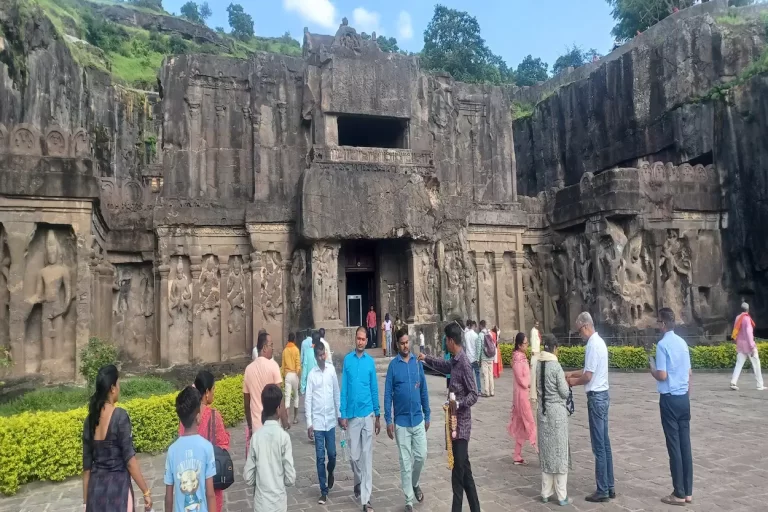
A two-storey Jain temple complex with an open courtyard, carved entirely from the basalt cliff using the same monolithic technique as Kailasa. The name Indra Sabha — Hall of Indra — comes from local tradition rather than original Jain designation, but reflects the perception of the cave’s grandeur.
What to look for:
The courtyard and freestanding shrine:
At the center of the courtyard stands a freestanding, fully carved monolithic shrine — a complete miniature temple carved entirely from a single block of rock left standing when the surrounding courtyard was excavated. This is the same engineering principle as Kailasa Temple’s relationship to its excavated courtyard, demonstrated at a more intimate scale that is easier to comprehend in a single viewing.
The elephant and lion pillars:
Flanking the courtyard, carved monolithic pillars topped with elephant and lion figures stand as freestanding sculptural elements — each carved from the living rock, connected to the ground by the same stone they emerge from.
The upper floor hall:
The principal shrine hall on the upper floor contains the main Tirthankara image — Mahavira, the 24th and final Tirthankara, seated in meditative posture — flanked by elaborately carved pillars and a richly decorated ceiling. The density of decorative carving on the upper floor ceiling and pillars rivals the finest work anywhere at Ellora.
The Yakshi Ambika panel:
A celebrated sculpture of Ambika, the Yakshi (semi-divine female guardian figure) associated with the Tirthankara Neminatha, seated beneath a mango tree with her children. This panel is admired for the naturalism of the tree canopy carved in stone and the tenderness of the maternal composition — a contemplative counterpart to the more famous goddess panels of the Hindu section.
The painted ceiling traces:
Unlike most of Ellora, Cave 32 retains faint traces of original paint on portions of its ceiling — a reminder that many of the now-bare stone surfaces throughout Ellora were originally painted, much like Ajanta. The surviving fragments give a glimpse of the original visual richness that has been lost from most of the complex.
💡 Tip: The upper floor ceiling of Indra Sabha is frequently missed because visitors focus on the courtyard shrine and the ground floor. Look up. The ceiling carving here is among the most intricate stone surface decoration at Ellora — densely worked lotus medallions and geometric patterns that reward close, patient examination. 👉 The Ellora Private Day Tour always allocates real time to the Indra Sabha upper floor — it is consistently one of the moments visitors remember most after the Kailasa Temple itself.
Caves 33 and 34 — The Final Caves
Caves 33 and 34 are the northernmost caves at Ellora, smaller in scale than Indra Sabha but containing worthwhile individual sculptures for visitors who have made it this far.
Cave 33 — Jagannath Sabha:
A smaller two-storey Jain shrine, similar in concept to Indra Sabha but less elaborately developed. Contains additional Tirthankara figures and decorative pillar work that, while less ambitious than Cave 32, completes the sense of the Jain section’s sustained sculptural program.
Cave 34:
The final and smallest cave in the numbered Ellora sequence — a modest shrine that marks the northern end of the complex. Primarily of interest to visitors completing the full sequence rather than as an independent destination.
💡 Tip: Most visitors do not reach Caves 33 and 34, and for a single-day Ellora visit, this is a reasonable place to turn back if time is limited. If you have already seen Indra Sabha in full, the marginal value of Caves 33 and 34 is lower than returning to spend additional time at the Kailasa Temple or Cave 21 in the Hindu section.
Jain Section Priority Summary
| Priority | Cave | What It Contains | Time Needed |
|---|---|---|---|
| Essential | Cave 32 | Indra Sabha — courtyard shrine, upper floor ceiling, Ambika panel | 30–40 min |
| Worthwhile | Cave 30 | Chhota Kailasa — unfinished sections showing carving process | 15 min |
| Optional | Cave 31 | Single shrine, transitional | 5 min |
| Optional | Caves 33–34 | Smaller shrines, completist visit | 10–15 min combined |
Why So Few Visitors Reach the Jain Section
The Jain section is approximately 1 km north of the Kailasa Temple along a paved path. For a day-tripper arriving late morning, spending 2 hours at Kailasa, and managing a full Buddhist section visit, the walk to the Jain caves often gets cut for time. Tour buses and shared group tours frequently exclude the Jain section from their standard itinerary entirely, prioritizing the more famous Kailasa Temple and a shortened Buddhist section.
This is the single biggest content gap between a rushed Ellora visit and a complete one. The Jain section is not a minor addendum — Indra Sabha is a major monument that, in any other heritage site in India, would be a primary attraction in its own right. At Ellora, it sits in the shadow of Kailasa and is consequently experienced by a fraction of visitors.
💡 Tip: If you are planning your own Ellora day, build the Jain section into your itinerary from the start rather than treating it as optional. Allocate the walk north and the time at Indra Sabha as a fixed part of your day, the same way you would fix time for Kailasa Temple. Treating it as “if there’s time” usually means it does not happen.
The Alternative — Seeing All of Ellora, Not Half of It
A rushed Ellora day means Kailasa Temple, a quick walk through the Buddhist section, and a turn back before the Hindu caves north of Kailasa or the Jain section are reached. This is the most common way Ellora gets experienced — and it means missing roughly half of what the site actually offers.
A private guided tour of Ellora is built around the full sequence — Buddhist section at opening, Kailasa Temple with full circuit, Cave 21 in the post-Kailasa Hindu section, and the walk north to Indra Sabha with real time at the ceiling and courtyard shrine. The Jain section is not an afterthought in the itinerary — it is planned for from the start.
👉 See Ellora Private Day Tour Details & Book — full sequence including Indra Sabha, with a guide who paces the day correctly.
👉 See Ajanta-Ellora 2-Day Tour Details & Book — both UNESCO sites, complete coverage of each.
FAQ — Ellora Caves Jain Section
Q1: What is the Ellora Caves Jain section?
The Ellora Caves Jain section consists of Caves 30 through 34, located approximately 1 km north of the Kailasa Temple. Carved primarily during the 9th and 10th centuries CE, the Jain section represents the final major construction phase at Ellora. The most significant monument is Cave 32, known as Indra Sabha, a two-storey Jain temple complex with a freestanding monolithic shrine in its courtyard.
Q2: What is Indra Sabha at Ellora?
Indra Sabha is Cave 32 in the Ellora Jain section — the most architecturally significant Jain monument at the site. It is a two-storey temple complex carved from the basalt cliff, with an open courtyard containing a freestanding monolithic shrine, elephant and lion pillars, and an upper floor hall with an intricately carved ceiling and a Mahavira Tirthankara shrine.
Q3: Why do most visitors skip the Ellora Jain caves?
The Jain section is approximately 1 km north of the Kailasa Temple, and most day visitors run out of time or energy after the Kailasa Temple and Buddhist section. Many shared group tours exclude the Jain section from their standard itinerary entirely. This means a significant proportion of Ellora visitors never see Indra Sabha, despite it being one of the most accomplished monuments at the site after Kailasa.
Q4: What is Chhota Kailasa at Ellora?
Chhota Kailasa — Little Kailasa — is Cave 30, a smaller-scale rock-cut shrine carved using the same monolithic excavation technique as the Kailasa Temple, but left architecturally incomplete. Its unfinished sections reveal visible chisel marks and rough excavation stages, offering insight into the carving process used at the much larger Kailasa Temple.
Q5: How much time should I allocate for the Ellora Jain section?
Allow at least 45 minutes to 1 hour for the Jain section, with the majority of that time at Cave 32 (Indra Sabha) — its courtyard, freestanding shrine, and upper floor ceiling all deserve careful attention. Caves 30, 31, 33, and 34 can be covered more briefly. Build this time into your Ellora itinerary from the start rather than treating it as optional.
👉 Related Posts You Might Like:
- Kailasa Temple – How It Was Built (The Engineering Mystery)
- Ellora Caves Hindu Section – Complete Guide to Caves 13–29
- Ellora Caves Buddhist Section – Complete Guide to Caves 1–12
- Hidden Areas at Ellora – Caves Most Tourists Skip
- Ellora Caves in One Day – Exact Itinerary