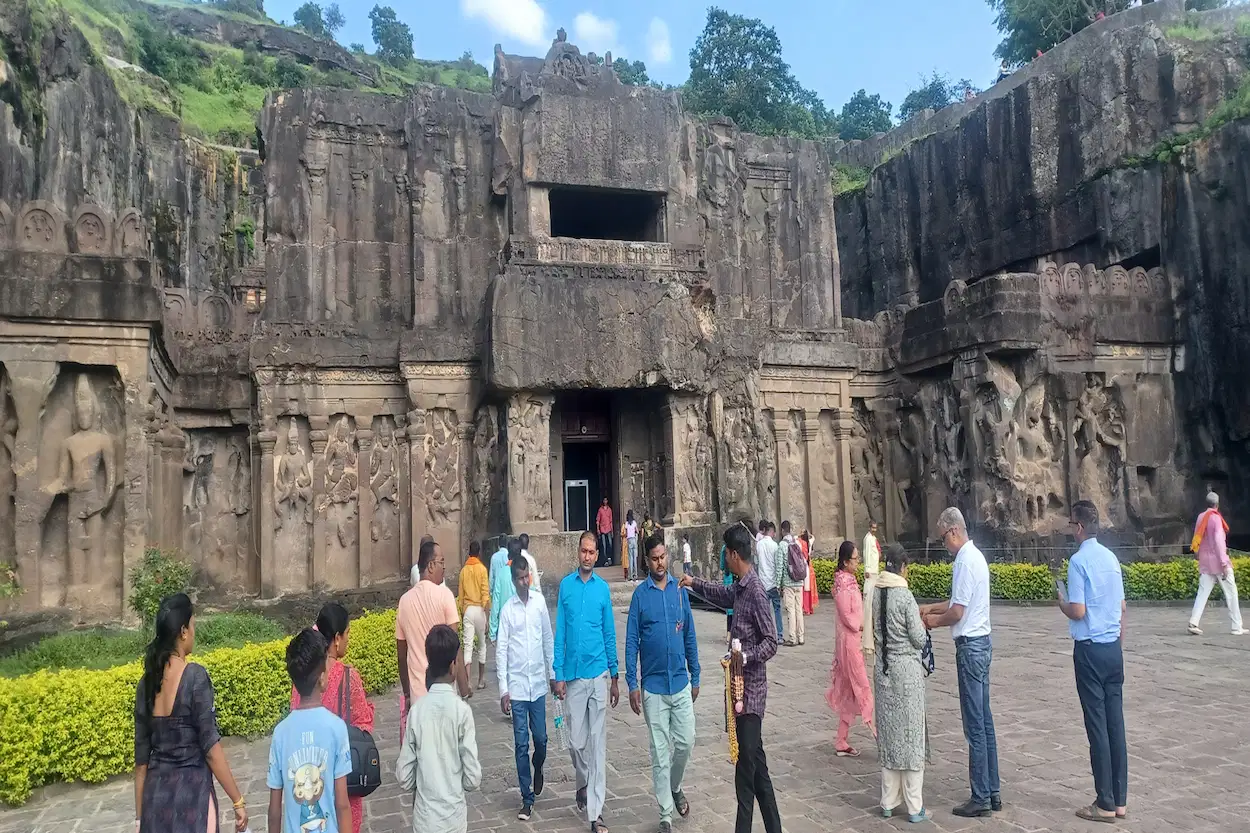
Ellora Caves Buddhist Section – Complete Guide to Caves 1–12 (2026)
The Ellora Caves Buddhist section — Caves 1 through 12 — is the part of Ellora that most visitors walk through too quickly on their way to the Kailasa Temple. This is a mistake. The 12 Buddhist caves at Ellora span approximately 500 years of monastic architecture, from simple early viharas to elaborate multi-storey monastery complexes that represent the most ambitious Buddhist construction in the Deccan. This guide tells you exactly what each significant cave contains and how to read what you are looking at.
Context — Why the Ellora Buddhist Caves Are Different From Ajanta
First-time visitors to Ellora who have already seen Ajanta sometimes expect the Buddhist section to be similar — intimate painted caves with murals on every wall. The Ellora Buddhist section is almost entirely different in character.
Ajanta Buddhist caves: Painted. Intimate. Focused on murals — Jataka narratives, Bodhisattva figures, celestial scenes in mineral pigment on lime plaster.
Ellora Buddhist caves: Largely unpainted. Monumental. Focused on architecture and sculpture — multi-storey monastery complexes with elaborate carved facades, large seated Buddha figures in shrine rooms, and functional monastic spaces that were actively used communities of monks for centuries.
The Ellora Buddhist caves are not Ajanta without paint. They are a different tradition entirely — the Vajrayana (Tantric Buddhist) and late Mahayana phase of Buddhist architecture, several centuries later than Ajanta, in a completely different structural idiom.
Understanding this distinction before you enter Cave 1 changes what you look for throughout the Buddhist section.
💡 Tip: The Buddhist caves at Ellora (Caves 1–12) are on the southern end of the complex — enter from the main gate and turn left. The Kailasa Temple (Cave 16) is in the middle section. Most visitors go straight to Kailasa and visit the Buddhist caves afterward, when energy is lower. Consider reversing this — Buddhist caves first at opening hour, Kailasa Temple mid-morning when the light on the courtyard is at its best.
Cave 1 — The Simple Beginning
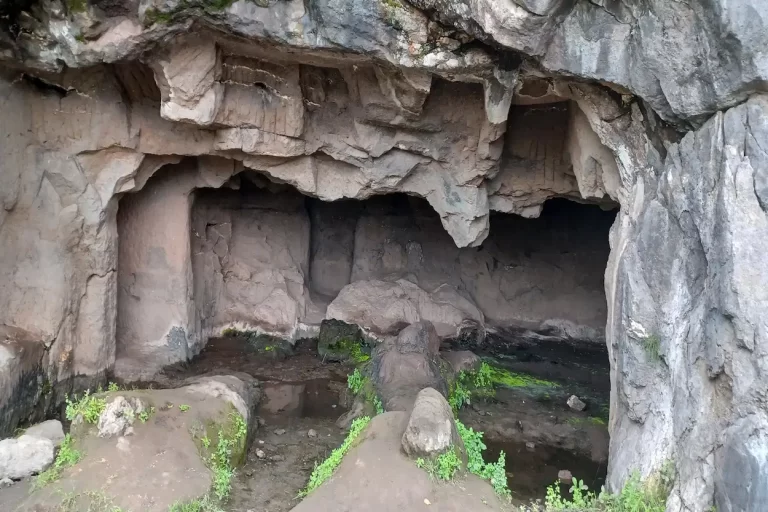
Cave 1 is the earliest and simplest of the Ellora Buddhist caves — a single-storey vihara (monastery) with a plain pillared verandah and a central hall with monk cells along the rear and side walls. Dating to approximately the 5th–6th century CE, it represents the starting point of Buddhist cave architecture at Ellora before the tradition developed into the elaborate multi-storey complexes of the later caves.
What to look for:
The monk cells — small rooms cut into the rear wall, each with a stone sleeping platform. These are functional spaces, not decorative. Monks lived and slept in these cells. The austerity of Cave 1 is intentional — this is what early Buddhist monastic architecture looked like before royal patronage began funding more elaborate construction.
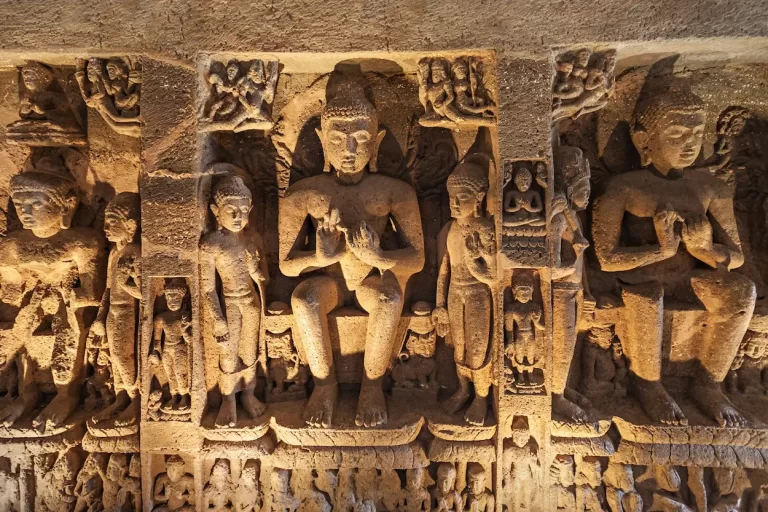
The shrine room at the rear contains a seated Buddha in the dharmachakra mudra — the gesture of teaching. This figure, relatively plain compared to later Ellora Buddha sculptures, sets the iconographic program that develops through the succeeding caves.
Cave 2 — The Transitional Cave
Cave 2 is a step up in elaboration from Cave 1 — a vihara with a more developed pillared hall, better-preserved carved doorways, and a shrine room with a more elaborate Buddha figure flanked by Bodhisattva attendants.
What to look for:
The doorway carvings — the entrance to the shrine room carries river goddess figures (Ganga and Yamuna) on the door jambs, a motif that becomes standard in later Ellora Buddhist caves and connects to the broader Indian sculptural tradition. The Bodhisattva figures flanking the main Buddha in the shrine room — Padmapani on the left, Vajrapani on the right — echo the iconographic program of Ajanta Cave 1 in sculptural form.
Cave 3 and Cave 4 — Developing the Formula
Caves 3 and 4 continue the development of the standard Ellora Buddhist vihara formula — pillared verandah, central hall, monk cells, rear shrine room with Buddha figure. Both are worth a brief visit for their carved doorways and the progressive elaboration of the pillar capitals, which become more ornate with each successive cave.
Cave 4 is notable for its upper storey — the earliest example at Ellora of the multi-level monastery format that reaches its fullest expression in Caves 11 and 12.
Cave 5 — The Maharwada (The Great Monastery)
Cave 5 is the most functionally significant Buddhist cave at Ellora — and one of the most spatially extraordinary spaces in the entire complex.
What it is:
A large rectangular hall — approximately 36 metres long and 17 metres wide — with two rows of stone benches running the full length of the hall on both sides. At the far end, a shrine room with a seated teaching Buddha. This was a dining hall — a refectory — where the monastic community gathered for communal meals. The stone benches are the tables and seats. The scale of the hall tells you something about the size of the community it served.
What to look for:
Stand at the entrance of Cave 5 and look down the full length of the hall to the Buddha at the far end. The spatial experience — the rows of benches converging on the shrine — is unlike anything else at Ellora. This is not a devotional space primarily — it is a functional institutional space, a dining hall for a working monastic community. The fact that a community large enough to require a hall of this scale was based here is significant historical information about Buddhist monasticism on the Deccan plateau in the 6th–7th century CE.
💡 Tip: Most visitors pass through Cave 5 without sitting on the stone benches. Sit down. The spatial experience of the hall from bench level — looking toward the Buddha at the far end the way a monk would have looked during a meal 1,400 years ago — is different from the experience of walking through it. Take a moment to be still in Cave 5.
Caves 6, 7, 8, and 9 — The Middle Caves
Caves 6 through 9 are a cluster of viharas that show the Buddhist tradition at Ellora moving toward increasingly elaborate decoration while maintaining the standard monastery format.
Cave 6 — The syncretic cave:
Cave 6 is notable for containing figures of both Buddhist and Hindu deities in the same space — Tara (a Buddhist goddess) and Mahishasuramardini (the Hindu goddess Durga slaying the buffalo demon) appear in adjacent panels. This syncretism — the blending of Buddhist and Hindu iconography in the same monument — is a distinctive feature of late Buddhist art at Ellora and reflects the period when Buddhism was declining as a distinct tradition in the Deccan and absorbing Hindu elements.
Cave 7: A simpler vihara, notable for its well-preserved pillared hall and the quality of its doorway carvings.
Cave 8: Contains one of the better-preserved early Buddhist shrine rooms at Ellora, with a seated Buddha of good quality and relatively intact flanking Bodhisattva figures.
Cave 9: A transitional cave showing the beginning of the elaboration that characterizes the later Buddhist caves — more ornate pillar capitals, more developed doorway decoration, larger shrine figure.
💡 Tip: The syncretism in Cave 6 — Buddhist and Hindu deities sharing the same space — is one of the most historically significant aspects of Ellora as a whole. Ellora was not built in three separate religious phases that ignored each other. The boundaries between Buddhist, Hindu, and Jain traditions at Ellora were more porous than the neat cave numbering system suggests. Cave 6 is the clearest evidence of this.
_(4558324543).jpg)
Cave 10 — The Vishvakarma (The Carpenter’s Cave)
Cave 10 is the only chaitya hall — prayer hall — in the Ellora Buddhist section, and it is one of the most significant Buddhist monuments at Ellora. It is known as the Vishvakarma Cave, after the divine craftsman of Hindu mythology — a name given to it by local tradition, not its original Buddhist designation.
What makes it extraordinary:
The facade: The exterior of Cave 10 has the most elaborate carved facade in the Ellora Buddhist section — a large horseshoe-shaped chaitya arch above the entrance, with a seated Buddha figure carved inside the arch, flanked by celestial figures and decorative carving that covers the full facade surface. This is the most photographed exterior in the Buddhist section.
The interior: A single large barrel-vaulted hall with a stupa at the far end — but this stupa has a significant difference from Ajanta Cave 10. Carved into the face of the stupa drum is a large standing Buddha figure — the stupa and the Buddha image merged into a single object. This is a Mahayana innovation — the historical stupa of Hinayana Buddhism transformed by the addition of the Mahayana Buddha figure.
The ceiling: The stone ceiling of Cave 10 is carved to simulate wooden ribbing — as in Ajanta Cave 10 — but the Ellora version is more elaborate and better preserved. The timber-effect ribs run the full length of the barrel vault. This is a direct record of the wooden architecture that preceded stone cave construction in the Deccan.
💡 Tip: The upper gallery of Cave 10 — reached by stairs inside the cave — gives you a view down into the chaitya hall from above and a close-up of the facade sculpture at eye level. Most visitors do not find the upper gallery. Ask your guide to take you up.
Cave 11 — Do Thal (Two Floors)
Cave 11 is known locally as Do Thal — two floors — and represents the beginning of the multi-storey monastery format that reaches its peak in Cave 12.
What to look for:
The ground floor is a standard vihara format. The upper floor contains a large pillared hall with a shrine room at the rear — a more elaborate Buddha figure with attendant Bodhisattvas and, significantly, the beginning of Tantric Buddhist iconography in the wall panels. The inclusion of Tantric figures — multiple-armed deities, female Bodhisattvas (Taras) in various forms — marks Cave 11 as belonging to the Vajrayana phase of Buddhism, the tradition that was the final flowering of Buddhist culture in the Deccan before the tradition’s decline.
Cave 12 — Teen Thal (Three Floors) — The Pinnacle
Cave 12 is the largest and most elaborate Buddhist cave at Ellora — known as Teen Thal (three floors) — and is the culmination of 500 years of Buddhist cave architecture at the site.
What it is:
A three-storey monastery complex with a pillared courtyard on the ground floor, a large meditation and assembly hall on the second floor, and the main shrine hall on the third floor. The total scale of Cave 12 — its courtyard, its three levels of pillared halls, its carved facades — makes it one of the most ambitious monastery structures in Indian Buddhist architecture.
What to look for:
The third floor shrine hall: The main shrine room on the top floor contains a large seated Buddha in the dharmachakra mudra flanked by the most elaborate assembly of Bodhisattva and Tantric figures in the Ellora Buddhist section. Seven seated Buddhas — representing the Manushi Buddhas of previous cosmic ages — are carved along the rear wall of the shrine. This Seven Buddhas panel is the most significant iconographic statement in the Ellora Buddhist section.
The second floor meditation hall: A large pillared hall with carved panels on the walls depicting Bodhisattvas and Tantric deities. The quality of individual sculptures here — particularly the Tara figures — is among the best in the Buddhist section.
The ground floor courtyard: The open courtyard of Cave 12, with its pillared galleries on three sides, gives a sense of the monastic community life that the cave was designed to support — a space for movement, gathering, and communal activity around the central courtyard.
💡 Tip: Most visitors reach Cave 12 after Cave 10 and the Kailasa Temple and are already tired. Cave 12 deserves fresh energy — it is the most complex structure in the Buddhist section and the third floor shrine hall specifically rewards careful attention. If you are visiting Ellora with limited time, consider starting at Cave 12 before Kailasa rather than ending there. 👉 The Ellora Private Day Tour sequences the Buddhist caves in the order that makes most sense for understanding — Cave 12 is always visited with enough time and energy for the third floor shrine hall to register properly.
The Buddhist Section — Priority Summary
For visitors with limited time at Ellora, this is the honest priority order for the Buddhist section:
| Priority | Cave | What It Contains | Time Needed |
|---|---|---|---|
| Essential | Cave 10 | Vishvakarma chaitya hall, elaborate facade | 20–25 min |
| Essential | Cave 12 | Teen Thal, Seven Buddhas panel, three-storey complex | 25–30 min |
| Essential | Cave 5 | Maharwada dining hall, stone benches, spatial experience | 15–20 min |
| Worthwhile | Cave 6 | Buddhist-Hindu syncretism, Tara and Durga together | 10–15 min |
| Worthwhile | Cave 11 | Do Thal, Tantric Buddhist iconography begins | 10–15 min |
| Contextual | Caves 1–4 | Early vihara development, historical sequence | 5–10 min each |
| Contextual | Caves 7–9 | Middle phase development | 5 min each |
The Alternative — Buddhist Caves With Context
Walking through 12 caves and understanding what you are looking at requires knowing the difference between a vihara and a chaitya hall, recognizing Tantric Buddhist iconography when it appears, and understanding why the Seven Buddhas panel in Cave 12 is significant. This is not common knowledge — it requires either preparation or a guide.
A private guided tour of Ellora sequences the Buddhist section intelligently — Cave 12 and Cave 10 with full explanations, Cave 5 with time to sit and absorb the spatial experience, Cave 6 with the syncretism explained — before moving to the Kailasa Temple with enough context to understand where it sits in the Ellora sequence.
👉 See Ellora Private Day Tour Details & Book — Buddhist section, Kailasa Temple, Hindu caves, and Jain caves — all covered with a licensed guide.
👉 See Ajanta-Ellora 2-Day Tour Details & Book — Ajanta on day one, full Ellora sequence on day two.
FAQ — Ellora Caves Buddhist Section
Q.1 : What is the Ellora Caves Buddhist section?
The Ellora Caves Buddhist section consists of Caves 1 through 12 — 12 rock-cut monastery and prayer hall complexes carved from the basalt cliff at Ellora between approximately the 5th and 8th centuries CE. The Buddhist caves represent the Mahayana and Vajrayana phases of Indian Buddhist architecture and include Cave 5 (the Maharwada dining hall), Cave 10 (the Vishvakarma chaitya hall), and Cave 12 (the Teen Thal three-storey monastery complex).
Q.2 : Which Buddhist caves at Ellora are most worth visiting?
The three essential Buddhist caves at Ellora are Cave 10 (Vishvakarma — the only chaitya hall, with the most elaborate facade in the Buddhist section), Cave 12 (Teen Thal — the largest and most complex Buddhist monument at Ellora, with the Seven Buddhas panel on the third floor), and Cave 5 (Maharwada — the dining hall with stone benches that communicates the scale of the monastic community). Cave 6 is worth visiting for its Buddhist-Hindu syncretic iconography.
Q.3 : How are the Ellora Buddhist caves different from Ajanta?
The Ellora Buddhist caves are fundamentally different from Ajanta in character and period. Ajanta is primarily about painting — 1,500-year-old Buddhist murals in intimate cave chambers. The Ellora Buddhist caves are largely unpainted and focused on architecture and sculpture — multi-storey monastery complexes from the later Mahayana and Vajrayana period. Ajanta dates primarily to the 5th century CE. The Ellora Buddhist caves span roughly the 5th to 8th centuries CE. Both are UNESCO World Heritage Sites and both are essential — neither replaces the other.
Q.4 : What is the Vishvakarma Cave at Ellora?
The Vishvakarma Cave is Cave 10 in the Ellora Buddhist section — the only chaitya (prayer) hall in the Buddhist section of Ellora. It has the most elaborate carved facade in the Buddhist section, including a large horseshoe arch with a seated Buddha figure. The interior barrel-vaulted hall ends in a stupa with a standing Buddha carved into its drum — a Mahayana innovation merging the stupa and Buddha image. The stone ceiling is carved to simulate wooden ribbing, recording the timber architectural tradition that preceded rock-cut construction.
Q.5 : How much time do I need for the Ellora Buddhist section?
Allow 1.5 to 2 hours for a meaningful visit to the Ellora Buddhist section with a licensed guide — covering the essential caves (5, 10, 12) in depth and the contextual caves (1–4, 6–9, 11) at a measured pace. If visiting the full Ellora complex in one day — Buddhist section, Kailasa Temple, Hindu caves, and Jain caves — budget your energy accordingly. The Buddhist section is best visited first, at opening hour, before the Kailasa Temple.
👉 Related Posts You Might Like:
- Kailasa Temple – How It Was Built (The Engineering Mystery)
- Ellora Caves Hindu Section – Complete Guide to Caves 13–29
- Ellora Caves Jain Section – Complete Guide to Caves 30–34
- Ellora Caves in One Day – Exact Itinerary
- Ajanta vs Ellora – Which Caves Should You Visit First?