Ellora Caves Hindu Section – Complete Guide to Caves 13–29 (2026)
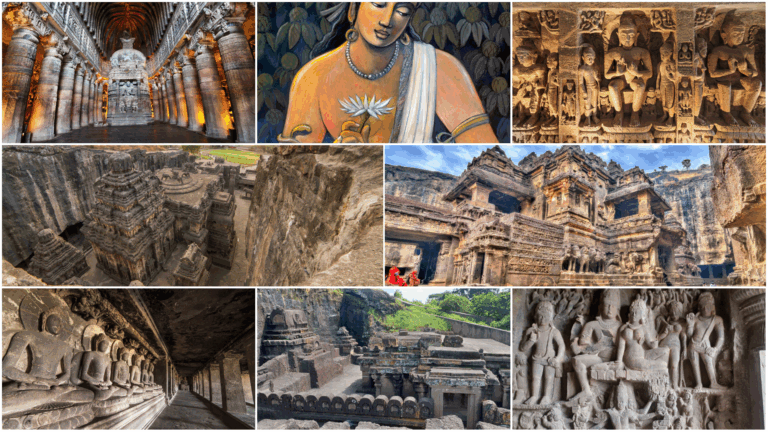
The Ellora Caves Hindu section — Caves 13 through 29 — contains the Kailasa Temple and sixteen other rock-cut Hindu monuments that together represent the peak of Deccan Hindu temple architecture between the 6th and 9th centuries CE. Most visitors see only the Kailasa Temple and move on. This is understandable — the Kailasa Temple is the Kailasa Temple. But the Hindu section contains several caves that deserve serious attention in their own right, and understanding the full sequence makes the Kailasa Temple itself more comprehensible. This guide covers what matters, what to look for, and what most visitors entirely miss.
Context — The Hindu Section in the Ellora Sequence
The Hindu caves at Ellora were carved roughly between the 6th and 9th centuries CE — overlapping with the later Buddhist caves and predating the Jain caves. The primary patrons were successive Deccan dynasties: the Chalukyas of Badami in the earlier phase, the Rashtrakutas in the later and more monumental phase that produced the Kailasa Temple.
The Hindu caves at Ellora are Shaivite — devoted primarily to Shiva — with a smaller number of Vaishnavite caves (devoted to Vishnu). This reflects the dominant religious patronage of the Deccan dynasties of the period, particularly the Rashtrakutas, who were strong Shiva devotees.
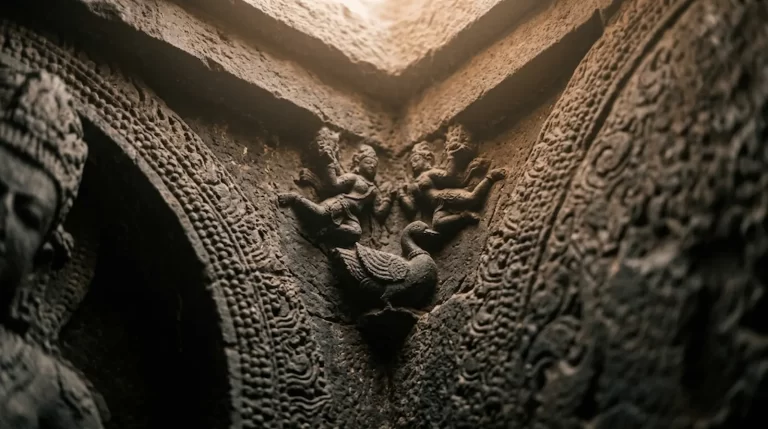
The sculptural program across the Hindu section is the most ambitious in the entire Ellora complex — surpassing even the Buddhist caves in the quality and density of individual carved panels. The Ravana lifting Kailash panel, the Shiva-Parvati marriage scenes, the Nataraja figures, the Mahishasuramardini panels — all are in the Hindu section, primarily in and around the Kailasa Temple.
💡 Tip: The Hindu section runs from south to north — Caves 13 through 29 — with the Kailasa Temple (Cave 16) roughly in the center. The caves south of Kailasa (13–15) are the earlier phase; the caves north of Kailasa (17–29) are contemporary with or slightly later than Kailasa. Understanding this sequence helps you read the sculptural development across the section.
Cave 13 — The Transition Cave
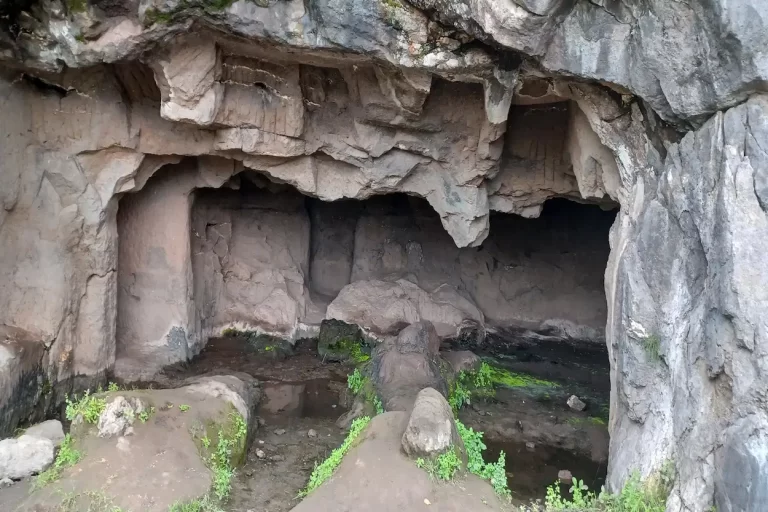
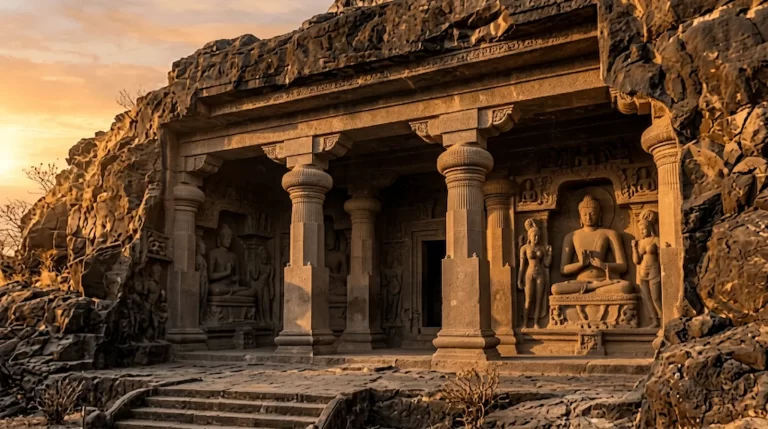
Cave 13 is the first Hindu cave at Ellora — a simple single-storey vihara-format structure that was likely converted from a Buddhist monastery to Hindu use, or built in a transitional period when the two traditions overlapped at the site.
What to look for:
The basic format — pillared hall, rear shrine room — is identical to the Buddhist viharas in the preceding section. The distinction is the iconography: a Shivalinga in the shrine room rather than a Buddha figure. Cave 13 is primarily significant as evidence of the continuity between Buddhist and Hindu cave traditions at Ellora rather than as a monument of individual importance.
Cave 14 — Ravana Ki Khai
Cave 14 is known as Ravana Ki Khai — Ravana’s prison — a name from local tradition with no direct historical basis, but one that reflects the Shaivite character of the cave’s sculptural program.
What makes it significant:
Cave 14 is the first Hindu cave at Ellora with an ambitious sculptural program — multiple large-scale panels covering the side walls of the main hall depicting key Shaivite and Vaishnavite mythology. This is where the Hindu section’s sculptural ambition becomes apparent for the first time.
Key panels:
- Durga Mahishasuramardini — the goddess Durga slaying the buffalo demon Mahisha. One of the earliest Mahishasuramardini panels at Ellora, this sets the iconographic template for later versions in the Hindu section.
- Vishnu Anantashayana — Vishnu reclining on the cosmic serpent Ananta, with Brahma emerging from his navel. A rare Vaishnavite panel in a predominantly Shaivite section.
- Lakshmi Abhisheka — the goddess Lakshmi being anointed by elephants. A scene of auspicious abundance.
💡 Tip: Cave 14 is often walked past quickly because it sits between the Buddhist section and the dramatically more famous Cave 16. This is exactly why it is worth pausing at. The sculptural panels in Cave 14 establish the iconographic vocabulary that the Kailasa Temple later uses at monumental scale. Seeing Cave 14 with your guide before Kailasa means the Kailasa panels are legible rather than simply impressive.
Cave 15 — Das Avatara (The Ten Avatars of Vishnu)
Cave 15 is the most significant Hindu cave at Ellora after the Kailasa Temple — and one of the most undervisited monuments in the complex.
What it is:
A two-storey rock-cut temple dedicated jointly to Vishnu and Shiva — unusual in the predominantly Shaivite Hindu section. The name Das Avatara refers to the ten avatars of Vishnu depicted in the sculptural program.
What to look for:
The Vishnu Anantashayana panel — ground floor:
Vishnu reclining on the cosmic serpent, larger and more elaborately carved than the version in Cave 14. This is one of the finest Vaishnavite panels at Ellora.
The Nataraja panel — upper floor:
Shiva as Nataraja — the cosmic dancer — in one of the most dynamically composed sculptures at Ellora. The figure of Shiva dancing within a ring of flame, with attendant figures around him, represents the peak of Chalukya-period sculptural achievement at the site.
The Shiva Andhakasura panel:
Shiva piercing the demon Andhaka with his trident. A composition of violent energy that contrasts completely with the serene Nataraja panel nearby.
The two-storey format:
Cave 15 is the only two-storey Hindu cave at Ellora outside the Kailasa Temple complex itself. The upper floor — reached by stairs inside the cave — contains the most significant sculptural panels. Most visitors who enter Cave 15 do not find the upper floor. Ask your guide specifically to take you up.
💡 Tip: The Nataraja panel on the upper floor of Cave 15 is one of the great sculptures at Ellora — comparable in quality to the best panels at the Kailasa Temple. It is almost always empty of other visitors. Spend fifteen minutes on the upper floor of Cave 15. The combination of the Nataraja and the Andhakasura panel in the same space, with nobody else present, is one of those Ellora moments that most visitors never find. 👉 The Ellora Private Day Tour always includes the upper floor of Cave 15 — it is one of the first things I show visitors who want to understand what Ellora actually contains beyond Kailasa.
Cave 16 — Kailasa Temple
The Kailasa Temple is covered in full in a separate guide. In the context of the Hindu section sequence:
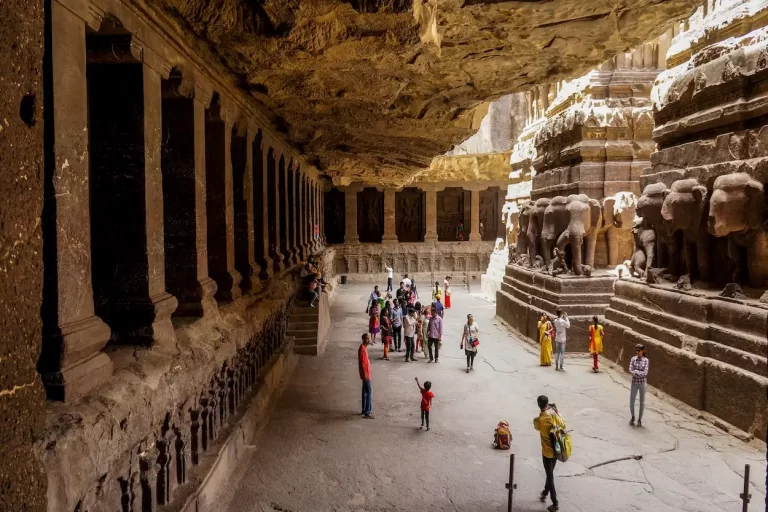
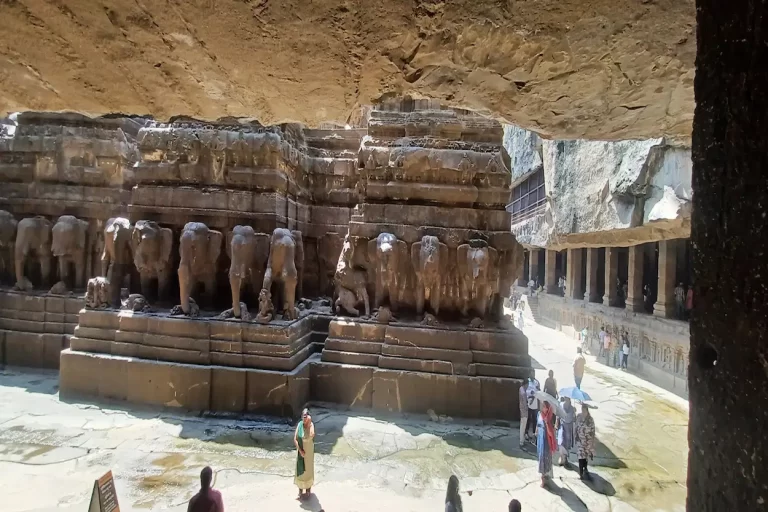
The Kailasa Temple is Cave 16 — the central monument of the Hindu section, the largest rock-cut structure on earth, and the defining achievement of Rashtrakuta patronage at Ellora. Everything in the Hindu section before Cave 16 builds toward it. Everything after Cave 16 was carved in its shadow.
See the dedicated Kailasa Temple guide for the full engineering, sculptural, and historical analysis.
👉 Read: Kailasa Temple – How It Was Built
Caves 17 to 20 — The Post-Kailasa Phase
The caves north of the Kailasa Temple — Caves 17 through 29 — are generally smaller and less elaborate than Kailasa but contain individual panels of significant quality. They were carved during and after the Kailasa period, largely under Rashtrakuta patronage.
Cave 21 — Rameshvara:
The most significant Hindu cave north of Kailasa and one of the finest caves in the entire Hindu section. Cave 21 is a Shiva temple with an exceptionally refined sculptural program — the figures here have a softness and elegance of carving that some art historians consider superior in quality to the more dramatic Kailasa panels.
Key panels in Cave 21:
- Shiva-Parvati marriage (Kalyanasundara): One of the most tenderly rendered Shiva-Parvati compositions at Ellora. The figures of Shiva and Parvati at the moment of their divine marriage — hands joined, attendants surrounding them — have a quality of intimate warmth that contrasts with the cosmic violence of the Kailasa Ravana panel.
- Gangadhara: Shiva catching the river Ganga in his matted hair as she descends from heaven — preventing her force from destroying the earth. The figure of Ganga descending, the gesture of Shiva’s upraised arm, and Parvati’s expression of slight jealousy at the new arrival are all rendered with remarkable specificity.
- River goddesses on the entrance doorway: The Ganga and Yamuna figures flanking the main entrance to Cave 21 are among the finest examples of this standard Indian temple doorway motif anywhere in Maharashtra.
💡 Tip: Cave 21 is consistently undervisited because it sits north of the Kailasa Temple and most visitors turn back at Kailasa. This is the single biggest missed opportunity in the Ellora Hindu section. The Shiva-Parvati marriage panel in Cave 21 is among the most beautifully carved compositions at Ellora — comparable to the best Kailasa panels but with a different emotional register entirely.
Cave 29 — Dhumar Lena
Cave 29 is the northernmost significant Hindu cave at Ellora and one of the most architecturally interesting — a cave that most visitors never reach.
What it is:
A large cruciform-plan Shiva temple — the only cruciform layout Hindu cave at Ellora — with three entrance porches, a large central hall, and a Shivalinga shrine at the center. The plan is more elaborate than any other Hindu cave at Ellora outside the Kailasa complex.
What to look for:
The Shiva-Parvati panels:
Cave 29 contains multiple large-scale Shiva-Parvati panels — the divine couple playing dice, the marriage scene, Shiva as Nataraja — in a sculptural program that covers the full perimeter of the central hall.
The Ravana panel:
Cave 29 contains its own version of the Ravana lifting Kailash composition — the same subject as the famous south gallery panel at the Kailasa Temple, but in a different compositional treatment. Comparing the two versions of the same subject — Kailasa’s and Cave 29’s — is one of the most instructive exercises in Ellora’s sculptural program.
The scale and emptiness:
Cave 29 is large, well-lit by its three entrance porches, and almost always empty of other visitors. The combination of a significant sculptural program, a distinctive architectural plan, and complete solitude makes it one of the most rewarding caves in the Hindu section for visitors who make the effort to reach it.
💡 Tip: Cave 29 is a 10-minute walk north of the Kailasa Temple. Most visitors turn back at Cave 21 at most. The walk to Cave 29 is on a paved path and entirely manageable. If you have a full day at Ellora and a guide who knows the cave, the comparison between the Ravana panel at Cave 29 and the Kailasa Ravana panel is one of the most illuminating single exercises the site offers.
Hindu Section Priority Summary
| Priority | Cave | What It Contains | Time Needed |
|---|---|---|---|
| Essential | Cave 16 | Kailasa Temple — complete guide separate | 2+ hours |
| Essential | Cave 15 | Das Avatara — Nataraja, upper floor panels | 20–25 min |
| Essential | Cave 21 | Rameshvara — finest post-Kailasa sculpture | 20–25 min |
| Worthwhile | Cave 14 | Ravana Ki Khai — early Hindu sculptural program | 15 min |
| Worthwhile | Cave 29 | Dhumar Lena — cruciform plan, Ravana panel | 20 min |
| Contextual | Caves 17–20 | Post-Kailasa development | 5–10 min each |
| Contextual | Cave 13 | Transitional cave, Shivalinga shrine | 5 min |
The Alternative — Hindu Section With a Guide Who Knows Every Panel
Knowing that Cave 15 has an upper floor with the Nataraja panel, that Cave 21 exists north of Kailasa, and that Cave 29 has its own Ravana composition for comparison — this is the difference between a visitor who has been to Ellora and a visitor who has seen Ellora.
A private guided tour of the Ellora Hindu section sequences the caves intelligently — Cave 14 for context before Kailasa, Cave 15 with the upper floor included, Kailasa Temple with the full gallery wall circuit, Cave 21 for the post-Kailasa refinement, Cave 29 for the serious visitor who wants the full picture.
👉 See Ellora Private Day Tour Details & Book — full Hindu section including Cave 15 upper floor and Cave 21, with licensed guide.
👉 See Ajanta-Ellora 2-Day Tour Details & Book — both UNESCO sites in two days, correct sequence throughout.
FAQ — Ellora Caves Hindu Section
Q.1 : What is the Ellora Caves Hindu section?
The Ellora Caves Hindu section consists of Caves 13 through 29 — 17 rock-cut Hindu monuments carved between approximately the 6th and 9th centuries CE under Chalukya and Rashtrakuta dynasty patronage. The section is primarily Shaivite — devoted to Shiva — and includes the Kailasa Temple (Cave 16), Cave 15 Das Avatara, Cave 21 Rameshvara, and Cave 29 Dhumar Lena among its most significant monuments.
Q.2 : Which Hindu caves at Ellora are worth visiting besides the Kailasa Temple?
Cave 15 Das Avatara — with the Nataraja panel on the upper floor — is the most significant Hindu cave at Ellora after Kailasa and is consistently undervisited. Cave 21 Rameshvara has the finest post-Kailasa sculptural program at Ellora, including the most beautifully rendered Shiva-Parvati marriage composition at the site. Cave 29 Dhumar Lena has a distinctive cruciform plan and its own Ravana lifting Kailash panel for comparison with the famous Kailasa version.
Q.3 : What dynasty built the Hindu caves at Ellora?
The Hindu caves at Ellora were built under two primary dynasties. The earlier caves — including Cave 14 and Cave 15 — were built under the Chalukyas of Badami, who patronized rock-cut architecture across the Deccan from the 6th century CE. The later and more monumental caves — including the Kailasa Temple and the post-Kailasa caves — were built under the Rashtrakuta dynasty from the mid-8th century CE onward.
Q.4 : What is Cave 15 at Ellora and why is it important?
Cave 15 Das Avatara is a two-storey rock-cut Hindu temple dedicated jointly to Vishnu and Shiva — the only two-storey Hindu cave at Ellora outside the Kailasa complex. The upper floor contains the finest Nataraja (Shiva dancing) sculpture at Ellora and a major Shiva Andhakasura panel. Most visitors to Ellora do not find the upper floor of Cave 15 — it is reached by stairs inside the cave and is almost always empty.
Q.5 : How long does it take to see the Ellora Hindu section properly?
The Ellora Hindu section — including the Kailasa Temple in full, Cave 15 with upper floor, Cave 21, and Cave 29 — requires a minimum of 3 to 3.5 hours with a licensed guide. The Kailasa Temple alone deserves at least 2 hours for three full circuits of the courtyard and gallery walls. Caves 14, 15, 21, and 29 add another 1 to 1.5 hours. Visitors who allocate less time will see the Kailasa Temple and miss much of what makes the Hindu section significant.
👉 Related Posts You Might Like:
- Kailasa Temple – How It Was Built (The Engineering Mystery)
- Ellora Caves Buddhist Section – Complete Guide to Caves 1–12
- Ellora Caves Jain Section – Complete Guide to Caves 30–34
- Ellora Caves in One Day – Exact Itinerary
- Ellora Caves for Architecture Lovers