Kailasa Temple – How It Was Built & Why It Still Defies Explanation (2026)
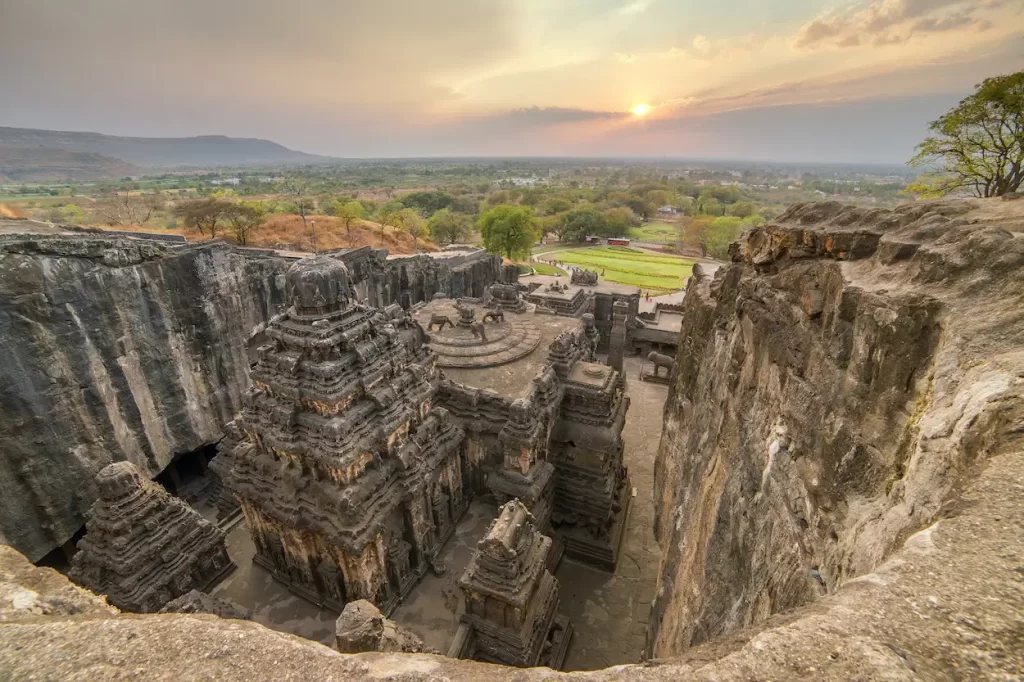
How the Kailasa Temple was built is a question that stops people mid-sentence when they first understand the answer. It was not built. It was carved — downward, from the top of a basalt cliff, removing an estimated 200,000 tonnes of rock over approximately 100 years, to reveal a complete Hindu temple inside the stone. No assembly. No construction sequence from foundation to roof. The roof came first. This is what makes Kailasa Temple the most extraordinary structure in India — and possibly on earth.
What the Kailasa Temple Actually Is
Before the engineering, the object itself.
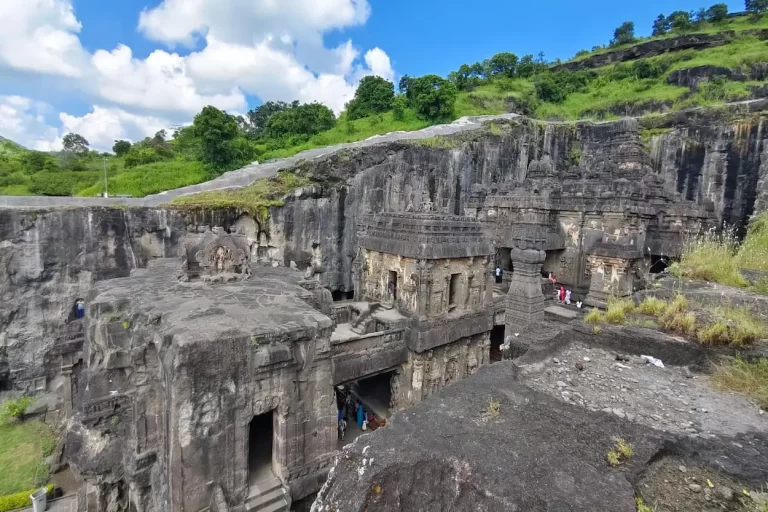
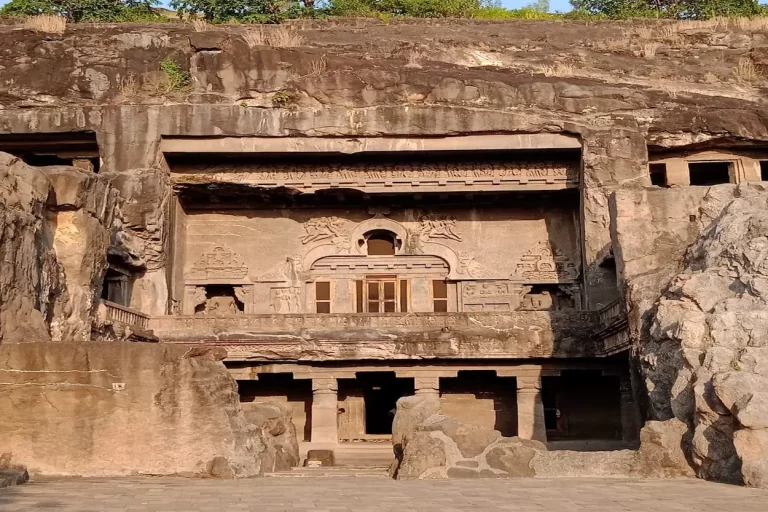
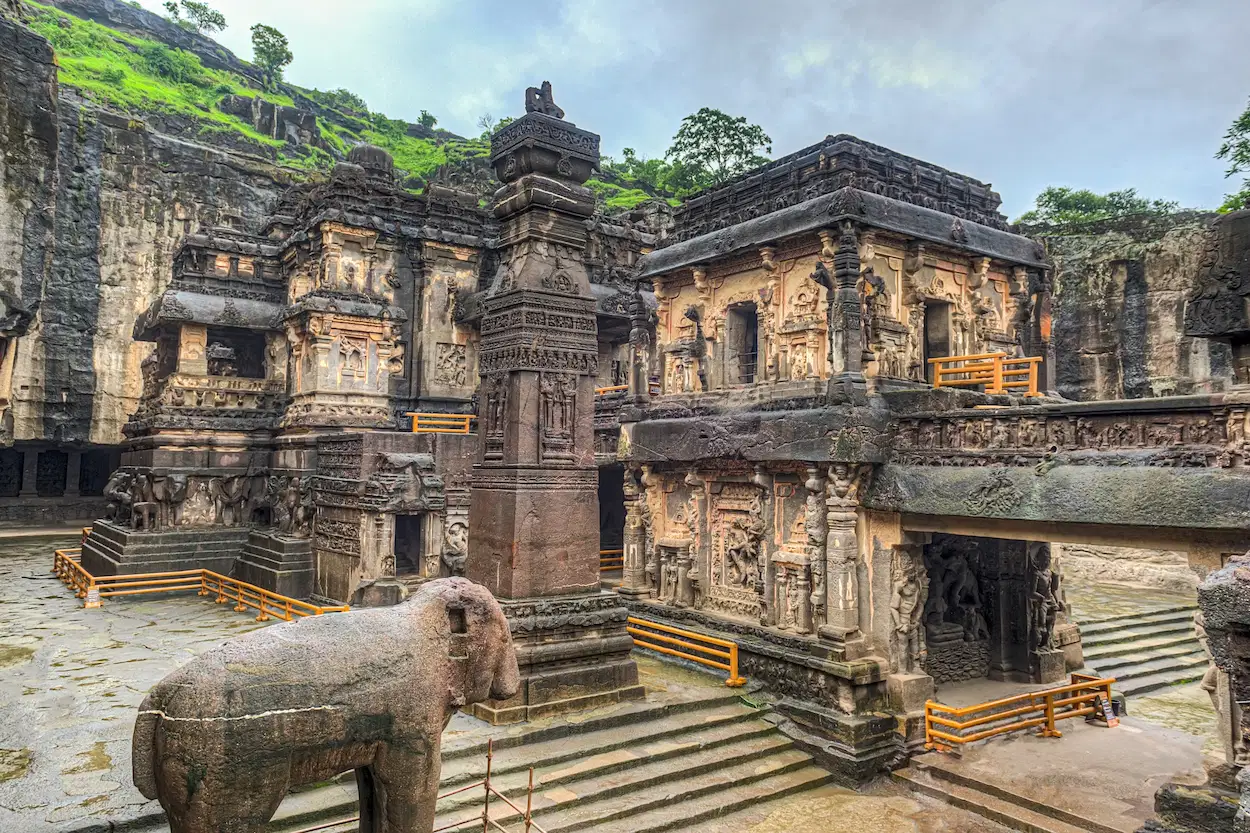
Kailasa Temple is Cave 16 at the Ellora Caves complex — though calling it a cave is immediately misleading. It is a complete, freestanding Hindu temple — shikhara (tower), mandapa (pillared hall), antarala (vestibule), garbhagriha (inner sanctum), subsidiary shrines, two life-size elephant sculptures at the entrance, a ceremonial gateway, and a courtyard — all carved from a single basalt cliff on the Deccan plateau.
The temple is dedicated to Shiva. The name Kailasa refers to Mount Kailash — the Himalayan peak that is Shiva’s mythological abode. The intention of the Rashtrakuta craftsmen was to recreate Mount Kailash in rock — not represent it symbolically, but recreate it physically, at scale, carved from the earth itself.
The dimensions: approximately 84 metres long, 47 metres wide, and 30 metres high. The shikhara rises 32 metres from the courtyard floor. The courtyard is excavated to a depth of approximately 30 metres from the original cliff surface.
These numbers do not communicate the scale. Standing in the courtyard and looking up at the shikhara rising from the rock — knowing that the rock above it, stretching to the plateau level, has been entirely removed — is the moment Kailasa stops being information and becomes an experience.
💡 Tip: Do not form your impression of Kailasa Temple from the entrance gateway. Walk through, turn around, and look at the full temple from the far end of the courtyard. Then walk around the perimeter of the excavation to see the temple from the sides and rear. Kailasa reveals itself in stages — each circuit around it adds a new dimension to what you are seeing. Most visitors who spend 20 minutes at Kailasa have not yet seen it properly.
📍 Kailasa Temple Ellora on Google Maps
The Engineering — What Was Actually Done
The construction method of Kailasa Temple is the reason it appears in every serious discussion of ancient engineering. Understanding it requires setting aside the normal vocabulary of construction.
Normal temple construction: Foundation laid, walls built upward, roof placed last. Workers add material to create the structure.
Kailasa Temple construction: Begin at the top of the cliff. Remove material downward and outward. Workers subtract rock to reveal the structure within it. The roof of the temple was the first element to emerge — carved at the level of the original cliff surface. The courtyard floor was the last.
The sequence, as best as scholars can reconstruct it:
Phase 1 — The three trenches:
Three large trenches were cut into the basalt cliff — one across the top and two down each side — to isolate the rock mass that would become the temple. This defined the outer dimensions of the structure and created the initial working space for the excavation of the courtyard galleries.
Phase 2 — Top-down carving of the temple mass:
The temple mass — the rock that would become the shikhara, mandapa, and inner sanctum — was carved from the top downward. The shikhara shape was established first, then the mandapa roof, then the exterior walls of the structure. At this stage, the temple was still attached to the cliff floor below.
Phase 3 — Excavation of the courtyard:
The rock around and beneath the temple mass was removed to create the excavated courtyard. As this rock was cleared, the temple emerged from the cliff as a freestanding structure — still standing on the original basalt floor, now visible as the courtyard level.
Phase 4 — Interior carving and sculpture:
With the courtyard excavated and the temple freestanding, the interior spaces — the mandapa columns, the garbhagriha, the antarala — were carved inward from the exterior walls. Simultaneously, the sculptural program on the exterior walls, the elephant base, the bridge connecting the mandapa to the entrance porch, and the two victory pillars in the courtyard were carved.
The material removed:
Estimated at 200,000 tonnes of basalt. Removed entirely by hand — chisels, hammers, and human labor. No explosives, no machinery, no mechanical advantage beyond the inclined plane and the lever. Every tonne of rock was broken free from the cliff and carried out of the excavation.
💡 Tip: Stand at the rear of the Kailasa courtyard and look at the gallery walls — the vertical cliff faces on either side of the temple that form the courtyard boundaries. These walls carry carved relief panels of their own — Ramayana and Mahabharata scenes, celestial figures, narrative friezes. The craftsmen who removed this rock did not simply excavate — they carved every surface they revealed. The gallery walls are as densely worked as the temple itself.
The Timeline — How Long Did It Take?
The Kailasa Temple is attributed to the reign of the Rashtrakuta king Krishna I, who ruled approximately 756–773 CE. The inscription evidence — a copper plate grant — credits Krishna I with the temple’s construction, describing it as built in a single reign.
This creates the central historical puzzle of Kailasa: the temple as it stands — with its full sculptural program, its interior carvings, its gallery reliefs — represents a volume of work that most scholars consider impossible to complete in a single reign of approximately 17 years.
The scholarly positions:
Position 1 — Single reign, extraordinary mobilization:
Some scholars argue that Krishna I mobilized an unprecedented concentration of skilled craftsmen — estimates range from several hundred to over a thousand working simultaneously — and that the 17-year timeline, while extraordinary, is physically possible if the workforce was large enough and the organization sufficiently systematic.
Position 2 — Multiple reigns, single attribution:
Others argue that the core temple was begun under Krishna I and completed under his successors — with the attribution to Krishna I reflecting his role as the initiating patron rather than the sole commissioner. The sculptural style across different sections of the temple shows variations that some art historians interpret as evidence of different carving periods.
What is agreed:
The temple was substantially complete by the early 9th century CE. The Rashtrakuta dynasty was its patron. The scale of the undertaking — regardless of exact timeline — represents the most ambitious single act of rock-cut architecture in human history.
💡 Tip: The inscription evidence for Kailasa Temple is fragmentary — the copper plate grant that attributes the temple to Krishna I does not describe the construction method or timeline in detail. What you hear at the site from guides about the construction period varies. The honest answer is that the exact timeline remains uncertain — and that uncertainty is part of what makes Kailasa genuinely mysterious rather than simply ancient.
,_Ellora.,_a_photo_by_Henry_Cousens,_1867.jpg)
The Sculptural Program — What the Carvings Show
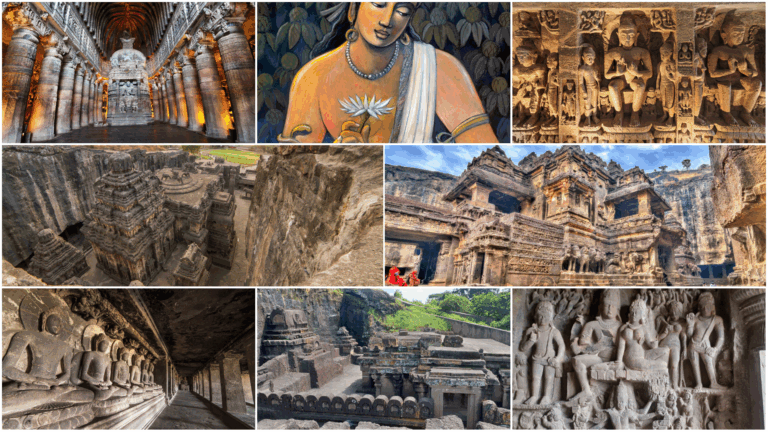
The Kailasa Temple is not only an engineering achievement — it is one of the greatest sculptural programs in Indian art. Every surface of the temple exterior, the gallery walls, and the interior carries carved imagery. Understanding what you are looking at changes the experience completely.
The elephant base:
The temple platform rests on a continuous frieze of life-size elephants carved in high relief around the entire base — as if the elephants are physically lifting the temple on their backs. This is not decorative. In Hindu cosmology, elephants support the world. The Kailasa craftsmen built the cosmological support structure directly into the temple’s foundation.
The Ravana panel — south gallery wall:
The most celebrated single sculpture at Ellora. The demon king Ravana — ten heads, twenty arms — attempts to lift Mount Kailash (with Shiva and Parvati seated on its summit) from the earth. Shiva presses one toe downward, pinning Ravana beneath the mountain. The composition — the straining musculature of Ravana’s arms, the calm of Shiva above, Parvati turning in alarm — is executed in a basalt panel approximately 5 metres high. It is one of the great narrative sculptures of world art.
The Shiva-Parvati panels:
Multiple panels on the mandapa exterior depict Shiva and Parvati in various mythological episodes — the divine marriage, the game of dice, Shiva as Nataraja. The figural quality of these panels — the softness of Parvati’s form, the dynamism of Shiva’s postures — represents the height of Rashtrakuta sculptural achievement.
The Mahabharata and Ramayana friezes:
The gallery walls carry continuous narrative friezes depicting episodes from both epics — recognizable to any visitor familiar with the stories. The Mahabharata battle scenes on the north gallery wall are particularly dense and dramatically composed.
💡 Tip: The Ravana panel on the south gallery wall is where most guides spend the most time — and correctly so. But after examining it, walk the full perimeter of the gallery walls at close range. The narrative friezes carry dozens of individual scenes, many of extraordinary quality, that most visitors walk past at a distance without examining. Bring your guide to the gallery walls after the Ravana panel and ask them to identify specific scenes.
Why Kailasa Temple Remains Unexplained
The engineering mystery of Kailasa Temple is not that we do not know the method — top-down subtractive carving is documented and understood. The mystery is the decision-making that preceded the carving.
To begin carving Kailasa Temple, the Rashtrakuta architects needed to know — before removing a single tonne of rock — the precise final dimensions of every element of the temple: the height of the shikhara, the span of the mandapa, the depth of the courtyard, the thickness of the gallery walls, the position of every subsidiary shrine. A single miscalculation in the initial trenches — cutting too close to the temple mass, or too far from it — could not be corrected. There is no adding rock back.
This means that somewhere in the 8th century CE, a Rashtrakuta architect held in his mind — or on a planning medium we have not found — the complete three-dimensional form of the Kailasa Temple, and communicated it to a workforce sufficiently precisely that 200,000 tonnes of basalt were removed without destroying the structure within.
We do not know how this planning was done. We do not know what medium the design was communicated on. We do not have the equivalent of blueprints or models that precede the carving. We have only the temple — which is itself the evidence that the planning existed and worked.
This is the genuine mystery of Kailasa Temple. Not that it could not have been built by humans — it clearly was — but that the cognitive and organizational achievement required to build it this way, at this scale, in the 8th century, is something we cannot fully reconstruct.
💡 Tip: I have been to Kailasa Temple hundreds of times. I still find something new on every visit — a panel I had not examined closely, an angle from the gallery wall that reframes the scale of the shikhara. If you visit Ellora only once, spend at least two hours at Kailasa. Walk around it three times. Let the scale become real.
Visiting Kailasa Temple — Practical Information
Location: Cave 16, Ellora Caves complex, 30 km from Chhatrapati Sambhajinagar (Aurangabad)
Ellora Caves Timings:
- Open: Wednesday to Monday (Closed: Every Tuesday)
- Hours: 9:00 AM to 5:30 PM
- Entry Fee (Indian national, online): ₹35
- Entry Fee (Indian national, counter): ₹40
- Entry Fee (Foreign national): ₹600
- SAARC and BIMSTEC citizens: Indian rates apply
- Children under 15: Free
Photography at Kailasa Temple:
- Mobile phones and still cameras (without flash): Permitted, no additional fee
- Tripods: Prohibited
- Flash: Prohibited inside the mandapa and inner sanctum
- Exterior photography: Unrestricted
Best time to visit:
Early morning — within the first hour after 9:00 AM opening. Kailasa Temple in the morning light, before the tour groups arrive, is a different experience from the same temple at noon. The sidelight on the carved relief surfaces in early morning creates shadow definition that disappears in flat midday light.
Getting there:
Ellora is 30 km from Chhatrapati Sambhajinagar (Aurangabad) — approximately 45 minutes to 1 hour by road. Private car is the most flexible option. MSRTC buses run from Chhatrapati Sambhajinagar (Aurangabad) to Ellora but timing control is limited. For first-time visitors managing Ellora alongside Daulatabad Fort and Grishneshwar Temple in one day, private transport is strongly recommended.
👉 See Ellora Private Day Tour Details & Book — Kailasa Temple, Buddhist caves, Jain caves, and the gallery walls — all covered with a licensed guide who knows exactly where to stand for each panel.
.jpg)
The Alternative — Kailasa With Someone Who Has Walked It a Thousand Times
Reading about the Ravana panel and standing in front of it while someone who has explained it hundreds of times points to exactly the details that matter — the straining knuckles of Ravana’s upper arms, the calm expression of Shiva above, the specific quality of Parvati’s alarm — these are two different experiences.
A private guided tour of Ellora means arriving at Kailasa at opening hour, walking the full three circuits with a guide who knows every panel on every wall, and finishing at the Jain caves in the late afternoon having understood what you were looking at throughout. No guide negotiation on arrival. No uncertainty about whether the explanation goes beyond the obvious.
👉 See Ellora Private Day Tour Details & Book — early start, Kailasa Temple in the morning light, every section of Ellora covered.
👉 See Ajanta-Ellora 2-Day Tour Details & Book — Ajanta on day one, Ellora and Kailasa on day two, both UNESCO sites done properly.
FAQ — Kailasa Temple How It Was Built
Q.1 : How was the Kailasa Temple at Ellora built?
The Kailasa Temple was not built in the conventional sense — it was carved from a single basalt cliff using a top-down subtractive method. Three trenches were cut into the cliff to isolate the rock mass, then the temple was carved downward — the roof and shikhara first, the courtyard floor last. An estimated 200,000 tonnes of basalt were removed entirely by hand over an estimated 100 years during the Rashtrakuta dynasty period beginning in the reign of Krishna I (approximately 756–773 CE).
Q.2 : How long did it take to build the Kailasa Temple?
The exact timeline is debated among scholars. The temple is attributed to the reign of Rashtrakuta king Krishna I (approximately 756–773 CE), suggesting a 17-year construction period. Many scholars consider the full sculptural program too extensive for a single reign and argue construction continued under Krishna I’s successors. The temple was substantially complete by the early 9th century CE.
Q.3 : Who built the Kailasa Temple at Ellora?
The Kailasa Temple was built under the patronage of the Rashtrakuta dynasty — specifically attributed to King Krishna I, who ruled approximately 756–773 CE. A copper plate grant credits Krishna I with the temple’s commission. The craftsmen who executed the carving are unnamed in surviving records — their identities, like those of the Ajanta painters, are unknown.
Q.4 : Is the Kailasa Temple the largest rock-cut structure in the world?
Yes — by volume of rock removed, Kailasa Temple is the largest rock-cut monolithic structure on earth. The excavation removed an estimated 200,000 tonnes of basalt to reveal the complete temple complex. No other single rock-cut structure approaches this volume. The Abu Simbel temples in Egypt and the Petra monuments in Jordan are significant rock-cut achievements but smaller in scale.
Q.5 : What is the mystery of the Kailasa Temple?
The genuine mystery of Kailasa Temple is not the carving method — top-down subtractive carving is documented — but the planning that preceded it. To begin carving, the Rashtrakuta architects needed to hold the complete three-dimensional form of the temple in precise enough detail to communicate it to a large workforce, with no ability to correct mistakes once rock was removed. The planning medium — whatever was used to design and communicate the temple before carving began — has not survived. We have only the temple as evidence that the planning worked.
👉 Related Posts You Might Like:
- Ellora Caves Travel Guide – Complete Visitor Guide
- Ellora Caves Hindu Section – Complete Guide to Caves 13–29
- Ellora Caves in One Day – Exact Itinerary
- Ajanta Caves Nearby Attractions – What to See Around
- Ajanta vs Ellora – Which Caves Should You Visit First?