Lonar Crater – Complete Guide (2026)
Lonar Crater is one of Maharashtra’s most unusual destinations and one of the most scientifically important natural sites in India. Located in Buldhana district, this 50,000-year-old meteor impact crater contains a rare saline lake, ancient temples, forest trails, and a geological story that attracts researchers from around the world.
If you’re planning a visit, this Lonar Crater guide covers everything you need to know, including history, geology, temples, timings, best viewpoints, photography tips, how to reach, and whether a day trip or overnight stay makes more sense.
Quick Facts
| Fact | Details |
|---|---|
| Age | Approximately 50,000–52,000 years |
| Diameter | 1.8 km |
| Depth | Approximately 150 metres |
| Entry Fee | Free |
| Distance from Aurangabad | Approximately 140 km |
| Travel Time | 3–3.5 hours |
| Designation | National Geo-Heritage Monument |
What Is Lonar Crater?
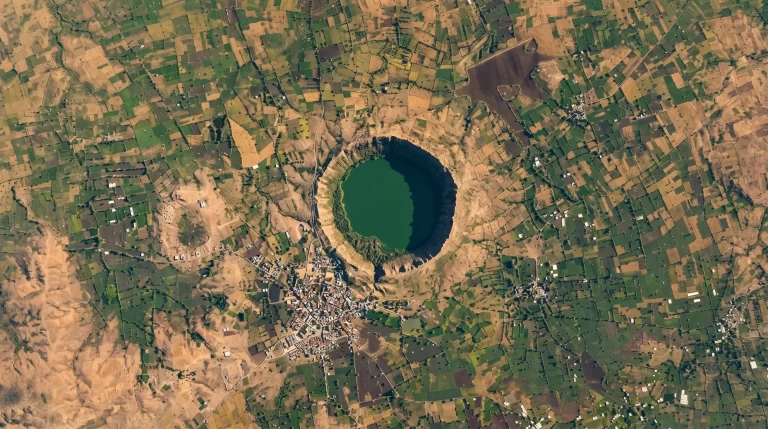
Lonar Crater formed when a meteorite, estimated at roughly 60 metres in diameter and travelling at extraordinary speed, struck the Deccan Plateau around 50,000 years ago.
The impact created a nearly perfect circular depression approximately 1.8 km across and 150 metres deep. Over thousands of years, rainwater accumulated inside the crater, forming the unusual lake visible today.
What makes Lonar scientifically remarkable is its geology. Most famous impact craters worldwide formed in sedimentary or granitic rock. Lonar formed entirely in basalt, making it one of the most important natural laboratories for studying meteor impacts on volcanic planetary surfaces.

Why Is Lonar Crater Scientifically Important?
Scientists consider Lonar one of the world’s most significant impact crater sites because of its unusual basaltic composition.
Researchers from Indian scientific institutions and international organizations have studied the crater because its conditions resemble features observed on Mars and other volcanic planetary surfaces.
Several characteristics make Lonar unique:
- Meteor impact in basalt rock
- Saline and alkaline lake water
- Distinct microbial ecosystem
- Well-preserved crater structure
- Rare geological setting
For geologists, Lonar is far more than a scenic lake. It provides valuable insight into planetary impact processes that are difficult to observe elsewhere on Earth.
💡 Tip: If you’re interested in geology, hire a local guide. The crater becomes far more interesting once you understand what you’re actually looking at.
The Unique Lake Inside the Crater
At the centre of the crater sits Lonar Lake, one of India’s most unusual water bodies.
The lake contains both saline and alkaline water, creating conditions that support microorganisms adapted to extreme environments. Researchers continue to study these ecosystems because they may help explain how life survives in harsh conditions.
The lake also contains small islands, including Kamalja Devi Island, visible from several viewpoints around the crater rim.
The combination of the green crater walls, dense forest, and unusual lake colour creates one of Maharashtra’s most distinctive landscapes.
Temples Around Lonar Crater
Lonar is not only a geological attraction.
Around the crater rim and within the crater bowl stand approximately 12 ancient temples dating from the 6th to 13th centuries CE.
The most important is Daitya Sudan Temple, dedicated to Lord Vishnu and built in the Hemadpanthi architectural style.
According to local legend, Vishnu defeated the demon Lonasura here, giving the crater its name and creating a fascinating connection between mythology and geology.
Several smaller temples are scattered throughout the crater area, adding significant historical and cultural value to the site.

Best Time to Visit Lonar Crater
October to February offers the most comfortable weather for exploring the crater.
The monsoon season from July to September transforms the crater into a lush green landscape and is particularly popular with photographers. However, some trails can become slippery.
Summer temperatures between March and June can be intense, especially during midday.
For photography, sunrise and sunset provide the best light across the crater walls and lake surface.
💡 Tip: Sunrise from the crater rim is one of the most rewarding experiences at Lonar and worth planning an overnight stay for.
Visiting Lonar Crater – Practical Information
Entry Fee
General entry is free.
Photography rules and camera charges occasionally change, so confirm locally before travel.
Time Needed
- Quick visit: 2–3 hours
- Full exploration: 4–5 hours
- Photography-focused visit: Half day or overnight stay
Guides
Local guides are highly recommended. Lonar combines geology, archaeology, temple history, ecology, and mythology, and several visitors specifically mention that a knowledgeable guide significantly improves the experience.
Accommodation
Basic hotels and guesthouses are available in Lonar town.
More comfortable accommodation options are available in Chhatrapati Sambhajinagar (Aurangabad) and Jalna.
How to Reach Lonar Crater
From Aurangabad
Distance: Approximately 140 km
Travel Time: 3–3.5 hours
Route:
Aurangabad → Jalna → Sindkhed Raja → Lonar
From Jalna
Distance: Approximately 95 km
Travel Time: Around 2 hours
From Pune
Distance: Approximately 350 km
Travel Time: Around 7–8 hours
From Mumbai
Distance: Approximately 500 km
Travel Time: Around 9–10 hours
Most visitors arrive by private vehicle or hired taxi.
Day Trip or Overnight Stay?
A day trip from Aurangabad is completely possible and remains the most common way people visit Lonar.
However, an overnight stay offers a noticeably better experience.
The crater is at its most impressive during sunrise and sunset, when the changing light highlights the crater walls, temples, and lake. Visitors interested in photography usually find the extra night worthwhile.

Is Lonar Crater Worth Visiting?
Yes.
Lonar Crater is one of the most unique destinations in India.
Very few places combine:
- A meteor impact crater
- A saline lake
- Ancient temples
- Forest trails
- International scientific significance
within a single landscape.
If you enjoy unusual geology, ancient history, photography, or destinations that feel genuinely different from standard tourist attractions, Lonar is absolutely worth the journey.
FAQ — Lonar Crater
Q1: What is Lonar Crater famous for?
Lonar Crater is famous for being one of the world’s few known hyper-velocity meteor impact craters formed in basalt rock. It contains a rare saline lake surrounded by ancient temples.
Q2: Is there an entry fee for Lonar Crater?
General entry is free. Visitors should confirm any current photography or camera policies locally before visiting.
Q3: How far is Lonar Crater from Aurangabad?
Approximately 140 km, requiring around 3 to 3.5 hours by road.
Q4: Why is Lonar Crater scientifically important?
Its basaltic composition makes it highly valuable for studying impact processes on volcanic planetary surfaces and comparing them with features observed on Mars.
Q5: What temples can be seen at Lonar Crater?
Approximately 12 temples are located around the crater, with Daitya Sudan Temple being the most significant and best preserved.
Related Posts You Might Like
- Lonar Crater Timings and Entry Fees
- How to Reach Lonar Crater from Aurangabad
- Lonar Crater History – Meteor Impact and Ancient Temples
- Lonar Crater Temples – Complete Guide
- Aurangabad to Lonar Crater – Day Trip Guide