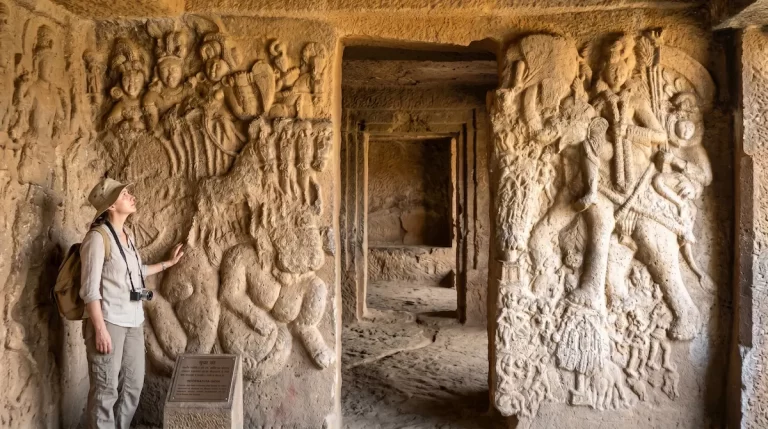
Maharashtra Caves for History Lovers (2026)
Most visitors come to Maharashtra’s caves for the architecture.
History lovers come for the stories hidden inside them.
Across Maharashtra, cave walls preserve royal inscriptions, political victories, merchant donations, religious transformations, and architectural experiments spanning more than a thousand years. These aren’t simply ancient monuments — they’re historical records carved directly into stone.
From Satavahana kings and Western Kshatrapa rivals to Vakataka patrons, Rashtrakuta emperors, and medieval temple builders, Maharashtra’s caves offer one of the richest historical landscapes anywhere in India.
If history is your main reason for visiting, these are the sites that deserve your attention.
Why Maharashtra’s Caves Matter Historically
Most ancient monuments tell part of a story.
Maharashtra’s cave complexes tell several stories at once.
They reveal:
- The rise of Buddhism in western India
- Ancient trade routes connecting ports and inland cities
- Rivalries between powerful dynasties
- The evolution of Indian rock-cut architecture
- The transition from Buddhist patronage to Hindu and Jain patronage
- Medieval temple construction techniques
What makes these sites especially valuable is that much of this history survives in original inscriptions rather than later legends.
For historians, that makes them priceless.
Pandavleni Caves – History Written in Stone
If you’re interested in political history, Pandavleni Caves near Nashik are among the most important cave sites in Maharashtra.
Several inscriptions here document donations by rulers, merchants, and local elites.
The most famous is the Nashik Prashasti, associated with Gautami Balashri, mother of the Satavahana king Gautamiputra Satakarni.
This inscription provides crucial evidence for one of the most important political rivalries in ancient western India — the conflict between the Satavahanas and the Western Kshatrapas.
Without inscriptions like these, historians would know far less about this period.
For history enthusiasts, Pandavleni feels less like a tourist attraction and more like an archive carved into rock.
Karla Caves – The Story of Trade and Empire
Karla Caves tell a different historical story.
Located near the ancient trade routes linking the western coast with the Deccan interior, Karla prospered because merchants and traders funded its construction.
The inscriptions here reveal donations from merchants, guilds, monks, and wealthy patrons.
They also preserve evidence of the same broader Satavahana-Western Kshatrapa political landscape seen at Pandavleni.
History becomes tangible when you realize the people named in these inscriptions were real individuals participating in a thriving commercial world nearly two thousand years ago.
Ajanta Caves – A Window Into the Vakataka World
Ajanta’s historical importance lies less in political inscriptions and more in what its paintings reveal about life during the Vakataka period.
The murals show:
- Royal courts
- Merchants
- Religious ceremonies
- Clothing and jewelry
- Social customs
- Buddhist narratives
These paintings provide an extraordinary glimpse into a world that largely disappeared centuries ago.
Ajanta is one of the rare places where history survives not only in written records but also in visual storytelling.
Another fascinating chapter is the site’s abandonment.
Following the decline of royal patronage after the death of King Harishena in the late 5th century CE, work stopped abruptly. The caves were gradually reclaimed by the surrounding forest and remained largely forgotten until their rediscovery in the nineteenth century.
For many visitors, that story alone makes Ajanta unforgettable.
Ellora – A Thousand Years of Religious History
Ellora represents one of the most remarkable examples of religious continuity in Indian history.
The site contains:
- Buddhist caves
- Hindu caves
- Jain caves
all within a single complex.
Rather than replacing one another, these traditions occupied the landscape over centuries, creating a site that reflects changing patterns of patronage and belief.
The greatest historical achievement at Ellora is Cave 16, the Kailasa Temple.
Commissioned during the Rashtrakuta period, it remains one of the largest monolithic monuments ever created.
The scale of planning, labor, and engineering required for Kailasa continues to astonish historians and archaeologists today.
Lonar Crater – Where Natural History Meets Human History
Lonar Crater offers a different kind of historical experience.
Its story begins not with kings or temples but with a meteor impact approximately 50,000 years ago.
For nearly 150 years, scientists debated whether the crater was volcanic or meteoritic in origin.
Only in the twentieth century was the mystery finally solved.
Layered onto that geological story are centuries of human history.
Ancient temples around the crater reflect the influence of multiple dynasties, while local legends connected the crater to the demon Lonasura and the deity Vishnu.
Few places in India combine scientific history, mythology, archaeology, and geology so effectively.
A History Lover’s Maharashtra Cave Itinerary
If history is your primary interest, I would recommend the following route.
Day 1
Ajanta Caves
Focus on the murals, Buddhist history, and Vakataka patronage.
Day 2
Ellora Caves
Explore the Buddhist, Hindu, and Jain sections with particular attention to Kailasa Temple.
Day 3
Aurangabad Caves and Daulatabad Fort
Add medieval political history to the trip.
Day 4
Lonar Crater
Explore the combination of geology, mythology, and temple history.
Separate Extension
Pandavleni Caves and Karla Caves
For travelers specifically interested in Satavahana history and ancient inscriptions.
Which Cave Site Is Best for History Lovers?
Each site excels in a different area.
| Site | Historical Strength |
|---|---|
| Ajanta | Art and Buddhist history |
| Ellora | Religious and architectural history |
| Pandavleni | Political inscriptions |
| Karla | Trade and patronage networks |
| Lonar | Geological and temple history |
Together, they create one of India’s richest historical journeys.
FAQ – Maharashtra Caves for History Lovers
Q1: Which Maharashtra cave site has the most important inscriptions?
Pandavleni Caves near Nashik contain some of the most significant historical inscriptions relating to the Satavahana period.
Q2: Is Ajanta or Ellora better for history lovers?
Both are essential. Ajanta excels in art history, while Ellora offers broader religious and architectural history.
Q3: Why are Karla Caves important historically?
Karla preserves evidence of ancient trade routes, merchant patronage, and early Buddhist architecture.
Q4: What makes Lonar Crater historically interesting?
Its story combines a meteor impact, centuries of temple construction, mythology, and a long scientific debate about its origin.
Q5: How many days do history lovers need in Maharashtra?
At least 3–4 days for Ajanta, Ellora, Aurangabad, and Lonar, with additional time for Pandavleni and Karla.
Related Posts You Might Like
- Maharashtra Caves Circuit – 5-Day Complete Itinerary
- Ajanta Caves History and Architecture Explained
- Pandavleni Caves History – 24 Buddhist Caves Explained
- Karla Caves History – Complete Heritage Guide
- Lonar Crater History – Meteor Impact and Ancient Temples