Aurangabad Caves vs Ajanta Caves – What’s the Real Difference? (2026)
I get this question constantly from visitors deciding whether Aurangabad Caves is worth their time after already planning Ajanta: “Isn’t it basically the same thing, just smaller?” The honest answer is no — and explaining exactly why is the most useful thing I can do for anyone trying to decide how to allocate their limited days in this region.
The Core Difference — Painting vs Sculpture
This is the single most important distinction, and it shapes everything else about how the two sites feel to visit.
Ajanta is fundamentally about painting. The site’s global significance rests on its mineral-pigment murals — the Bodhisattva Padmapani, the Jataka narrative cycles, the ceiling mandalas — painted onto prepared lime plaster surfaces. Sculpture exists at Ajanta, but painting is the reason the site matters.
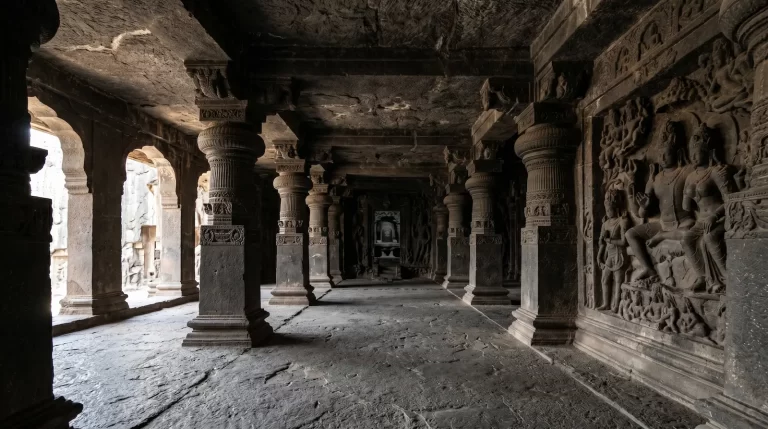
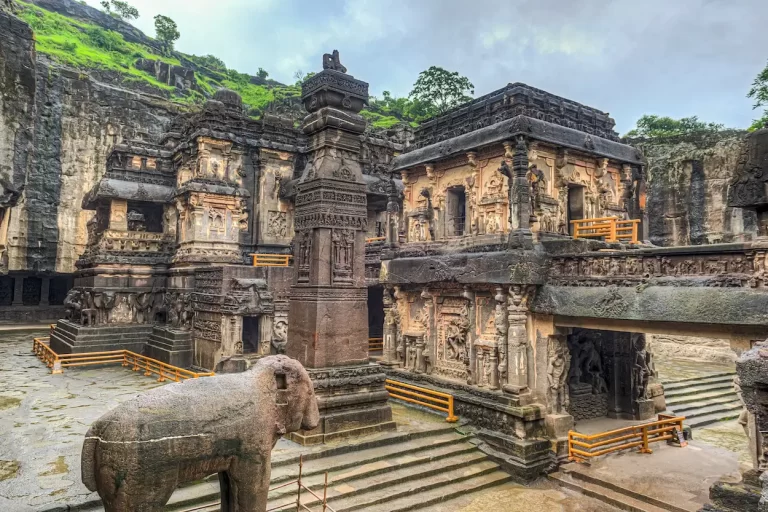
Aurangabad Caves is fundamentally about sculpture. There is no significant painted program here — what survives and matters at this site is carved relief work: Cave 3’s facade figures, Cave 7’s Tara and the Dancing Panel. You are looking at stone, not pigment.
💡 Tip: I tell visitors to think of it this way — if Ajanta is a gallery of ancient paintings, Aurangabad Caves is a gallery of ancient sculpture. Both are extraordinary, but they engage your attention completely differently, and neither substitutes for the other.
Scale — A Genuinely Different Order of Magnitude
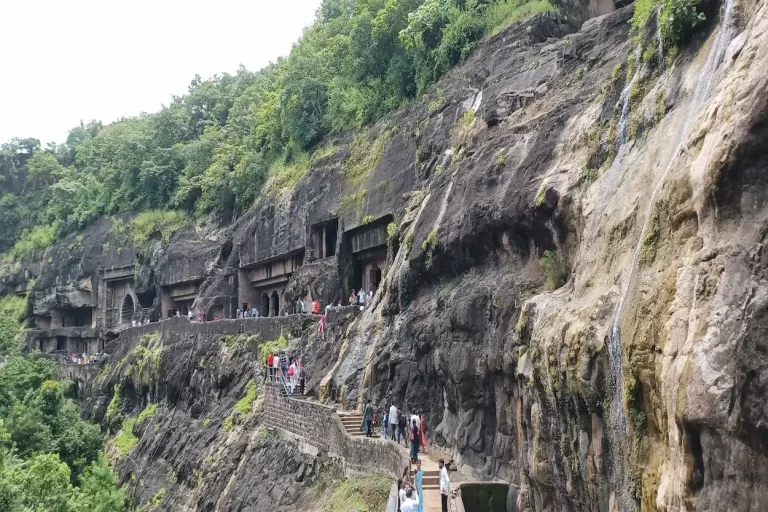
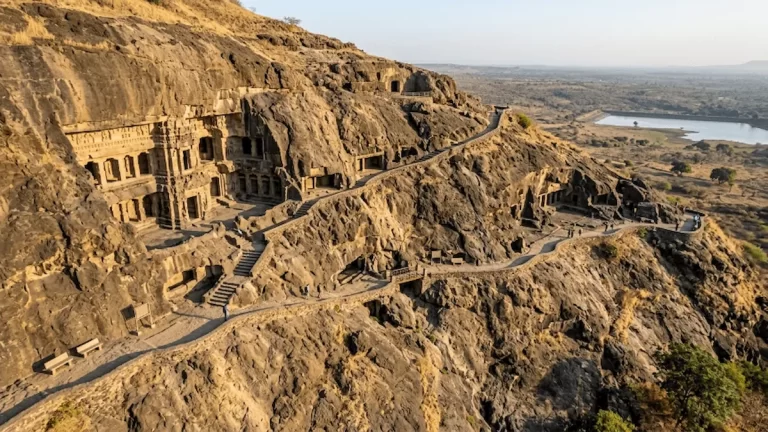
Ajanta: 30 caves, carved into a dramatic horseshoe-shaped cliff above the Waghur River, requiring a full day to visit properly and a 100 km journey from Chhatrapati Sambhajinagar (Aurangabad).
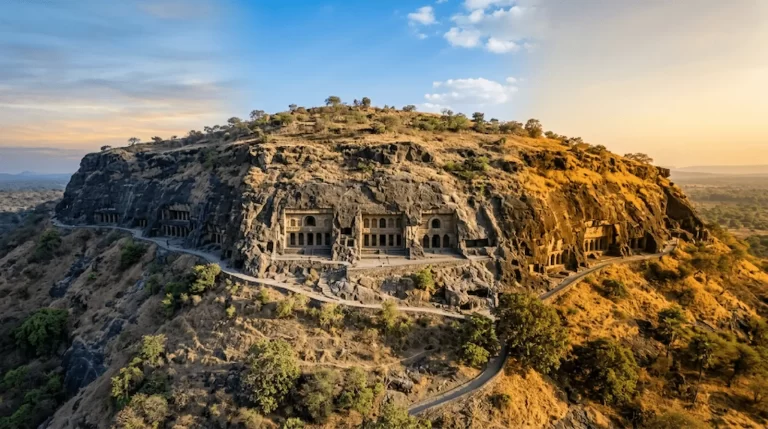
Aurangabad Caves: 12 caves across two smaller groups on a city-edge hillside, requiring 1.5 to 2 hours and a 5 km journey.
This is not a small difference in scale — Ajanta is a major undertaking requiring genuine time and planning. Aurangabad Caves is something you can fold into a half-day alongside another city site without disrupting your broader itinerary at all.
💡 Tip: I never suggest treating these two sites as comparable commitments. Ajanta deserves a dedicated, planned day. Aurangabad Caves is an easy add-on — plan your trip around Ajanta first, and let Aurangabad Caves fill a gap in your schedule rather than competing for a dedicated day of its own.

Crowds — The Most Immediately Felt Difference
Ajanta: A major tourist destination with significant daily visitor volume, particularly from mid-morning onward when tour groups arrive. Even with strategic early-morning timing, you are sharing the site with many other visitors.
Aurangabad Caves: I have visited dozens of times and rarely encountered more than a handful of other visitors, regardless of time of day. This is not a curated quiet experience — it is simply how few people know this site exists.
💡 Tip: If solitude and the feeling of genuine discovery matter to your travel experience, Aurangabad Caves delivers something Ajanta — for all its extraordinary content — cannot, simply because of how many other people are also trying to experience Ajanta at the same time as you.
Historical Period and Connections
Ajanta: Primarily the 5th century CE Mahayana painting phase under Vakataka patronage, with an earlier Hinayana phase from the 2nd century BCE.
Aurangabad Caves: Spans the Vakataka period (Western Group, Cave 3) through the later Kalachuri-Chalukya period (Eastern Group, Cave 7) — meaning it captures a dynastic transition that Ajanta, carved within a more concentrated window, does not show as directly.
There is a genuine historical link here too — Cave 3’s facade sculpture shares stylistic characteristics with Ajanta’s contemporary work, and some scholarship suggests overlapping patronage circles connected to Vakataka King Harishena’s court.
💡 Tip: I find this connection is what makes Aurangabad Caves click for visitors who have already done Ajanta — it is not a separate story, it is a continuation of the same one, carved by people working in a related tradition just a short distance away.
Logistics — A Genuinely Different Kind of Trip
Ajanta: Requires a full-day commitment, a mandatory Eco-Bus transfer, online ticket booking, and ideally a 6:00 AM departure from Chhatrapati Sambhajinagar (Aurangabad) for the best experience.
Aurangabad Caves: A 15-20 minute drive through BAMU campus, no Eco-Bus, simpler ticketing, and flexible timing within its 6:00 AM to 6:00 PM hours — though I always stress booking your transport as a round trip given the hillside’s limited return options.
💡 Tip: Aurangabad Caves is, logistically, the easiest heritage site to visit anywhere in this region. If you are short on planning energy after organizing Ajanta and Ellora, this is the one site that requires almost no additional effort to add to your trip.
So Which One Should You Visit?
This is not really the right question — I think of it less as either/or and more as what order, and how much time for each.
If you only have time for one: Ajanta, without question. Its global significance and the sheer scale of what you encounter there is something Aurangabad Caves, despite its genuine quality, does not match.
If you have already planned Ajanta and Ellora: Aurangabad Caves is a genuinely worthwhile half-day addition, not a redundant repeat. The sculpture-versus-painting distinction alone means you are seeing something different, not a smaller version of what you already saw.
If solitude matters to you: Aurangabad Caves offers something Ajanta structurally cannot — the experience of standing essentially alone in front of significant 1,500-year-old art.
💡 Tip: My honest recommendation for most travelers with 2-3 days in this region: Ajanta on day one, Ellora on day two, and if you have a third day, fold Aurangabad Caves into a morning alongside Bibi ka Maqbara. This sequencing means you encounter Aurangabad Caves with Ajanta and Ellora already fresh in your mind, which is exactly when the comparisons and connections land most meaningfully.
The Alternative — Seeing Both With the Right Context
Understanding what genuinely connects and distinguishes Ajanta and Aurangabad Caves — the shared Vakataka-era artistic links, the painting-versus-sculpture distinction, the dynastic transition visible at the smaller site — is exactly what a guide who knows both sites well can bring to your visit, sequenced in the order that makes the connections land.
👉 See Ajanta Private Day Tour Details & Book — the essential first stop in this comparison.
👉 See Aurangabad Heritage Tour Details & Book — Aurangabad Caves paired with Bibi ka Maqbara, ideally after your Ajanta day.
FAQ — Aurangabad Caves vs Ajanta Caves
Q.1 : Is Aurangabad Caves the same as Ajanta Caves?
No. While both are Buddhist rock-cut sites from overlapping historical periods, Ajanta is primarily known for its painted murals, while Aurangabad Caves is known for its carved sculpture, with no comparable painting program. They are related but distinct artistic traditions.
Q.2 : Should I visit Aurangabad Caves instead of Ajanta if I have limited time?
No — if you can only visit one site, Ajanta should be the priority given its much greater scale and global significance. Aurangabad Caves is best treated as an additional half-day visit if you have already planned Ajanta and Ellora, not a substitute for either.
Q.3 : How are Aurangabad Caves and Ajanta historically connected?
Cave 3 at Aurangabad Caves is dated to the Vakataka period, the same dynasty whose patronage produced Ajanta’s finest 5th-century CE painted caves, and shares stylistic characteristics with Ajanta’s contemporary sculptural work, suggesting connected artistic traditions or overlapping patronage circles.
Q.4 : Which site has fewer crowds, Ajanta or Aurangabad Caves?
Aurangabad Caves, by a significant margin. Ajanta is a major tourist destination with substantial daily visitor volume, while Aurangabad Caves remains comparatively unknown and is rarely crowded at any time of day.
Q.5 : How much time should I budget for each site?
Ajanta requires a full day (6-8 hours including travel) given its scale and the 100 km distance from Chhatrapati Sambhajinagar (Aurangabad). Aurangabad Caves requires only 1.5 to 2 hours given its smaller scale and 5 km proximity to the city center.
👉 Related Posts You Might Like:
- Aurangabad Caves – Complete Guide 2026
- Aurangabad Caves vs Ellora Caves – Which Is Better?
- Aurangabad Caves History – 1,500 Year Old Buddhist Secret
- Best Caves Inside Ajanta – Cave 1, 2, 16, 17 and 26 Explained
- Why Aurangabad Caves Are Worth Visiting (Even After Ajanta)