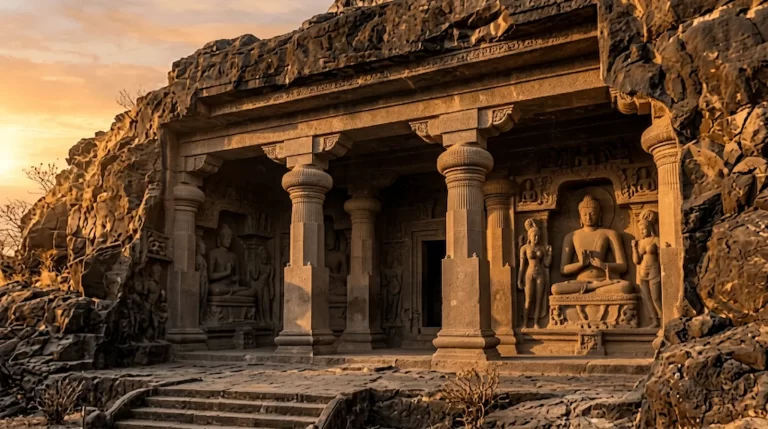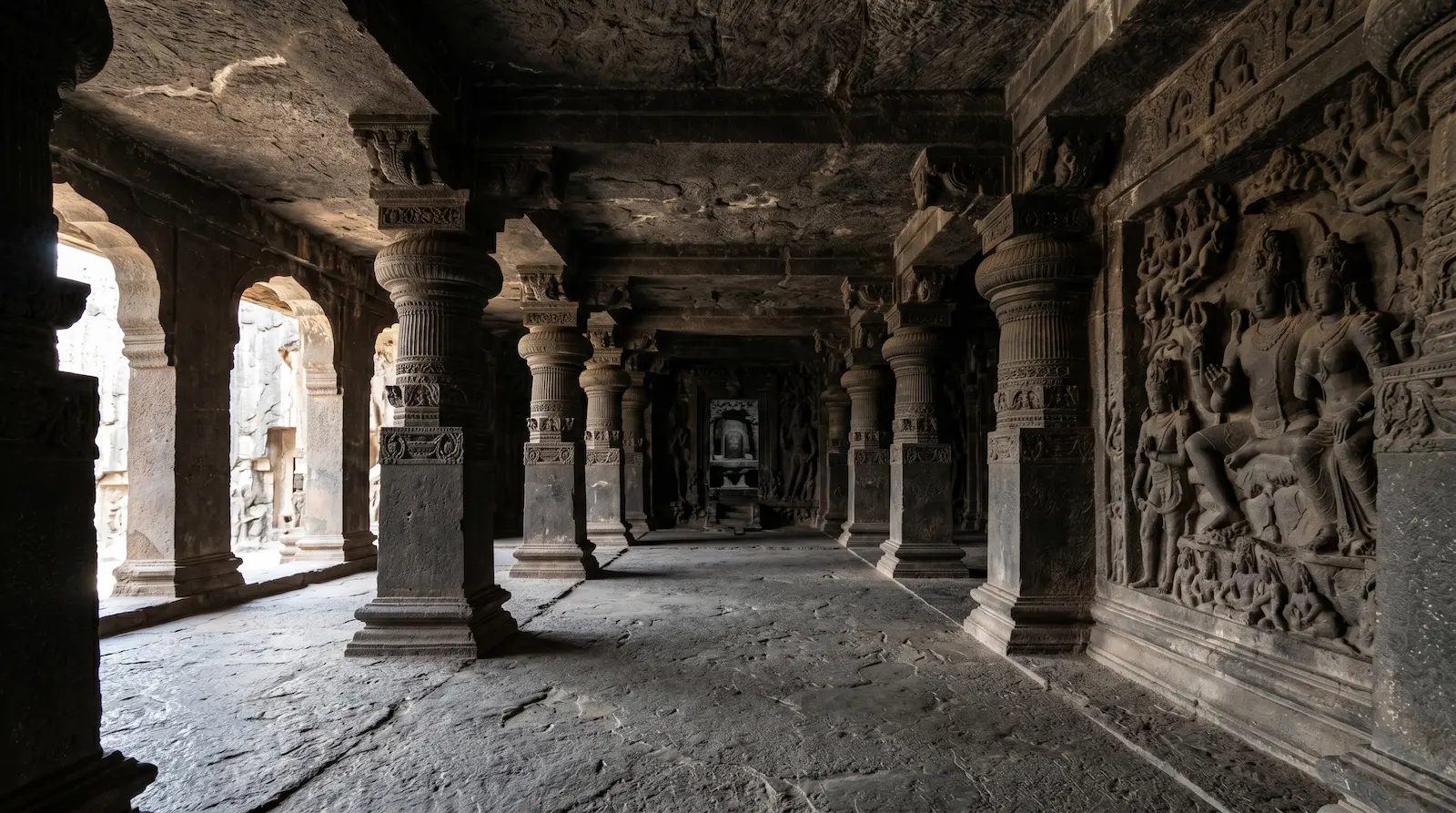
Hidden Areas at Ellora – Caves Most Tourists Skip (2026 Local Guide)
The hidden areas at Ellora are not actually hidden — they are clearly numbered, clearly accessible, and clearly marked on every site map. What makes them hidden is simpler: most visitors run out of time, energy, or awareness before reaching them. This guide is for travelers who have already done Kailasa Temple, or are planning a second visit, and want to see the parts of Ellora that almost nobody else does.
Why So Much of Ellora Goes Unseen
Ellora receives a significant volume of day visitors, and the overwhelming majority follow a near-identical pattern: enter, walk through a handful of Buddhist caves, spend the bulk of their time at the Kailasa Temple, and leave. Shared group tours reinforce this pattern — operating on fixed schedules that prioritize the most famous monument and treat everything else as optional.
The result is that several genuinely significant caves at Ellora — caves that would be primary attractions at almost any other heritage site in India — receive a fraction of the visitor attention they deserve. This is not a criticism of visitors; it is simply what happens when one monument (Kailasa) is so famous that it absorbs nearly all the available attention and time.
This guide covers the specific caves, chambers, and details that consistently go unseen — and tells you exactly how to find them.
💡 Tip: None of what follows requires special permission or off-limits access. Everything described here is open to any visitor during normal opening hours. The only barrier is knowing it exists and budgeting the time to reach it.
The Upper Floor of Cave 15 — Das Avatara
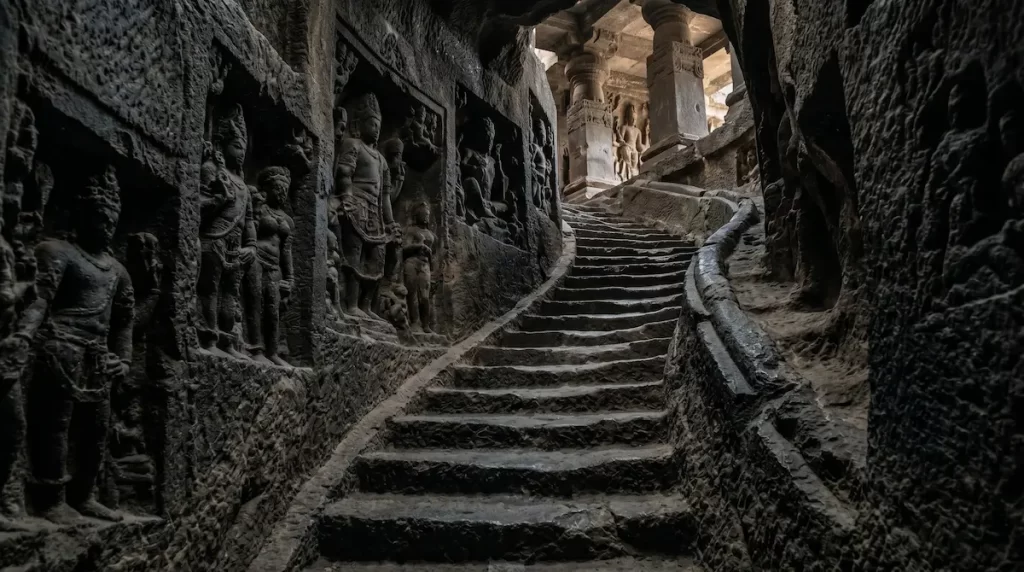
Covered in detail in the Hindu section guide, but worth restating here because it is the single most consistently missed significant artwork at Ellora. The ground floor of Cave 15 is on every standard itinerary. The upper floor — reached by an internal staircase that is not obviously signposted — contains the Nataraja panel, one of the finest individual sculptures at the entire site.
How to find it: Inside Cave 15, look for the staircase along the side wall of the ground floor hall. It is not hidden in the sense of being concealed — it is simply not where most visitors’ attention goes, since the ground floor Vishnu Anantashayana panel is impressive enough that many visitors assume they have seen what the cave offers and move on.
💡 Tip: If you visit Ellora with a guide and they do not mention the Cave 15 upper floor, ask specifically. This single detail is the clearest test of whether a guide has genuinely deep knowledge of the site or is working from the standard highlight script.
Cave 21 — Rameshvara, the Entire Cave
Unlike the Cave 15 upper floor, Cave 21 is not a hidden detail within a well-visited cave — it is an entire significant monument that most visitors never enter at all, simply because it sits north of Kailasa Temple and most day-trippers turn back before reaching it.
Cave 21 contains the finest post-Kailasa sculptural program at Ellora, including the Shiva-Parvati Kalyanasundara (marriage) panel and the Gangadhara panel depicting Shiva catching the descending river Ganga. The quality of carving here — the softness and emotional specificity of the figures — is, by the assessment of many art historians, equal to or exceeding individual panels at Kailasa itself.
Why it gets skipped: Geography and fatigue. Cave 21 requires continuing north past the Kailasa Temple complex, and by the time most visitors finish at Kailasa, the instinct is to turn back toward the entrance rather than continue deeper into the site.
💡 Tip: Cave 21 is a 5-minute walk north of Kailasa Temple’s main gateway. It is not a detour requiring special effort — it requires only the decision to keep walking rather than turning back. This is, by a meaningful margin, the single best “hidden” cave at Ellora for the effort required to reach it.
Cave 29 — Dhumar Lena, the Forgotten Cruciform Temple
Cave 29 sits further north still, past Cave 21, and is reached by fewer visitors than any other major Hindu cave at Ellora.
What makes it worth the walk: Cave 29 has a distinctive cruciform floor plan — unique among the Ellora Hindu caves — with three large entrance porches that flood the interior with natural light in a way most of Ellora’s interior spaces do not experience. The cave contains its own version of the Ravana lifting Kailash panel, executed differently from the famous version at the Kailasa Temple itself, offering a genuine point of comparison for visitors who have seen the more famous panel.
The experience of emptiness: Because so few visitors reach Cave 29, it offers something increasingly rare at a major UNESCO site — the experience of standing alone in a significant ancient monument, with time and space to look closely without crowd pressure.
💡 Tip: The walk from Cave 21 to Cave 29 takes roughly 10 minutes along a paved path. If you have made it to Cave 21, the additional effort to reach Cave 29 is genuinely small relative to what you gain — a complete Hindu cave experienced in near-total solitude.
Cave 30 — The Unfinished Sections of Chhota Kailasa
Covered briefly in the Jain section guide, but worth singling out because of what it specifically reveals: process rather than finished result.
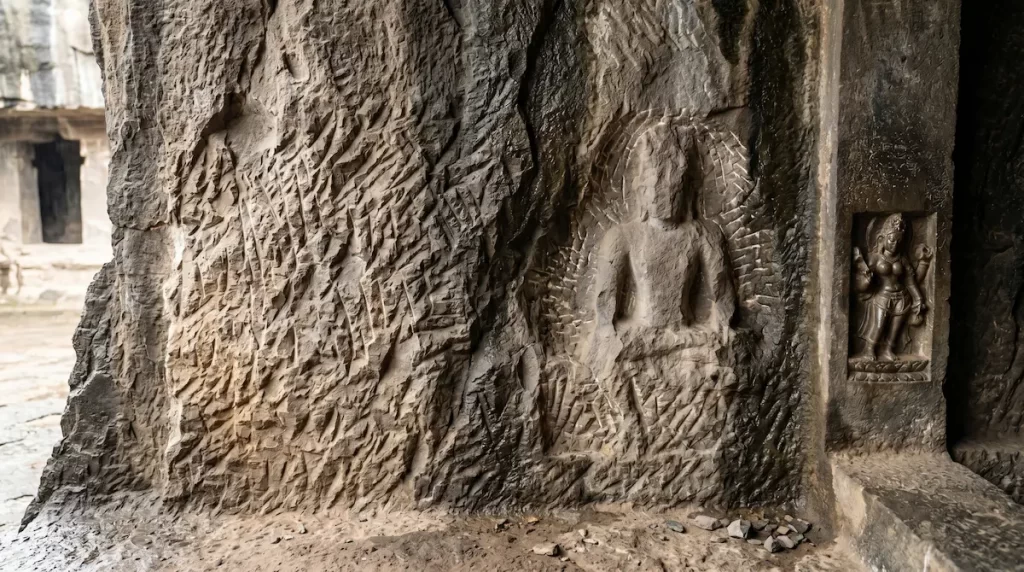
Cave 30, Chhota Kailasa, was conceived as a smaller echo of the Kailasa Temple but left incomplete. Where most of Ellora presents finished, polished sculpture, Cave 30’s unfinished sections show the raw, intermediate stages of the carving process — visible chisel marks, rough-blocked forms not yet refined into final sculptural detail.
Why this matters: Nowhere else at Ellora can you see the carving process this directly. The Kailasa Temple itself is entirely finished — its construction sequence has to be reconstructed through scholarly analysis. Cave 30 shows you, directly and visibly, what an intermediate stage of monolithic rock-cut carving actually looked like.
💡 Tip: This is a detail best appreciated with a guide who can point out specifically which areas represent unfinished work versus intentional rough-textured surfaces (some rough surfaces at Ellora are deliberate, used as background texture against more polished foreground sculpture). Knowing the difference changes what you are seeing.
Cave 6 — The Buddhist-Hindu Syncretism Most Visitors Walk Past
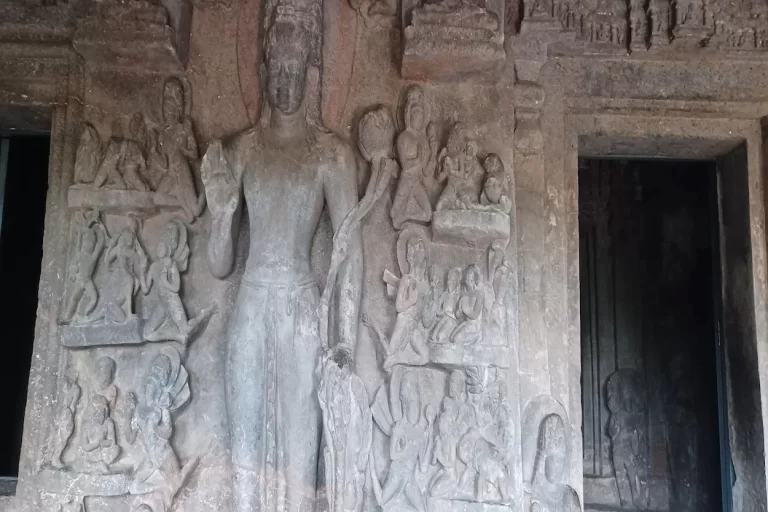
In the Buddhist section, Cave 6 contains something genuinely unusual: Buddhist and Hindu deities depicted within the same sacred space — the Buddhist goddess Tara alongside the Hindu goddess Mahishasuramardini (Durga slaying the buffalo demon).
This is not a large or visually dominant cave, which is precisely why it gets passed over. But it is one of the most historically significant single details at Ellora — direct physical evidence that the religious boundaries we now draw cleanly between “the Buddhist section,” “the Hindu section,” and “the Jain section” were considerably more porous in actual historical practice than the modern cave-numbering system suggests.
💡 Tip: Cave 6 rewards a specific question to your guide: ask them to point out exactly where the Tara figure and the Mahishasuramardini figure are in relation to each other within the cave. Understanding the spatial relationship between the two deities is what makes the syncretism concrete rather than abstract.
The Gallery Walls at Kailasa Temple — Beyond the Ravana Panel
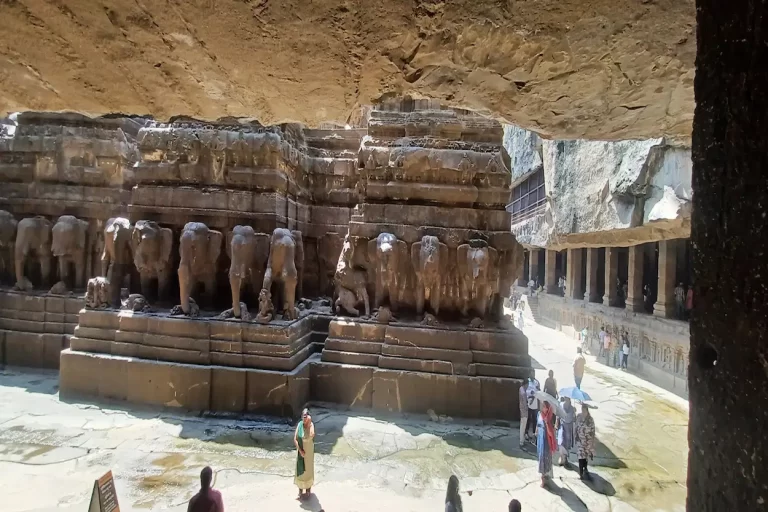
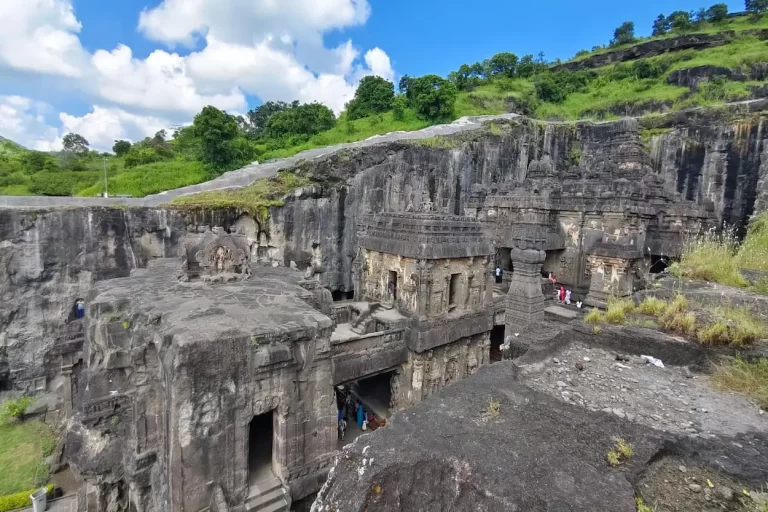
This is a hidden area within the most visited monument at Ellora — which seems contradictory but is genuinely true. Almost every visitor to Kailasa Temple sees the Ravana panel on the south gallery wall, because it is the most famous single sculpture at the site and every guide and every guidebook directs attention there.
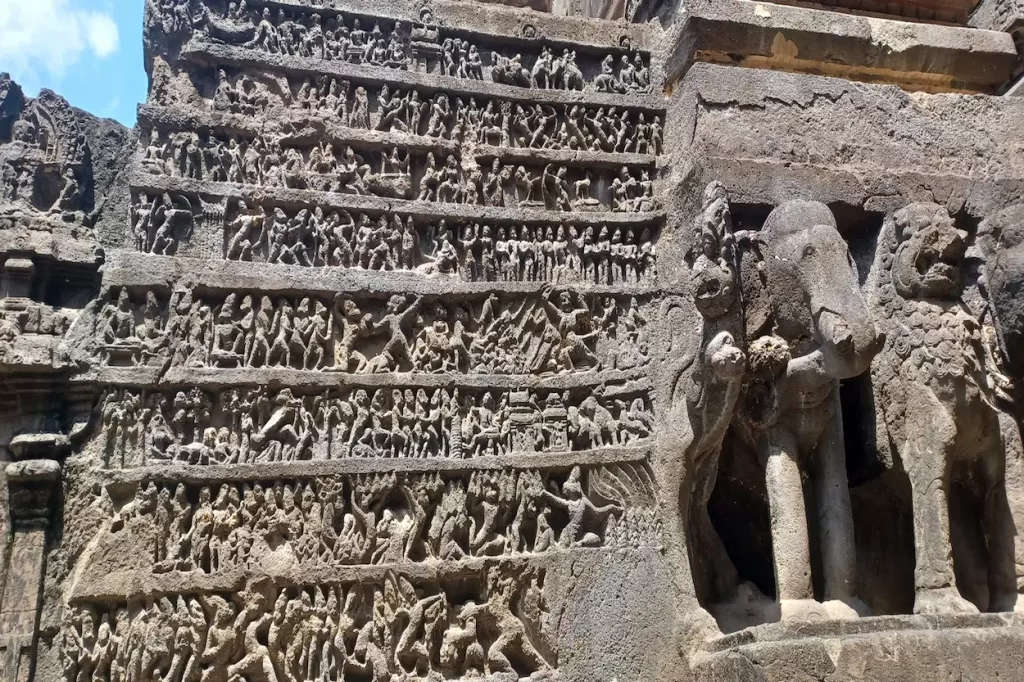
What gets missed: the full length of both gallery walls — the vertical cliff faces forming the courtyard’s boundary — carries continuous narrative friezes from the Ramayana and Mahabharata, dozens of individual scenes beyond the Ravana panel, many of exceptional quality, that most visitors walk past at a distance without close examination.
💡 Tip: After viewing the Ravana panel, deliberately walk the full perimeter of both gallery walls at close range — not the standard quick glance from courtyard distance, but slow walking with your attention on the wall surface itself. This single change in how you move through the Kailasa Temple courtyard reveals a substantial amount of sculpture that the standard visit pattern misses entirely.
Why Most Tour Groups Miss These Areas Entirely
Shared group tours at Ellora operate on fixed time budgets designed to fit a standard 3 to 4 hour visit — enough for the Buddhist section highlights and the Kailasa Temple, but not enough to reach Cave 21, Cave 29, or to walk the full gallery wall perimeter at Kailasa without rushing. This is a structural limitation of how group tours are timed, not a reflection of these areas being unimportant.
A private guided tour, by contrast, can be paced around what genuinely matters rather than a fixed group schedule — meaning the walk north to Cave 21 and Cave 29, the full gallery wall circuit at Kailasa, and the Cave 15 upper floor staircase are not casualties of time pressure but built into the day from the start.
👉 See Ellora Private Day Tour Details & Book — full site coverage including Cave 21, Cave 29, and the complete Kailasa gallery wall circuit, paced properly rather than rushed.
👉 See Ajanta-Ellora 2-Day Tour Details & Book — for visitors who want both UNESCO sites covered without compromise on either.
FAQ
Q1: What are the most overlooked areas at Ellora Caves?
The most overlooked significant areas at Ellora are the upper floor of Cave 15 (containing the Nataraja panel), Cave 21 (Rameshvara, with the finest post-Kailasa sculptural program), Cave 29 (Dhumar Lena, a cruciform-plan temple with its own Ravana panel), and the full gallery wall perimeter at the Kailasa Temple beyond the famous Ravana panel. All are open during normal visiting hours but receive far fewer visitors than the standard highlights.
Q2: Why do most tourists miss Cave 21 and Cave 29 at Ellora?
Both caves sit north of the Kailasa Temple, and most day visitors turn back toward the entrance after finishing at Kailasa rather than continuing further into the site. Shared group tours, operating on fixed time schedules, frequently exclude these caves from their standard itinerary entirely. Reaching them requires only continuing to walk rather than turning back — there is no special access requirement.
Q3: Is the Cave 15 upper floor at Ellora open to visitors?
Yes — the upper floor of Cave 15, reached by an internal staircase, is open to all visitors during normal hours. It is not hidden in the sense of being restricted; it is simply not where most visitors’ attention goes after seeing the impressive ground-floor panels, and the staircase is easy to overlook without specific guidance.
Q4: What does Cave 30 at Ellora show that other caves do not?
Cave 30, known as Chhota Kailasa, was left architecturally incomplete, and its unfinished sections show visible chisel marks and rough-carved stages of the monolithic carving process. This is the only place at Ellora where the intermediate stages of rock-cut carving are directly visible, rather than only the finished, polished result seen throughout the rest of the site.
Q5: How much extra time do I need to see Ellora’s hidden areas?
Allow an additional 1 to 1.5 hours beyond a standard Kailasa-and-Buddhist-section visit to properly cover Cave 21, Cave 29, the Cave 15 upper floor, and a slower, more complete walk of the Kailasa gallery walls. This is a meaningful addition to a single day but transforms the visit from seeing Ellora’s most famous monument to experiencing a genuinely fuller picture of the site.
👉 Related Posts You Might Like:
- Kailasa Temple – How It Was Built (The Engineering Mystery)
- Ellora Caves Hindu Section – Complete Guide to Caves 13–29
- Ellora Caves Jain Section – Complete Guide to Caves 30–34
- Ellora Caves in One Day – Exact Itinerary
- Ellora Caves for Architecture Lovers