Ellora Caves for Solo Travelers – Complete Honest Guide (2026)
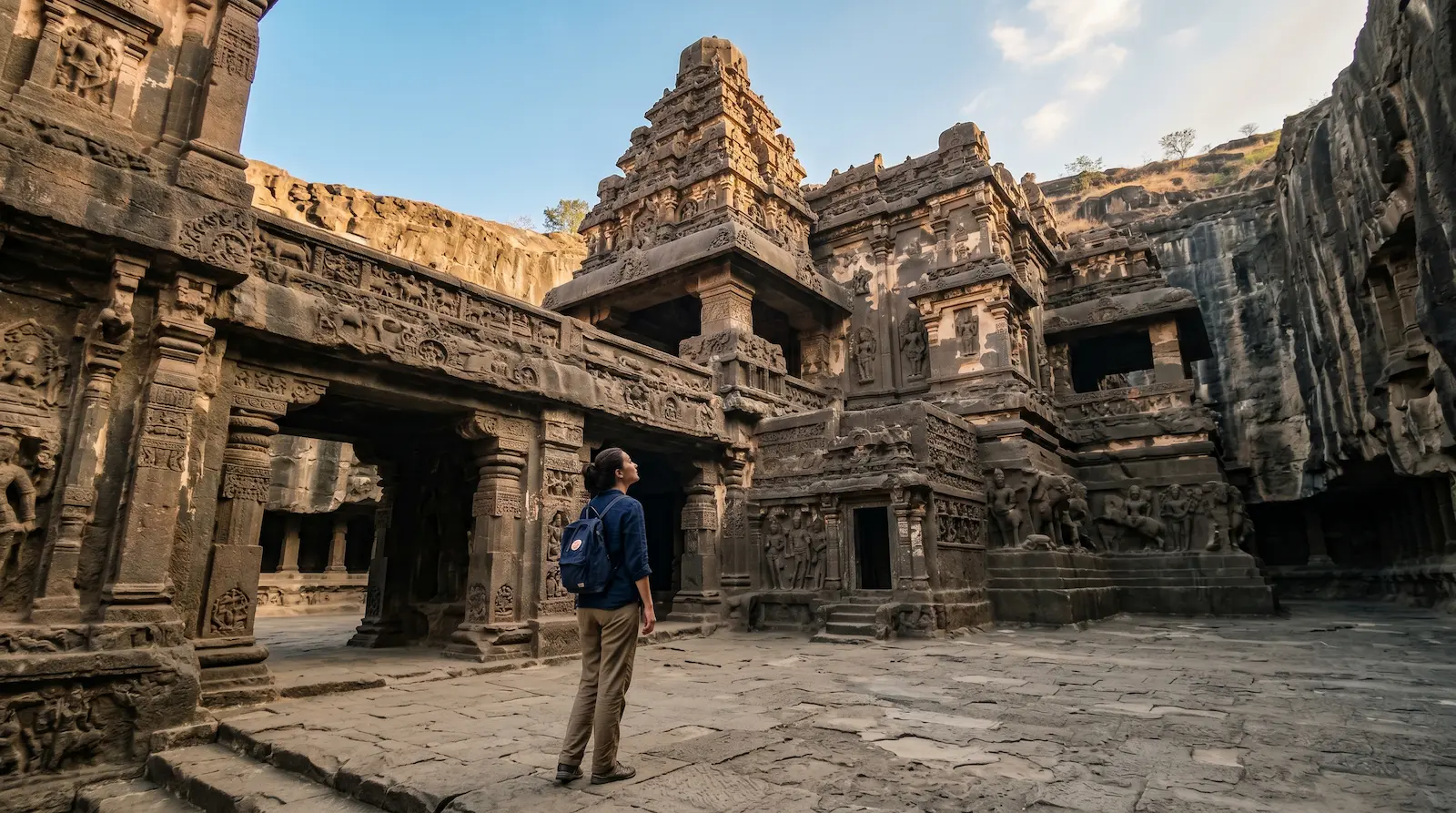
Ellora Caves for solo travel rewards exactly the kind of unhurried, self-directed attention that a site spanning three religious traditions and six centuries deserves. There is no group pace to match, no consensus to negotiate about which caves matter, and no pressure to keep moving when a single gallery wall panel deserves twenty minutes. This guide covers what solo travelers specifically need to know — transport, safety, guides, and how to make the most of a site this large on your own terms.
Why Ellora Works Well for Solo Travel
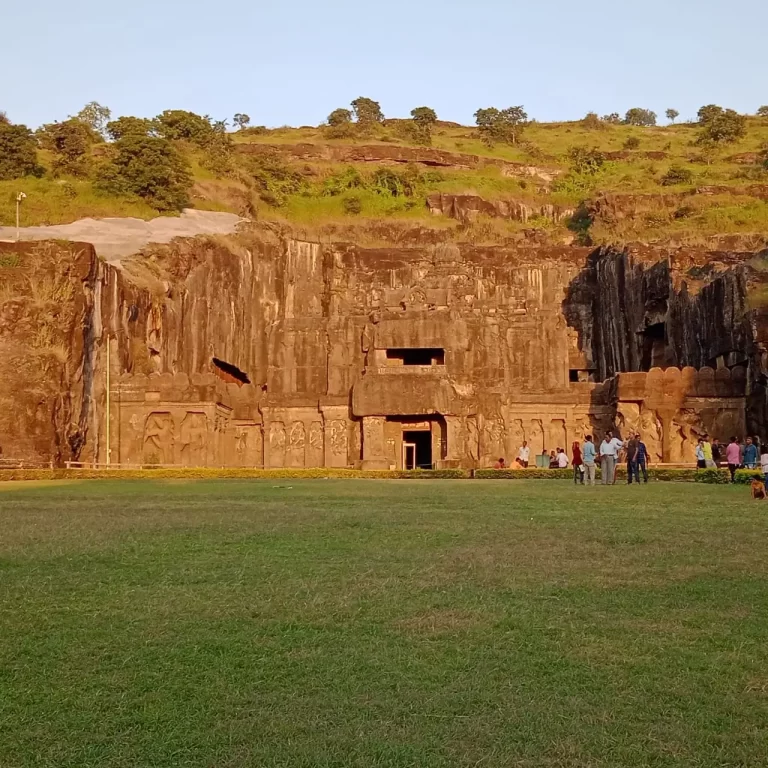
Ellora is a linear site — 34 numbered caves arranged south to north along a single pathway at the base of the cliff. This makes navigation straightforward in a way that benefits solo travelers specifically: there is no complex routing decision to make, no risk of genuinely getting lost, and no need for a group consensus about direction or pacing.
The scale of Ellora — significantly larger than Aurangabad Caves, comparable to Ajanta in total cave count but spread across a wider geographic area — means a solo traveler has real freedom to spend disproportionate time at what interests them most. A solo traveler who finds the Jain section’s precision carving more compelling than the Buddhist viharas can simply spend the extra hour there without negotiating with travel companions.
The one significant requirement, solo or otherwise, is a guide. Ellora’s three traditions and six centuries of religious and architectural development are not self-explanatory from information boards alone. The Kailasa Temple’s engineering, the syncretism in Cave 6, the significance of Cave 15’s upper floor — none of this is obvious without context.
💡 Tip: Solo travelers at Ellora have a specific advantage during guide negotiation at the entrance: a guide working with one person can adjust pacing entirely to that person’s interest, spending extra time at Cave 21 or the Jain section without managing a group’s competing priorities. Mention specifically what interests you most when arranging your guide — architecture, sculpture, religious history — and a good guide will weight the day accordingly.
Getting to Ellora Caves Solo — Transport Options
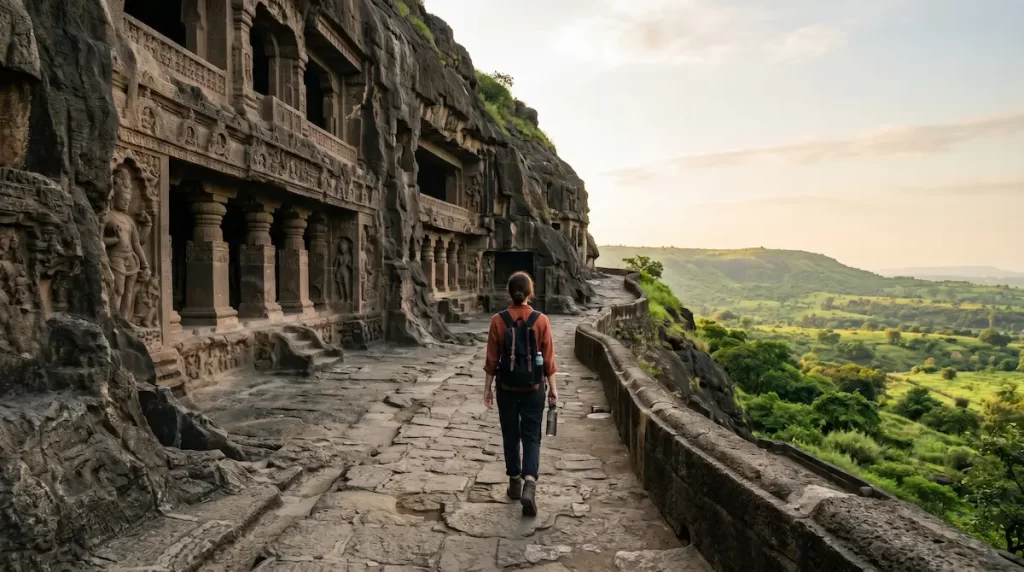
Ellora is significantly more accessible than Ajanta for solo travelers, being only 30 km from Chhatrapati Sambhajinagar (Aurangabad) rather than 100 km.
Option 1: Private taxi from Chhatrapati Sambhajinagar (Aurangabad) — Recommended
A private AC car for the day costs approximately ₹2,000–₹3,000 — somewhat less than the equivalent Ajanta trip given the shorter distance. This gives full timing control, particularly valuable at Ellora given how much there is to see if you intend to cover the hidden areas as well as the highlights.
Option 2: MSRTC State Bus
Regular MSRTC buses run from Chhatrapati Sambhajinagar (Aurangabad) directly to Ellora — a more straightforward route than the Ajanta bus journey since there is no Eco-Bus transfer required at Ellora. This is a genuinely practical budget option for solo travelers given the shorter, more reliable route.
Option 3: Auto-rickshaw
For solo travelers comfortable negotiating a day rate, an auto-rickshaw from Chhatrapati Sambhajinagar (Aurangabad) to Ellora and back is possible, though less comfortable than a car for a full day and less reliable for the return journey timing.
Option 4: Combine with Daulatabad Fort and Grishneshwar Temple
Since Ellora is on the same road as Daulatabad Fort (15 km from the city) and adjacent to Grishneshwar Temple, a private car allows a solo traveler to combine all three in a single well-paced day — something significantly harder to coordinate using public transport.
💡 Tip: Unlike Ajanta, Ellora does not require the mandatory Eco-Bus transfer from an Amenities Center — you can be dropped directly near the cave complex entrance. This makes Ellora meaningfully simpler logistics for a solo traveler than Ajanta, even though the site itself is larger in total scope.
📍 Daulatabad Fort on Google Maps
Guided vs Self-Guided at Ellora — Solo Traveler’s Reality
Self-guided at Ellora: More challenging than self-guided Ajanta, honestly. Ajanta’s linear cave numbering and relatively contained painting program is more approachable without a guide than Ellora’s three distinct religious traditions, each with their own iconographic vocabulary, spread across a significantly larger physical area. A self-guided solo traveler at Ellora risks either spending the entire day at Kailasa Temple alone (not unreasonable, but means missing the rest of the site) or wandering through 34 caves without the context to distinguish the essential from the skippable.
Guided at Ellora: Transforms the visit more dramatically than at almost any other site in the region, precisely because Ellora’s complexity is so much greater than a single-tradition site. A guide who knows to take you to Cave 15’s upper floor, who can explain why Cave 6 matters despite its modest scale, and who paces the day correctly across all three sections is the difference between seeing Kailasa Temple and seeing Ellora.
The honest recommendation for solo travelers: Hire a guide at the entrance, agree on the rate clearly before beginning, and specifically mention if you want the day to include the less-visited areas — Cave 21, Cave 29, the Jain section in full — rather than only the standard highlight circuit.
💡 Tip: At the Ellora entrance, as at Ajanta, approach the official guide booth rather than the first guide who approaches you. Ask specifically whether the guide covers all three sections — Buddhist, Hindu, and Jain — in depth, or primarily focuses on the Kailasa Temple. Some guides default to a Kailasa-heavy day unless asked otherwise.
Safety at Ellora Caves for Solo Travelers
Ellora, like Ajanta, is considered a safe heritage site for solo travel. The site is staffed by ASI security, well-visited throughout the day, and the linear layout means you are rarely far from other visitors or staff.
For all solo travelers:
- The pathway connecting caves is generally well-maintained, though some sections near the Jain caves at the northern end are quieter and less trafficked
- Standard valuables precautions apply — front-facing bag or money belt
- Cave interiors, particularly in the Hindu and Jain sections, can have uneven floors — watch your footing
For solo female travelers specifically:
Ellora is considered safe for solo female travel, with ASI security present throughout the site. The northern sections — Cave 21, Cave 29, and the Jain caves — are quieter and less trafficked than the Kailasa Temple area, which some solo female travelers may simply want to be aware of rather than avoid; these areas are not unsafe, simply less busy. Arriving at opening time means experiencing the site during its quietest, most pleasant hours regardless.
💡 Tip: If reaching the quieter northern sections (Cave 21, Cave 29, the Jain caves) alone feels less comfortable, this is one of the clearest cases where a guide adds value beyond interpretation — having company on the walk to the less-visited areas means you are not navigating Ellora’s quieter corners entirely alone, while still getting the full site experience.
Which Caves to Prioritize as a Solo Traveler

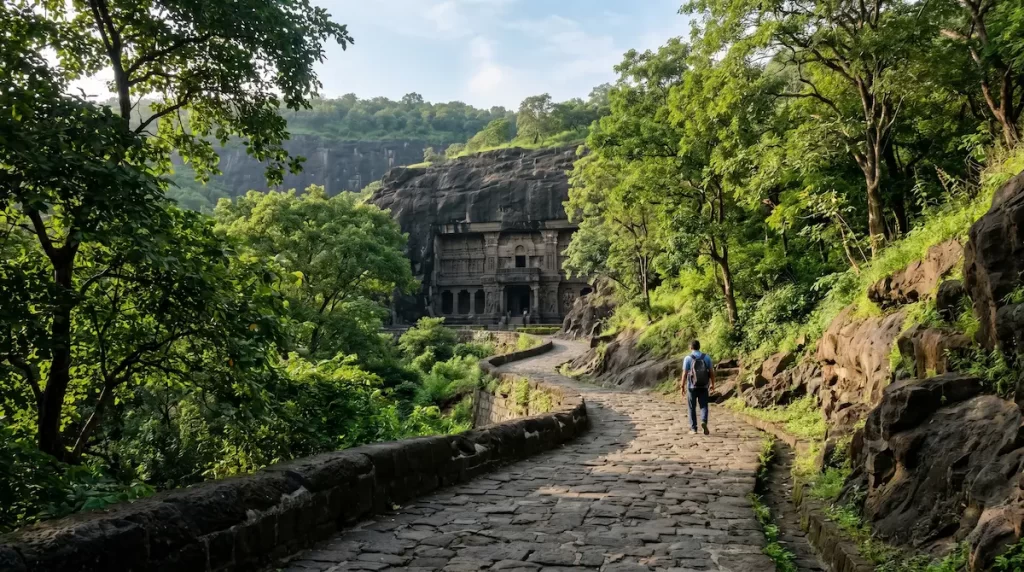
With a full day and no group to coordinate, a solo traveler can realistically cover the essential caves across all three traditions:
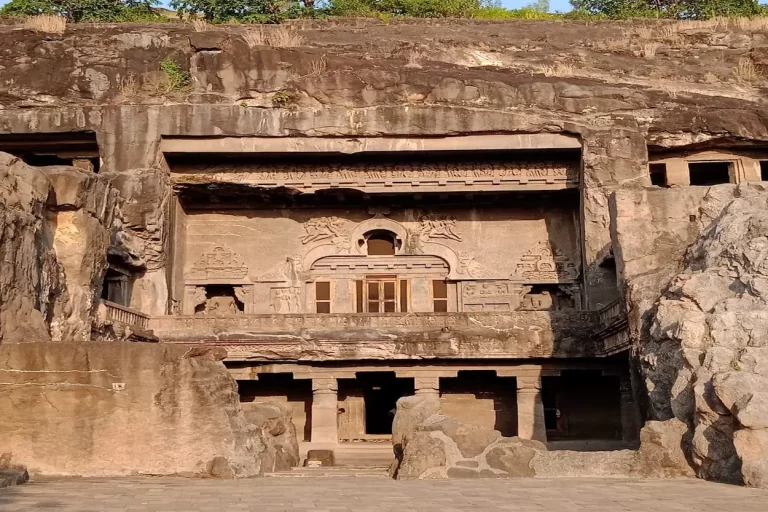
Cave 10 — Buddhist chaitya hall, elaborate facade, timber-effect ceiling. 20 minutes.
Cave 12 — Teen Thal three-storey complex, Seven Buddhas panel. 25–30 minutes.
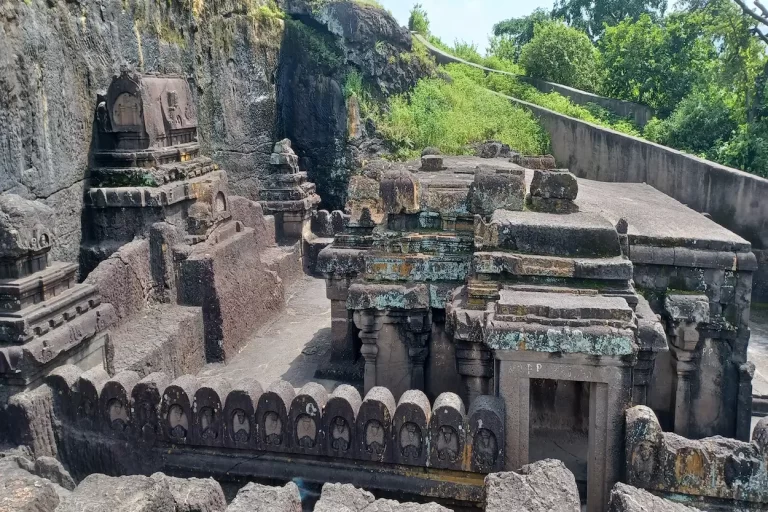
Cave 16 — Kailasa Temple — the anchor of the day. Minimum 2 hours, ideally more for a solo traveler with full schedule control.
Cave 15 — Das Avatara, including the upper floor Nataraja panel. 20–25 minutes.
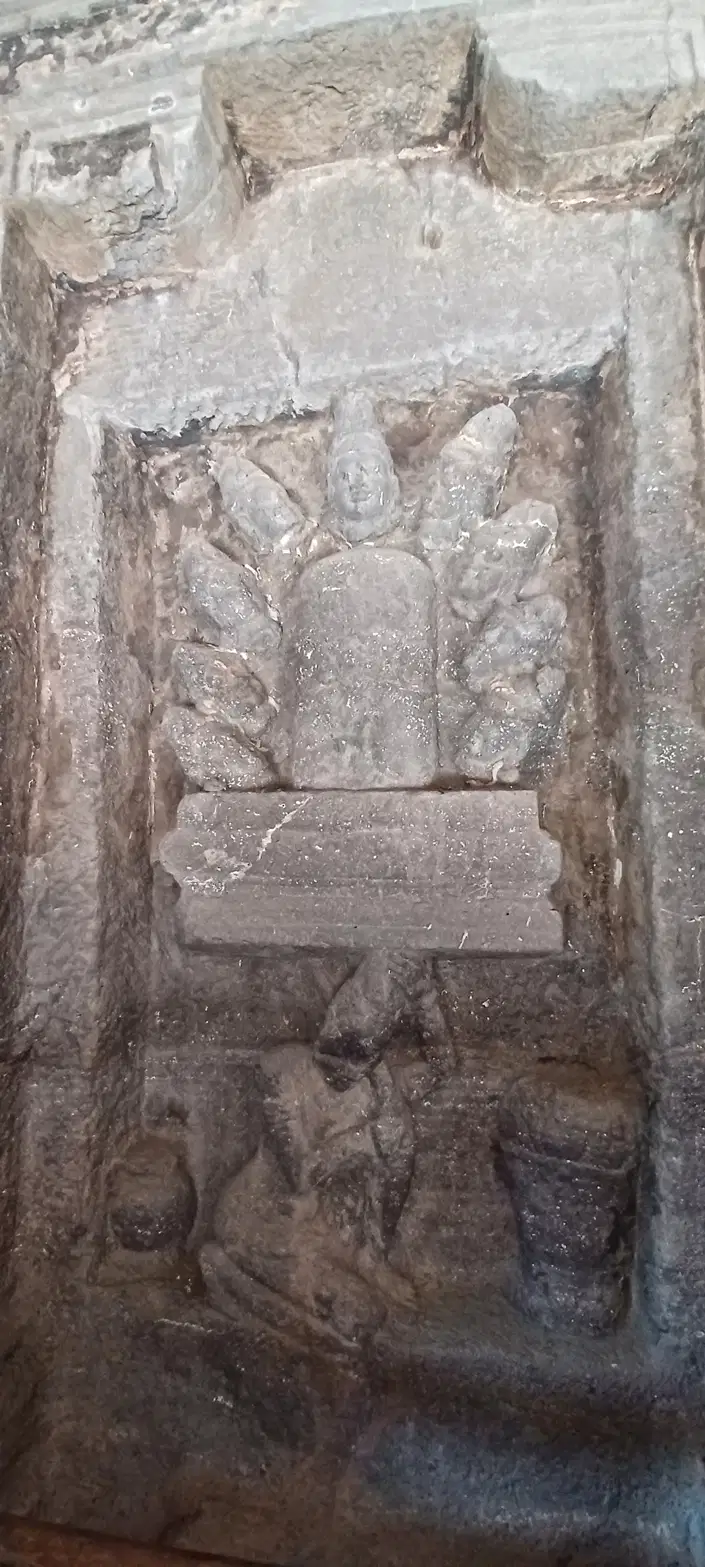
Cave 21 — Rameshvara, finest post-Kailasa sculpture. 20 minutes.
Cave 32 — Indra Sabha — essential Jain monument, courtyard and upper floor. 30–40 minutes.
💡 Tip: As a solo traveler with no group to manage, you are uniquely positioned to actually execute the full one-day Ellora itinerary that most group tours compress or skip portions of. Use this freedom — it is the genuine advantage of solo travel at a site this comprehensive.
Solo Ellora Budget Breakdown
| Expense | Amount |
|---|---|
| Private taxi Chhatrapati Sambhajinagar (Aurangabad)–Ellora–return | ₹2,000–₹3,000 |
| Entry fee (Indian national, online) | ₹35 |
| Entry fee (foreign national) | ₹600 |
| ASI-licensed guide (agree rate at booth) | — |
| Lunch near the complex | ₹200–₹400 |
| Water and snacks | ₹100–₹150 |
Note: Unlike Ajanta, Ellora does not require a mandatory Eco-Bus or separate cloakroom transfer, simplifying both the logistics and the cost structure for solo travelers.
The Alternative — One Booking, Full Coverage
Coordinating transport, finding a guide who covers all three sections rather than only Kailasa, and pacing a day that includes the less-visited northern caves — this is genuinely more complex to self-organize at Ellora than at most single-tradition heritage sites.
A private guided tour from Chhatrapati Sambhajinagar (Aurangabad) handles all of it — AC car, entry, and a guide briefed specifically to cover the full site, not just the highlight circuit.
👉 See Ellora Private Day Tour Details & Book — full three-section coverage, AC car, licensed guide, paced for a complete day.
👉 See Ajanta-Ellora 2-Day Tour Details & Book — for solo travelers extending their stay, both UNESCO sites covered properly.
FAQ
Q1: Is Ellora Caves solo travel safe?
Yes. Ellora Caves solo travel is considered safe, with ASI security present throughout the site and steady visitor traffic across most of the day. The northern sections — Cave 21, Cave 29, and the Jain caves — are quieter and less trafficked than the Kailasa Temple area, which solo travelers may want to be aware of, though this reflects lower footfall rather than any specific safety concern.
Q2: How do I get to Ellora Caves solo from Chhatrapati Sambhajinagar (Aurangabad)?
Ellora is 30 km from Chhatrapati Sambhajinagar (Aurangabad) — significantly closer than Ajanta. A private taxi for the day costs approximately ₹2,000–₹3,000 and provides the most timing flexibility. MSRTC state buses also run a direct route and are a practical budget option, since Ellora does not require the mandatory Eco-Bus transfer that Ajanta does.
Q3: Should I hire a guide at Ellora as a solo traveler?
Yes — strongly recommended, arguably more so than at Ajanta, given Ellora’s three distinct religious traditions spread across a larger area. Self-guided visitors risk either spending the whole day at Kailasa Temple alone or moving through 34 caves without the context to identify what matters. A guide ensures the Buddhist, Hindu, and Jain sections are all covered with appropriate depth.
Q4: Which caves should a solo traveler prioritize at Ellora?
Cave 10 and Cave 12 in the Buddhist section, the Kailasa Temple (Cave 16, minimum 2 hours), Cave 15 including its upper floor, Cave 21, and Cave 32 (Indra Sabha) in the Jain section are the essential caves. A solo traveler with a full day and no group to coordinate is well-positioned to cover all of these properly.
Q5: Is Ellora Caves safe for solo female travelers?
Yes. Ellora is considered safe for solo female travel, with ASI security present throughout the site. The quieter northern sections are less trafficked but not unsafe. Some solo female travelers prefer having a guide accompany them to these quieter areas simply for company on the walk, which also ensures the full site — not just the busier Kailasa Temple area — gets seen.
👉 Related Posts You Might Like:
- Ellora Caves in One Day – Exact Itinerary
- Hidden Areas at Ellora – Caves Most Tourists Skip
- Ellora Caves Budget Guide – How Much Does It Cost?
- Kailasa Temple – How It Was Built (The Engineering Mystery)
- Ajanta Caves for Solo Travelers – Complete Honest Guide